NumPy ndarray flatten returns a one-dimensional copy with entries arranged in a chosen order
Reducing an array to one dimension and deciding whether the result is a copy are separate questions. The NumPy ndarray method flatten answers both: it returns a copy of the input array collapsed into one dimension. Its order argument specifies how the entries are arranged in that copy.
Academia Master Trader presents this explanation in English for readers in the Federated States of Micronesia. The examples concern numerical array structure only. They are not market prices, trading signals or financial results. A two-by-two array gives a clear starting point.
Begin with a two-dimensional numerical array
Let a be a NumPy array with rows [1,2] and [3,4]. Its shape is (2,2), meaning two axes, each of length two. The array contains four numerical entries.
The call a.flatten() returns [1,2,3,4] as a one-dimensional array. Its shape is (4,). By default, flatten uses C-style order, which reads this example across each row before moving to the next row.
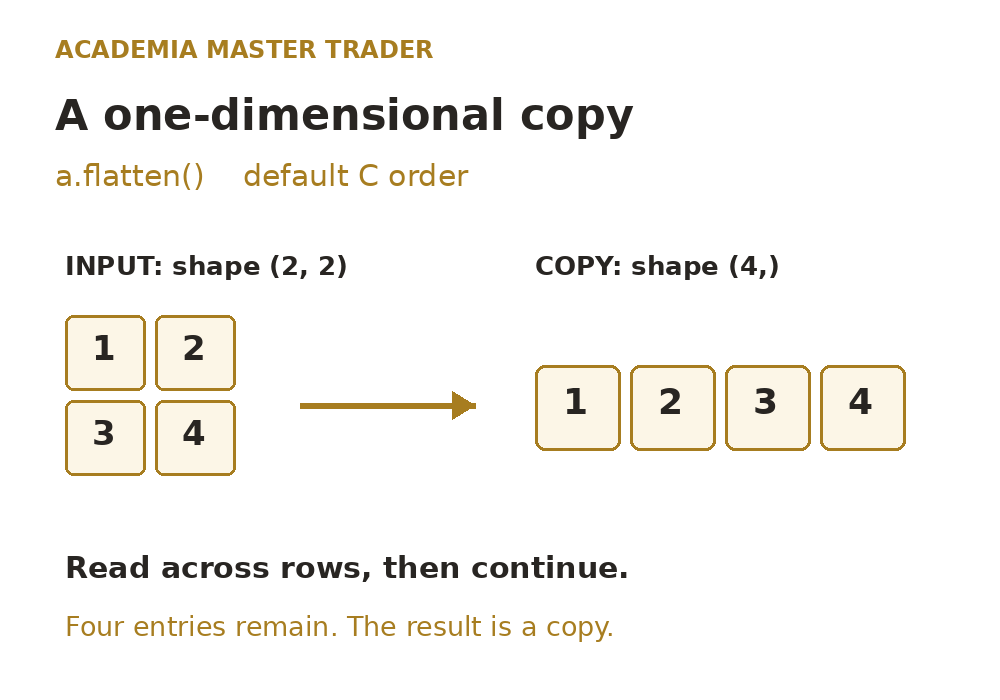
The method does not add the four values together. The output still contains four entries. It changes their arrangement into one dimension and returns a copy.
The method is called on the array
The documented interface is an ndarray method. In the expression a.flatten(), a is the array whose entries are being flattened.
That call structure is worth keeping clear when recording an example. The method name follows the array, and its optional argument selects the order. The input array is not written as another ordinary positional argument inside this method call.
For this lesson, the relevant object is a NumPy numerical array. Establishing the input type keeps the explanation tied to the interface described in the reference rather than assuming every Python sequence has this method.
C order reads across the rows in this example
For rows [1,2] and [3,4], default C order gives one and two from the first row, then three and four from the second row.
The shape (4,) describes the resulting one-dimensional arrangement. It does not record which reading order produced that sequence, so include the order when the sequence matters.
The ascending output follows from the chosen values and their positions. Flatten is not a numerical sorting method. Another input could give an irregular sequence while following the same row-major rule.
F order reads down the columns
The call a.flatten('F') returns [1,3,2,4] for the same input. The reference describes F as column-major, Fortran-style order.
The reading sequence takes one and three from the first column, followed by two and four from the second column. The result still has shape (4,) and still contains the same four values.
This contrast shows why shape alone does not explain the output contents. Both orders produce a one-dimensional copy, but the values appear at different positions in that copy.
A copy is part of the documented result
The reference explicitly describes flatten as returning a copy. A beginner explanation should retain that point rather than treating flatten and every other shape operation as interchangeable.
For the ordinary numerical array in this lesson, assigning a different number to an entry in the returned copy does not replace the corresponding numerical entry in the original array. The result is a copy, not another shape-only view of the same numerical buffer.
Keep that statement scoped to the numerical example. It is not a claim about recursively duplicating arbitrary Python objects that might be stored in a different kind of array.
Do not infer storage behaviour from brackets
The change from two rows to one flat sequence is visible in the printed array. That visual change alone does not establish whether an operation returns a copy or a view.
Here the copy property comes from the method's documented contract. The brackets explain the dimensional arrangement, while the reference explains the returned storage relationship.
This separation is useful when comparing array operations. Two methods may display the same values and shape while giving different guarantees about copying. Read both properties rather than substituting one for the other.
The order argument has other documented choices
The reference also lists A and K. A uses column-major order when the input is Fortran contiguous in memory, and row-major order otherwise. Its meaning therefore includes a condition about the input's layout.
K flattens in the order the elements occur in memory. That is a different description from simply choosing the visible row or column sequence in every situation.
For a first example, C and F give direct, readable sequences. When introducing A or K, preserve the documented layout conditions instead of predicting their results from a printed grid alone.
Entry count and dimension count answer different questions
The input shape (2,2) describes four entries across two dimensions. The output shape (4,) describes four entries in one dimension. Flattening reduces the number of dimensions here without reducing the number of entries.
Continue learning with Academia Master Trader at academiamastertrader.com.br. Aprenda provides access to educational material. Identify the array, state the reading order and write the complete sequence for a small example. Then keep the documented copy property separate from the shape change and from any assumption that values were sorted or combined.