NumPy ones fills every requested position with one rather than drawing a diagonal
A function name can describe the contents of an entire array. NumPy ones creates a new array of a requested shape and fills its entries with one. It does not select a diagonal or leave other positions at zero. Every position in the requested arrangement receives the initial value.
Academia Master Trader presents this explanation in English for readers in Eswatini. The examples are about numerical array construction. They are not prices, trading signals or financial results. The lesson separates the number of dimensions, the values placed in those dimensions and the data type used to represent them.
Begin with a rectangular example
The expression np.ones((2,3)) requests two rows and three columns. Its output contains two rows [1.,1.,1.] and [1.,1.,1.]. There are six entries in total. Each of them is a floating-point one under the default data type.
The tuple (2,3) specifies the shape. It does not provide two values to distribute through the output. The function supplies the ones; the shape supplies the arrangement in which they are stored. Keeping those roles separate makes the example easier to read.
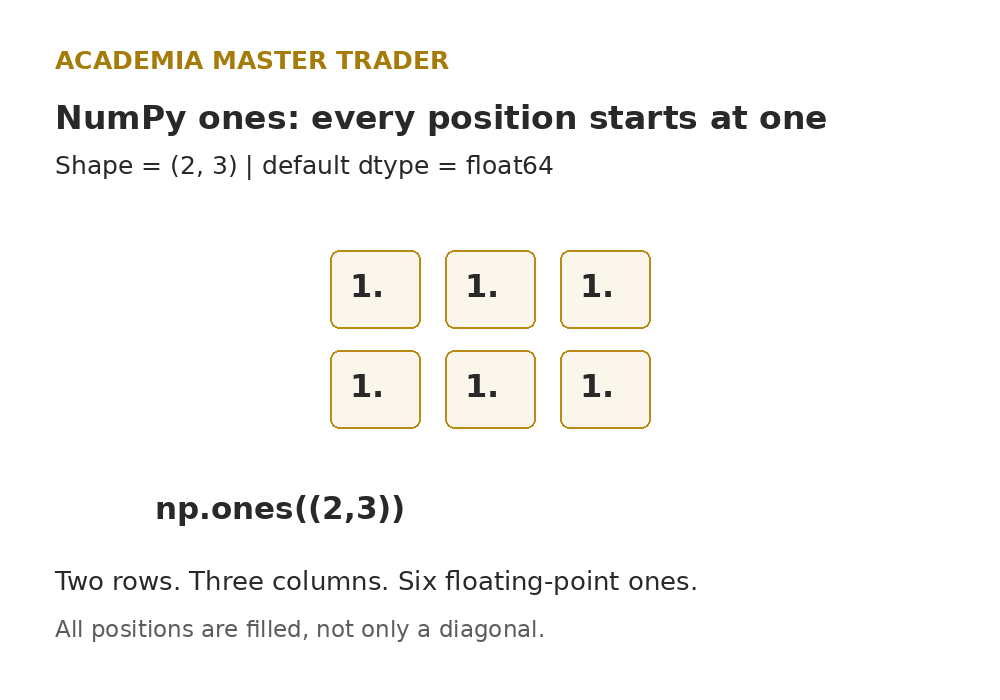
A rectangular result is useful for seeing that all positions are included. The top-right entry and the bottom-left entry are both one. There is no rule in this operation that reserves ones for matching row and column coordinates.
An array of ones is not an identity matrix
A matrix containing one everywhere has a different pattern from a matrix with ones on a diagonal and zeros elsewhere. In the two-by-three example, all six positions have the same initial value. Naming that pattern accurately avoids confusing two different array constructions.
The word one describes the fill value, not a request for one dimension. An array made by ones can have one axis, two axes or more, depending on the shape supplied. It can also be rectangular rather than square.
Explain the output by reading its rows and columns, not by assuming that familiar words imply a particular matrix role. A repeated value alone does not establish how an array will behave in a later calculation. That depends on the actual operation and the arrangement of its inputs.
Vector, row and column remain distinct
The expression np.ones(3) requests a one-dimensional array with three entries. Its shape is (3,). By contrast, np.ones((1,3)) requests one row and three columns, giving shape (1,3).
The expression np.ones((3,1)) requests three rows and one column. All three examples contain three ones. Their entry counts match, while their shapes do not. The number of values is therefore not enough to identify the array's dimensions.
When another function expects a particular arrangement, use the complete shape to explain why an input fits. A vector is not simply a row with its row count left unwritten. It has a different number of axes, which can matter when arrays participate in later operations.
Choose the representation explicitly when needed
The NumPy reference lists float64 as the default dtype for ones. This is why the simple examples show entries such as 1. rather than only integer-looking values. Printed notation helps a reader recognise the example, but the actual data type is the precise property to inspect.
The expression np.ones((2,3),dtype=int) requests integer ones in the same two-row, three-column arrangement. It does not change the six positions into a vector. Shape and dtype describe different aspects of the result.
If a program requires a particular representation, state that requirement when creating the array. Do not infer a guaranteed integer width merely from the general integer type name. The introductory point is that equal mathematical values can be represented using different numerical types.
Storage order does not redraw the array
The order argument describes multidimensional memory storage. C-style storage is row-major, while Fortran-style storage is column-major. The choice concerns how entries are arranged in memory, not a different visible pattern of ones and zeros.
A requested shape of (2,3) remains a two-by-three arrangement when a different supported storage order is chosen. The fill remains one in every position. Describing memory organisation separately prevents it from being mistaken for a change in the number of axes.
A new array is a starting object
The documented return value is a new array. If a variable receives that result, explain it as construction and assignment. It is not an instruction to replace entries in some other existing array that happens to be present in the program.
The meaning of the initial ones also belongs to the application. The constructor does not know whether a later program will treat them as counters, weights or another kind of numerical input. A lesson should explain the chosen meaning rather than presenting the constructor as evidence about external events.
Read shape, contents and type together
Continue learning with Academia Master Trader at academiamastertrader.com.br. Aprenda provides access to educational material. Describe ones by stating the requested shape, the fact that every position begins with one and the intended data type. Keeping those properties separate gives a clear account of the starting array before any later calculation changes it.