NumPy ravel produces a one-dimensional array by reading entries in a specified index order
Flattening an array requires more than stating that the output has one dimension. The entries also need an order. NumPy ravel returns a contiguous one-dimensional array containing the input's elements. Its order argument determines how those elements are read before being packed into the result.
Academia Master Trader presents this explanation in English for readers in the Marshall Islands. The examples concern array structure only. They are not market prices, trading signals or financial results. A small two-row array makes the difference between the two main index orders visible.
Begin with two rows and three columns
Let x be a NumPy array with rows [1,2,3] and [4,5,6]. Its shape is (2,3), so it contains six entries arranged along two axes.
The call np.ravel(x) produces [1,2,3,4,5,6]. The result has shape (6,). The default order is C-style indexing, which reads this example across each row before continuing to the next row.
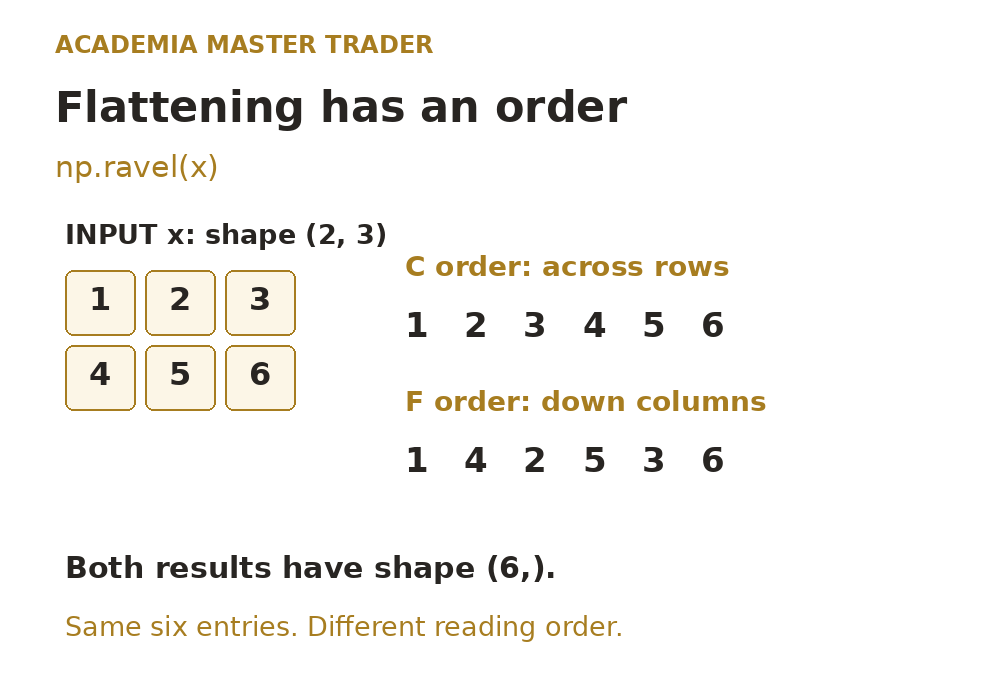
The output retains six entries. Ravel does not combine them into a total or average. It places them in a one-dimensional arrangement using the selected reading order.
C order changes the last axis index fastest
In the two-dimensional example, the column index changes fastest under C order. The row index changes more slowly. This gives one, two and three from the first row, followed by four, five and six from the second row.
The same description extends to more dimensions: the last axis index changes fastest, and the first changes slowest. The rule concerns the sequence of index positions used to read the array.
This is more precise than saying that C order always follows physical memory. The documentation explicitly separates C-style indexing from the underlying memory layout of the input array.
F order changes the first axis index fastest
The call np.ravel(x,order='F') produces [1,4,2,5,3,6]. In this example, the first axis is the row axis, so its index changes fastest.
The reading sequence takes one and four from the first column, then two and five from the second column, then three and six from the third column. The result still has shape (6,).
Changing the order argument changes the sequence, not the number of entries. Both outputs contain the original values, but their positions in the one-dimensional result differ.
Index order is not numerical sorting
The F-order result is not ascending, but that does not make it disordered relative to the function's rule. It follows a different sequence of array indices.
Likewise, the ascending C-order example is a consequence of the chosen input values. Ravel does not sort values from small to large. Another input could produce an irregular numerical sequence while following the same C-order indexing rule.
When explaining an output, identify the reading path through the input rather than attributing the arrangement to the magnitudes of the numbers. Index positions explain the result.
C and F do not inspect the input layout to choose their rule
The documentation says that the C and F options refer only to axis indexing order. They take no account of the underlying memory layout when selecting that index sequence.
An input's printed rows therefore do not justify a claim about how all of its data are stored. The order argument tells ravel how to read indices for the requested output.
Keep those ideas separate: the input has a shape, its storage has a layout and the operation has a reading order. They can be related without being interchangeable descriptions.
A order chooses from the input's contiguous layout
The order argument also accepts A. The reference defines A as Fortran-like index order when the input is Fortran contiguous in memory, and C-like order otherwise.
That is a conditional rule, so it should not be described as always matching the visible row sequence. The input's layout is part of the condition.
For a beginner explanation, C and F give direct index-order examples. Introduce A with its documented condition rather than guessing its result from a picture of the values alone.
A one-dimensional result can require a copy
The reference describes the output as a contiguous flattened array and states that a copy is made only if needed. Ravel should therefore not be described as always returning a view.
It should not be described as always making an independent copy either. Whether a copy is needed belongs to the input and the requested arrangement, not simply to the fact that the result has one dimension.
A different bracket layout is not proof of independent storage. If later work needs an independent snapshot, that requirement must be handled separately from the explanation of flattening.
State the shape and the reading order together
For the two-row example, both C and F orders yield shape (6,). Shape alone cannot distinguish [1,2,3,4,5,6] from [1,4,2,5,3,6].
Continue learning with Academia Master Trader at academiamastertrader.com.br. Aprenda provides access to educational material. Record the input shape, identify the requested reading order and write the complete output sequence for a small example. That keeps flattening distinct from sorting, aggregating values and assuming an independent copy.