NumPy repeat repeats individual entries along a chosen axis rather than repeating an entire sequence as a block
Repeating values is a structural operation as well as a numerical one. NumPy repeat places repetitions of each entry next to that entry along a selected axis. Its result depends on both the repetition count and the axis choice. When no axis is supplied, the input is flattened and the result is one-dimensional.
Academia Master Trader presents this explanation in English for readers in Mauritius. The examples concern numerical arrays only. They are not prices, trading signals or financial results. The aim is to distinguish repeating individual values, repeating rows and reading a flattened result.
Begin with a short vector
The expression np.repeat([2,5,8],2) produces [2,2,5,5,8,8]. Each input entry appears twice in a neighbouring pair. The output preserves the order of the input groups: the twos come first, followed by the fives and then the eights.
The count two means two occurrences in the result for each input entry. It does not mean the original value followed by two additional copies. There are six output entries, not nine.
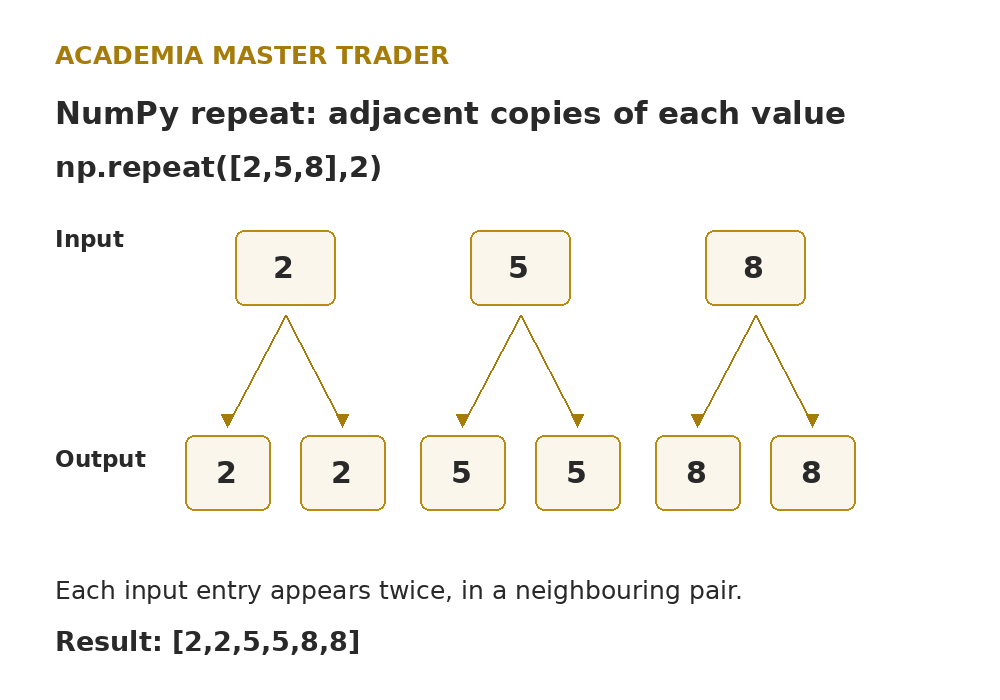
This output is different from [2,5,8,2,5,8]. That second arrangement repeats the whole three-value pattern as a block. Repeat's basic element-wise example instead groups each value's repetitions together before moving to the next input value.
No axis means a flattened result
Consider the two-row input with rows [1,2] and [3,4]. The expression np.repeat(x,2) produces [1,1,2,2,3,3,4,4]. Because axis is omitted, the function uses the flattened input and returns a flat output array.
The result has eight entries on one axis. It is not a four-by-two matrix merely because the original input had two rows. The default axis behaviour changes the arrangement as well as increasing the number of repeated values.
Explain that flattening explicitly when showing a multidimensional input. Without it, a reader may expect the original row structure to remain visible. The axis argument determines whether that structure is handled along a particular dimension instead.
Axis zero repeats rows in a two-dimensional example
For the same input x, np.repeat(x,2,axis=0) produces rows [1,2], [1,2], [3,4] and [3,4]. The row count increases from two to four. The column count remains two.
Each original row is repeated beside itself along the row axis before the next original row is handled. The result is not the original two-row matrix followed by another complete two-row block. Reading the row order makes the distinction concrete.
The output shape is (4,2). Naming both dimensions shows which axis changed and which stayed the same. An entry count alone would show eight values without describing their two-dimensional arrangement.
Axis one repeats values across columns
The expression np.repeat(x,2,axis=1) produces rows [1,1,2,2] and [3,3,4,4]. There are still two rows, while each row now contains four columns. The shape is (2,4).
Compare that with the axis-zero result. Both outputs contain eight values, but the shapes and visible groupings differ. The same repetition count does not determine one unique arrangement unless the axis choice is also known.
A helpful explanation reads the input shape, names the chosen axis and then reads one complete output row. That sequence makes the transformation visible without relying only on a long printed array.
Repetition counts can differ
The reference allows repeats to be an integer or an array of integers. With the two-row input, np.repeat(x,[1,2],axis=0) returns rows [1,2], [3,4] and [3,4]. The first row appears once and the second appears twice.
The two counts refer to positions along the selected axis. They are not values copied into the output as new data. In this example, one and two control how often the original rows occur.
The repeat specification must fit the selected axis under the function's compatibility rules. Do not assume any list of counts can be paired with any axis. A small example should show which original row or entry each count describes.
Order and shape are part of the result
Repeating an entry does not add a new kind of value to the numerical example. It changes how often existing values occur and how they are arranged. That can matter in a later calculation, so the repetition count should be explained rather than treated as cosmetic formatting.
The documented result is an output array. Describe the operation in terms of the input, the counts and the selected axis. Do not infer a purpose such as extra observations or additional measurements merely because a value now appears more often.
Read counts with their axis
Continue learning with Academia Master Trader at academiamastertrader.com.br. Aprenda provides access to educational material. State whether the input is flattened or an axis is selected, identify the repetition counts and read the output order. This separates repeated entries from a repeated whole pattern and makes the resulting shape clear.