NumPy sort changes value order, not the meaning of the observations
A numerical array often arrives in an order that matters. Its positions might follow collection time, a list of records, or a sequence chosen by the person preparing the data. Sorting answers a different question: how should the values be arranged according to their comparison order? NumPy sort returns a sorted copy, allowing us to inspect that arrangement without treating it as the original sequence.
This distinction is useful even for a short list. A sorted result can make small and large values easier to find, but it does not explain when those values occurred. It also does not decide which observation is more useful. The numerical order and the meaning of the records remain separate parts of the work.
Four entries, including one repeated value
Consider an array a containing 7, 2, 5 and 2. Calling np.sort(a) produces 2, 2, 5 and 7 in ascending order. The two entries equal to 2 are both present. Sorting has changed their arrangement; it has not removed repeated values or replaced them with a single representative.
The output still contains four elements. Its smallest value is now at the beginning and its largest at the end. In this one-dimensional example, the operation does not calculate a total, an average or a difference. It returns the same collection of numerical values in a comparison-based arrangement.
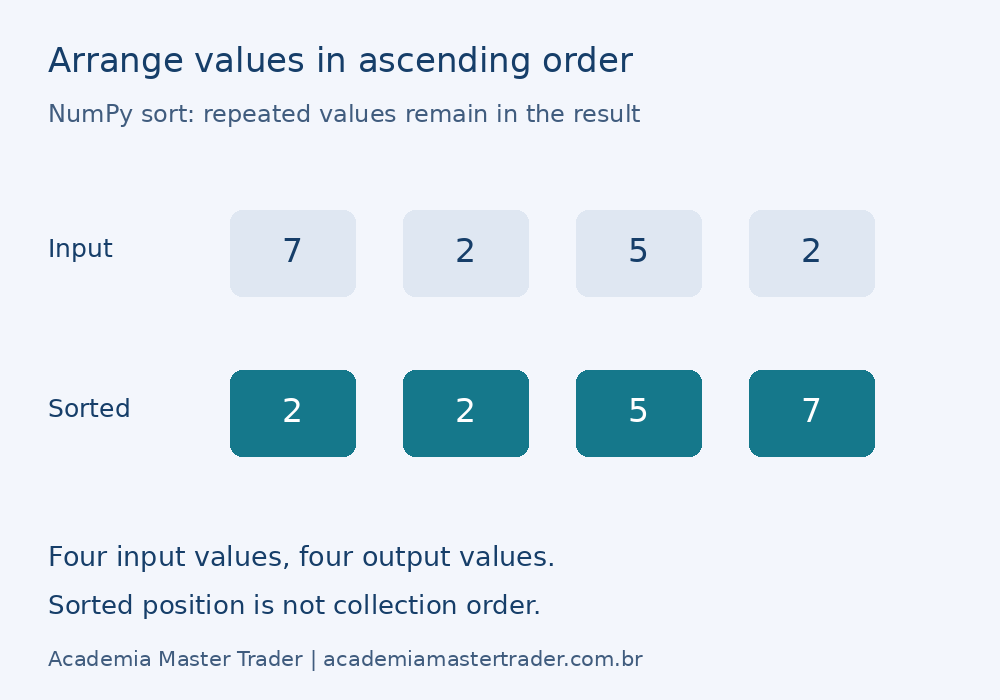
The figure places the original values and the sorted result on separate rows. This layout is deliberate: the first position in the result is not a claim about the first observation in the input. Once values move, their new positions describe sorted order. If we need to keep them connected to other record fields, we must preserve that relationship explicitly.
A copy and an in-place operation are different choices
The NumPy function np.sort returns a sorted copy of an array. The array method a.sort, by contrast, sorts the array in place. These are different ways of managing the data, even when the resulting value order is the same. Choosing between them affects whether the original arrangement remains available through the existing array.
Before sorting, decide which arrangement later steps will need. A calculation may use the ordered copy while a separate display still needs the collection sequence. Naming those objects clearly helps prevent a later step from treating a sorted position as an original record position.
Sorting values is not sorting record identities
Sometimes the question is about the positions that would arrange the data, rather than an ordered copy of the values. The documentation points to argsort for indirect sorting. That distinction matters when several arrays describe the same observations: moving one array independently can break the connection between a value and its accompanying information.
A small example makes the issue clear. If one array contains measurements and another contains labels, sorting the measurements alone does not automatically rearrange the labels. Their relationship needs its own handling. The numerical operation cannot infer the intended identity of a record from the words printed beside it elsewhere.
The axis defines which values are compared together
For an array with more than one dimension, NumPy sort uses the last axis by default. In a two-dimensional table, that means values are sorted within each row. It does not mean the rows are ranked by a selected column, and it does not mean every value in the table joins one global list.
Using axis=0 changes the sorting direction to the first axis. Using axis=None flattens the input before sorting, producing one ordered sequence. These choices answer different questions. An explanation should therefore name both the operation and the axis instead of showing an output array without its comparison groups.
Equal values bring a separate question
A stable sort preserves the relative order of entries that compare as equal. This property matters when equal keys belong to distinct records. The keyword stable=True requests that behaviour in NumPy versions that support it. The documentation records this keyword as available from version 2.0.
Without that request, the relative order of equal entries is not guaranteed by the default choice. In a plain list containing two identical numbers, their exchange may be invisible. With additional record information, preserving their previous order can matter. Stability is therefore a property of how ties are handled, not a promise that the input was already correct.
Keep the interpretation with the result
The current documentation also describes how special values are ordered and how structured arrays can use named fields for comparisons. Those cases require their own explanation. A first lesson is clearer when it starts with ordinary finite numbers, identifies repeated entries, and states the axis before introducing more detailed options.
For the example here, the complete description is short: a one-dimensional ascending sorted copy of 7, 2, 5 and 2 is 2, 2, 5 and 7. It keeps all four values and changes their order. Everything beyond that, including record identity, time order and the purpose of the comparison, must come from the surrounding task.
Academia Master Trader publishes educational material about numerical operations and reading data. You can explore more study material at academiamastertrader.com.br and continue with explanations that connect each calculation to a clear question.