NumPy swapaxes exchanges two array axes while leaving the other axes in their existing positions
A multidimensional array can describe the same entries through a different order of dimensions. NumPy swapaxes performs a specific version of that change: it exchanges two named axes. The function takes the input array and the two axis numbers, making the selected exchange explicit.
Academia Master Trader presents this explanation in English for readers in Samoa. The examples concern numerical arrays only. They are not prices, trading signals or financial results. Reading axis numbers separately from dimension lengths helps explain what changes and what remains in place.
Start with a matrix that has one row
Let x be a NumPy array with one row, [1,2,3], and shape (1,3). The expression np.swapaxes(x,0,1) produces three rows: [1], [2] and [3]. The output shape is (3,1).
The first axis and the second axis exchange places. The input's three-column dimension becomes the output's three-row dimension, while its single-row dimension becomes the single-column dimension.
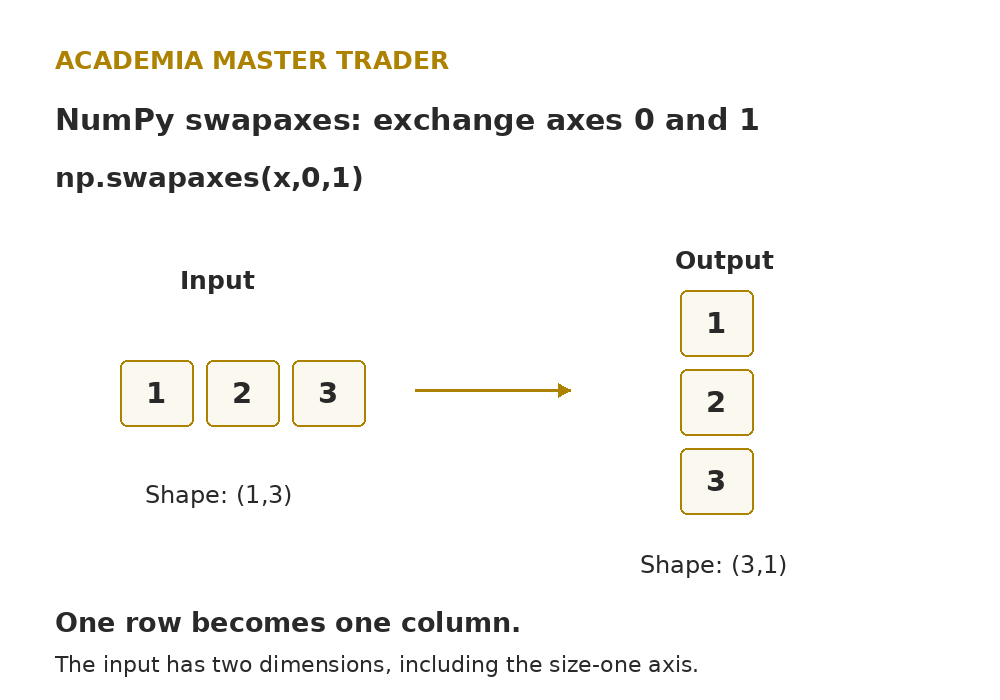
The values remain one, two and three. They are not summed, sorted or replaced. The operation changes how existing entries are indexed through the selected axes.
A single row is not a one-dimensional vector
The shape (1,3) contains two dimensions. The shape (3,) contains only one. Both can display the values one, two and three in a horizontal line, but they do not supply the same set of axes.
The reference's first example deliberately uses a two-dimensional input with a single row. That provides axis zero and axis one for the exchange. Do not remove the extra dimension from the explanation and still describe the same operation.
Read the shape before choosing axis numbers. An axis names a dimension that exists in the input; it is not created merely by including its number in the function call.
Axis numbers are positions, not lengths
For an input shape (2,3,4), exchanging axes zero and two gives shape (4,3,2). The middle axis remains in its original position. The lengths two and four move because the dimensions they describe have exchanged places.
The arguments zero and two identify the first and third axes. They do not request dimensions with lengths zero and two. Keep the axis identifiers separate from the numbers written in the input shape.
Writing both shapes side by side is useful. Mark the two exchanged positions and leave the middle position unmarked. That makes the scope of this operation clearer than saying that every dimension has been reversed.
A square shape can hide the exchange
The reference includes a three-dimensional array with shape (2,2,2). Exchanging axes zero and two leaves that shape unchanged, because both exchanged dimensions have length two. The entries still move to different indexed positions.
The input has two blocks: rows [0,1] and [2,3] in the first block, followed by rows [4,5] and [6,7] in the second. After np.swapaxes(x,0,2), the first block has rows [0,4] and [2,6]; the second has rows [1,5] and [3,7].
The equal dimension lengths make shape an incomplete description of the result. Read selected entries as well as the shape. An unchanged shape does not establish that the arrangement stayed unchanged.
Follow an index to understand the rule
In that three-dimensional example, the value one begins at index (0,0,1). Exchanging axes zero and two places it at (1,0,0). The middle index stays zero while the outer index positions exchange places.
This is a rule about index positions, not about reversing the values within every row. The value one remains one, and the new location follows from the selected axes.
A single traced entry can explain a large printed result. State its original index, exchange the selected index positions and identify the resulting location. That links the function call to the output without depending only on visual block layout.
Distinguish a pairwise exchange from a general permutation
Swapaxes names two axes to exchange. A general transpose can specify an entire ordering of axes. When describing a pairwise exchange, the two-axis function makes that intention direct.
For shape (2,3,4), swapping zero and one yields (3,2,4). A default transpose would instead reverse the complete axis order to (4,3,2). The two operations need not produce the same arrangement or shape.
Choose an explanation that matches the intended change. Do not call every axis operation a reversal, because a two-axis exchange can leave several other dimensions untouched.
Keep the return-value condition
The reference states that, for NumPy versions from 1.10.0 onwards, an ndarray input returns a view; otherwise a new array is created. Keep the input condition when describing storage behaviour.
A view is not automatically an independent snapshot. If later work needs separate storage, that is a different requirement from exchanging two axes. A changed printed arrangement does not itself show that a separate copy exists.
For this lesson's matrix example, name x as a NumPy array before discussing its view result. That prevents a statement about one input type from becoming a broader claim about every accepted input.
Explain the selected pair clearly
Continue learning with Academia Master Trader at academiamastertrader.com.br. Aprenda provides access to educational material. Read the input shape, name the two axes and follow an entry into the output. This keeps a pairwise axis exchange distinct from creating a dimension, reversing entries or applying a complete default transpose.