NumPy tile repeats a complete array pattern along specified dimensions
A repeating numerical pattern can be represented by joining copies of a small array. NumPy tile performs that construction using a repetition count for each relevant dimension. Academia Master Trader explains the operation in English for readers in Portugal. The examples use invented arrays to make block order and output shape visible. Repeating an existing pattern creates copies of the supplied numbers, not additional observations or new evidence about a sequence.
Repeat the complete vector as a block
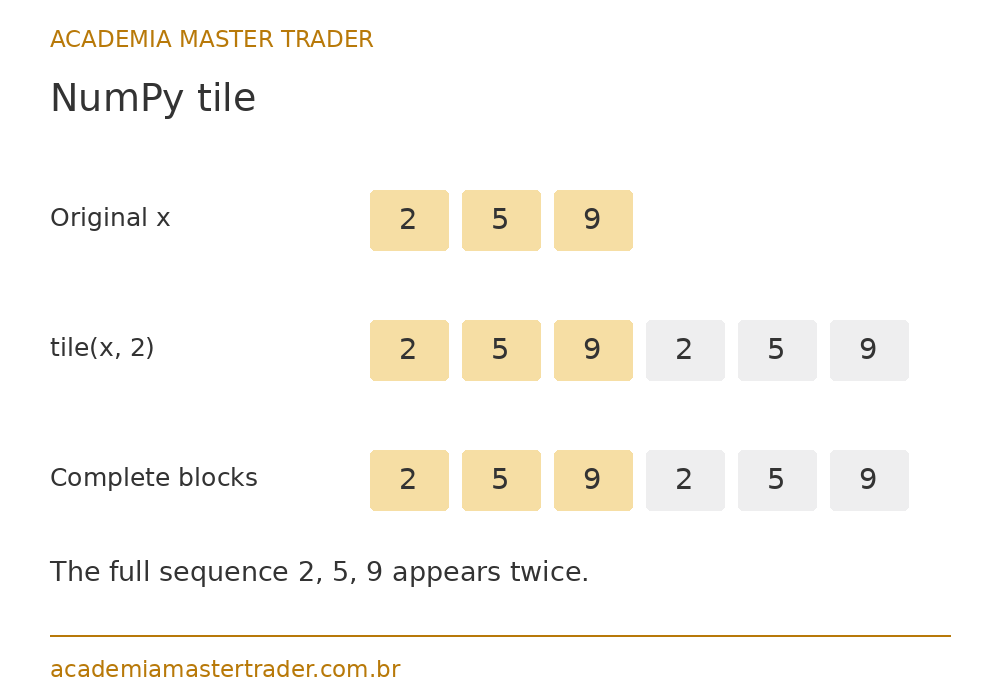
After import numpy as np, define x = np.array([2,5,9]). The call np.tile(x,2) returns [2,5,9,2,5,9]. One complete copy of the vector follows another. The order inside each copy remains two, five, nine. The output has six entries because the original three entry block appears twice.
This differs from repeating each entry consecutively. The tiled output is not [2,2,5,5,9,9]. The unit being copied is the complete input pattern. State that unit before describing the result, especially when the values could be interpreted as an ordered record. Pattern repetition does not add a calculation between one copy and the next.
A pair of counts can produce a matrix
The call np.tile(x,(2,2)) returns [[2,5,9,2,5,9],[2,5,9,2,5,9]]. There are two rows, and each row contains two copies of x. The shape is two by six. The first repetition count controls the vertical dimension and the second controls the horizontal dimension in this two dimensional example.
The input vector originally had one dimension. To use two repetition dimensions, NumPy treats it as having shape one by three before constructing the output. That added leading dimension explains why the first count creates rows instead of repeating each scalar entry individually. Shape reasoning is more reliable than guessing from the flattened numbers alone.
Follow an existing matrix through both axes
Define a = np.array([[1,3],[6,8]]). The call np.tile(a,(2,1)) returns [[1,3],[6,8],[1,3],[6,8]]. It places two copies of the complete two row block vertically. The original row order is preserved inside each copy, giving four rows and two columns.
The call np.tile(a,(1,2)) instead returns [[1,3,1,3],[6,8,6,8]]. It joins two copies horizontally, giving two rows and four columns. The pair of counts determines which dimension grows. Both arrays have eight entries, yet their shapes describe different arrangements and lead to different positional interpretations.
Short repetition specifications align from the end
For that same matrix, np.tile(a,2) gives the same result as np.tile(a,(1,2)). Because a already has two dimensions, the single repetition count is treated as a horizontal count with a leading one. It does not flatten the matrix before repeating it.
More generally, NumPy adds leading ones to a short repetition specification until it matches the number of input dimensions. Conversely, when the repetition specification has more dimensions than the input, leading dimensions are added to the input shape. Write these leading ones down when explaining a shape change so that the alignment is explicit.
Check the shape as well as the values
For a matrix with shape two by two and repetition counts (3,2), the tiled output has shape six by four. Each corresponding dimension is multiplied by its repetition count. This gives a compact check before reading every output entry. It also shows how quickly a constructed output can grow when several dimensions are repeated.
Continue learning with Academia Master Trader at academiamastertrader.com.br and in Aprenda. Record the input shape, complete block and repetition counts. Then verify the resulting shape and the order inside each copy. This keeps array construction separate from any claim that a repeated pattern predicts what comes next.