NumPy tile repeats a complete array pattern along specified dimensions rather than grouping copies of each value
A repeated pattern can look simple while hiding an important question: what exactly is being repeated? NumPy tile constructs an output array by repeating the input array according to repetition counts. The repeated unit is the array pattern. This differs from repeating each individual entry beside itself.
Academia Master Trader presents this explanation in English for readers in Seychelles. The examples are small numerical arrays, not prices, trading signals or financial results. Reading the pattern, the repetition counts and the output shape together makes the operation easier to explain.
Start with one complete pattern
Let a be the vector [0,1,2]. The expression np.tile(a,2) produces [0,1,2,0,1,2]. The original three-value pattern appears twice in sequence. The zero is followed by one and two before the next copy begins.
The count two means two occurrences of the pattern in the result. It does not mean the original pattern followed by two extra copies. There are six output entries, arranged as two groups of three.
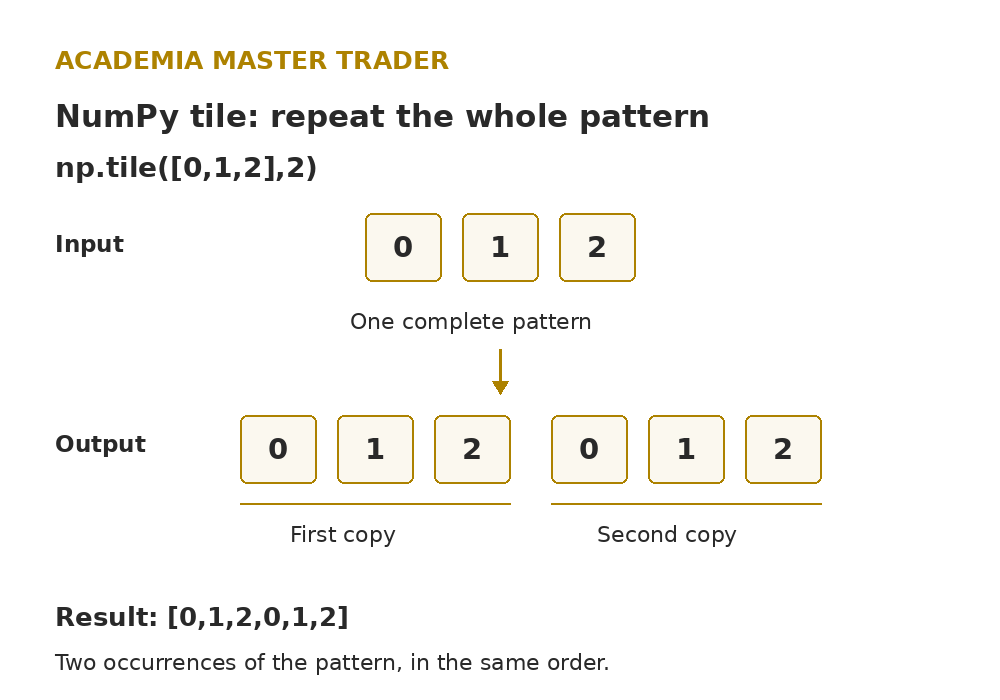
Compare that output with [0,0,1,1,2,2]. Both contain six entries and each input value occurs twice, but the order differs. A count of values alone therefore cannot distinguish repeating a pattern from grouping repetitions of each entry.
A tuple describes repetition along dimensions
The expression np.tile(a,(2,2)) returns two rows. Each row is [0,1,2,0,1,2]. The output shape is (2,6): two rows and six columns.
The tuple describes two repetitions along each of two dimensions. To interpret this example, the one-dimensional input is treated as a single row before repetition. That gives a starting shape of (1,3), followed by the two-by-two repetition arrangement.
This does not mean the input values become two. The repetition counts control how often the pattern occurs along dimensions; they are not replacement values placed into the array.
Read a matrix example separately
Now let b contain rows [1,2] and [3,4]. The expression np.tile(b,2) produces rows [1,2,1,2] and [3,4,3,4]. The row count stays two and the column count becomes four.
The scalar repetition count applies to the last dimension in this example. It does not repeat the two-row matrix vertically as well. Naming the output shape (2,4) makes that clear without relying on the printed arrangement alone.
When the input has more dimensions than the repetition specification, NumPy extends the repetition specification by placing ones at its beginning. Here, the count two behaves like (1,2) for a two-dimensional input. The leading one leaves the row dimension unchanged.
Repeat the matrix vertically
For the same b, np.tile(b,(2,1)) returns rows [1,2], [3,4], [1,2] and [3,4]. The output shape is (4,2). The whole two-row pattern occurs twice along the first dimension.
Read the row order carefully. The first row is followed by the second row, and then that two-row sequence begins again. This is different from placing two copies of the first row together before two copies of the second row.
The second repetition count is one, so the column pattern is not repeated horizontally. Each row still has two entries. The pair of counts explains both the changed dimension and the unchanged dimension.
Understand the dimension rule
The reference states that the output has as many dimensions as the larger of the input dimension count and the length of the repetition specification. If the repetition specification has more dimensions, NumPy adds new leading axes to the input for the operation.
For example, the vector shape (3,) is treated as (1,3) when two-dimensional repetition is requested. With three-dimensional repetition, that same vector can be treated as (1,1,3). These leading dimensions explain why the result need not remain a vector.
Keep the leading-axis rule separate from the numerical contents. It describes the arrangement used for repetition, not an arithmetic transformation of zero, one or two. The original value order remains the pattern being tiled.
Choose the operation from the intended arrangement
Tile and repeat answer different structural questions. Tile repeats an array pattern. Repeat repeats elements along a selected axis, or from a flattened input when no axis is supplied. Compare a complete small output before choosing between them.
The NumPy reference also recommends broadcasting operations and functions rather than using tile merely for broadcasting. Repetition should express the arrangement actually needed, rather than being an automatic preliminary step for every calculation involving different shapes.
Explain the pattern before the count
Continue learning with Academia Master Trader at academiamastertrader.com.br. Aprenda provides access to educational material. Name the input pattern, read the repetition specification and state the output shape. Those details distinguish a repeated block from repeated individual entries and make a multidimensional result understandable.