NumPy tile repeats a whole array pattern along axes rather than repeating each entry in place
A repeated pattern has an order. NumPy tile preserves the order within an input array and repeats that array along the directions described by reps. Understanding the repeated unit is the first step: a complete block is being arranged again, rather than each individual entry being written several times before moving to the next one.
Academia Master Trader presents this lesson for English-language study in Dominica. All values below are invented teaching numbers. They describe array positions and shapes, not prices, trading signals or financial outcomes. The examples start with a short sequence and then move to a matrix so that the meaning of each repetition direction stays visible.
Identify the block before counting copies
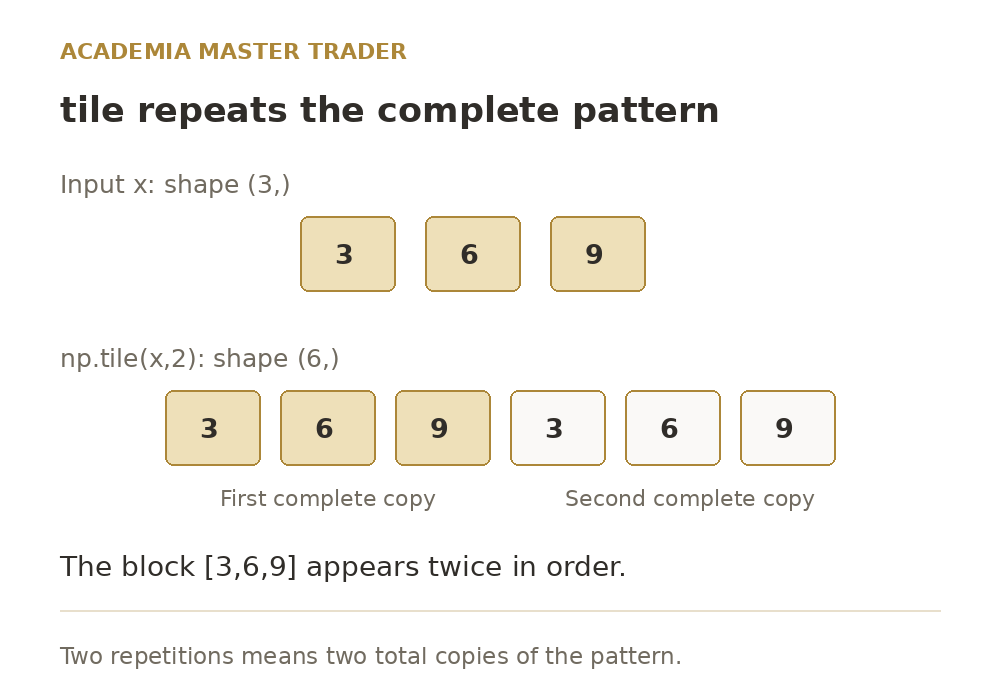
Let x be [3,6,9]. The expression np.tile(x,2) returns [3,6,9,3,6,9]. The complete three-entry sequence appears twice. The output has six positions, but its first two entries are 3 and 6, not two adjacent copies of 3. The input sequence is the unit that repeats.
Compare that arrangement with repeating each entry twice. That different operation would give [3,3,6,6,9,9]. Both outputs have six entries and contain the same numbers the same number of times. Their positions differ. Looking only at the output length or a list of distinct values cannot tell these arrangements apart.
Read reps as repetitions along axes
The reps argument can contain more than one count. For a two-dimensional arrangement, the first count belongs to axis 0 and the second belongs to axis 1. In a simple matrix, these correspond to the row direction and column direction. The counts specify total repetitions along those directions, not additional copies after an original block.
For the one-dimensional x above, np.tile(x,(2,1)) creates two rows, each containing [3,6,9]. The output shape is (2,3). The count one preserves one horizontal copy of the sequence; the count two places that sequence in two rows. No numerical entry is doubled by this operation.
Follow the shape promotion rule
A one-dimensional input has fewer axes than a pair of repetition counts. NumPy tile handles this by adding leading axes to the input for the arrangement. The shape (3,) is treated as (1,3) when two repetition directions are needed. Applying reps=(2,1) then gives shape (2,3).
This is a shape rule, not a change in the input values. With reps=(2,2), the same sequence produces two rows, each [3,6,9,3,6,9]. The shape is (2,6). Naming the promoted input shape helps explain why the first count creates rows rather than inserting a new entry between neighbouring values.
Repeat a matrix horizontally
Now let a have rows [2,5] and [8,11]. Its shape is (2,2). The expression np.tile(a,(1,2)) produces rows [2,5,2,5] and [8,11,8,11]. The entire two-column block appears twice across the output. The number of rows remains two and the number of columns becomes four.
Trace one block using both rows together. Its first column contains 2 and 8, and its second contains 5 and 11. Those two columns then appear again in the same order. Reading only the first row can hide the fact that a matrix block, including its row relationships, is repeated.
Repeat the same matrix vertically
For np.tile(a,(2,1)), the output rows are [2,5], [8,11], [2,5] and [8,11]. Its shape is (4,2). The complete original matrix appears once and then appears again in the row direction. This differs from writing [2,5] twice followed by [8,11] twice.
When explaining the output, describe the block boundary as well as the final shape. Four rows and two columns do not, on their own, describe which row comes first. A small drawn divider between complete copies can help a reader connect each output region with the original input.
Keep missing repetition directions explicit
When the input has more axes than the reps argument supplies, NumPy tile adds leading counts of one to reps. For the two-dimensional a, a single repetition count of two acts like (1,2). It repeats the block horizontally, rather than automatically repeating it along every axis.
Writing the full pair is often clearer in a teaching example. Compare (1,2), (2,1) and (2,2) before looking at the resulting arrays. Each pair states a different arrangement. The final pair repeats in both directions and produces shape (4,4) from the original shape (2,2).
Explain the arrangement before using the values
A clear explanation names the input shape, the repeated unit, the repetition counts and the output shape. Repetition creates an arrangement containing existing values. If those values describe recorded observations, copying them does not create newly observed information. Preserve that distinction when labelling a larger table or discussing what its rows represent.
Continue learning with Academia Master Trader at academiamastertrader.com.br. Aprenda opens the educational material. Sketch one complete input block, place its copies according to the axes, and then read the resulting positions in order. That sequence connects the repetition counts to the output without confusing a repeated pattern with numerical multiplication.