NumPy tril preserves the lower region of an array while keeping its original shape
A lower triangular arrangement can be represented inside an ordinary rectangular array. NumPy tril creates that arrangement by keeping entries on or below a chosen diagonal and replacing entries above it with zeros. The output retains the input shape, so the operation changes selected values rather than cutting away part of the array.
Academia Master Trader presents this explanation in English for readers in Botswana. The examples describe array positions and numerical structure only. They do not represent prices, trading signals or financial results. Understanding the boundary diagonal helps distinguish a lower-region arrangement from a smaller array, a sorted sequence or a collection of minimum values.
Follow the default boundary
Let x have rows [1,2,3], [4,5,6] and [7,8,9]. Its shape is (3,3). The expression np.tril(x) returns rows [1,0,0], [4,5,0] and [7,8,9]. The output is still a three-by-three array.
One, five and nine lie on the main diagonal and remain in place. Four, seven and eight lie below it and also remain. Two, three and six lie above it, so their output positions contain zeros. None of the retained values moves to a new coordinate.
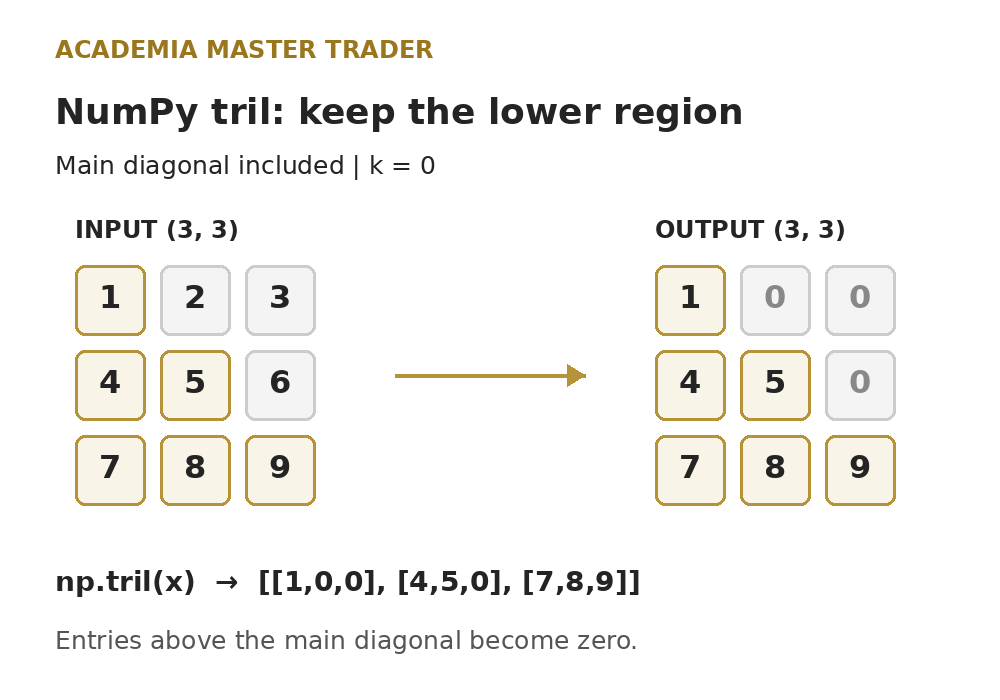
The zeros are part of the resulting data structure. They are not missing cells or an instruction to ignore those coordinates. If a later calculation adds, averages or otherwise processes the full array, those zeros participate according to that later operation's rules.
Selection depends on position
With zero-based indices, the main diagonal has equal row and column indices. Below it, the row index is greater than the column index. The default tril operation therefore keeps positions whose column index is no greater than their row index.
The value at (2,0) remains because it lies below the main diagonal. The value at (0,2) becomes zero because it lies above it. This decision would be the same if the original values were negative, repeated or much larger than the example numbers.
Lower means a region of the array, not a ranking by numerical size. A very small number above the diagonal is still replaced. A very large number below the diagonal is still retained. The function does not compare each value with its neighbours or rearrange the rows to create a sorted order.
A negative offset excludes the main diagonal
The parameter k determines the boundary. Zero is the default and includes the main diagonal. A negative k moves the boundary below it. For x, np.tril(x,k=-1) returns rows [0,0,0], [4,0,0] and [7,8,0].
This is the strictly lower region for the square example. The main diagonal itself has become zero, while the first diagonal below it remains. Moving the boundary farther down would keep fewer positions. The parameter changes which entries survive, not where the entries are placed.
A positive offset moves the boundary above the main diagonal. The expression np.tril(x,k=1) returns rows [1,2,0], [4,5,6] and [7,8,9]. Two and six now remain because they lie on the selected upper diagonal. Three remains above that boundary and is replaced with zero.
Rectangles use the same coordinate rule
Consider a four-by-three array with rows [1,2,3], [4,5,6], [7,8,9] and [10,11,12]. The operation np.tril(x,k=-1) for this rectangular x gives rows [0,0,0], [4,0,0], [7,8,0] and [10,11,12].
Every entry in the last row is below the main diagonal, so that row remains unchanged under this boundary. The result still has shape (4,3). It does not become a square matrix simply because the operation is described using a triangle.
A rectangular example makes the index rule particularly useful. The visible outline of retained entries depends on the available number of rows and columns. The function follows positions relative to the chosen diagonal rather than resizing the array to match a drawing.
Higher dimensions use the final two axes
For an array with more than two dimensions, tril applies to the final two axes. The earlier axes identify the surrounding collections of matrix-like planes. Each of those planes receives the lower-region rule in its own row and column positions.
Before interpreting such an output, write down the full shape and identify which dimensions are last. A program that treats the first two axes as the relevant plane may attach the wrong meaning to the result even when the array itself is valid.
The NumPy reference describes the output as having the same shape and data type as the input, and as a copy. Keep that result separate from an assumption that the original input has been edited directly. Naming the output makes the data flow easier to follow.
Keep the operation distinct from later arithmetic
Tril does not return only the retained entries as a compact vector. It does not add them, count them or infer why the lower region matters. Those tasks require their own operations and an explanation of the array's meaning.
Continue learning with Academia Master Trader at academiamastertrader.com.br. Aprenda provides access to educational material. Record the input shape, identify the chosen diagonal and describe which positions become zero. That account makes the lower-region rule clear without confusing it with sorting, extraction or a change in the number of dimensions.