One filter time constant is not the same as a settled reading
A lock-in amplifier can display a quieter output when its low-pass filtering is made slower. That quieter number still needs time to respond after the measured signal changes. The filter time constant describes part of this response, but it is not a promise that the output has reached its final value after one time constant.
A simple first-order low-pass filter makes the distinction clear. Following an ideal step, its output approaches the new level gradually. The amount of change already completed and the amount still remaining are different quantities.
Start with a defined step and a defined model
Assume a first-order filter with unity steady-state gain. Before the change, its input and output are both zero. At time zero, the input changes abruptly to one unit and then stays there.
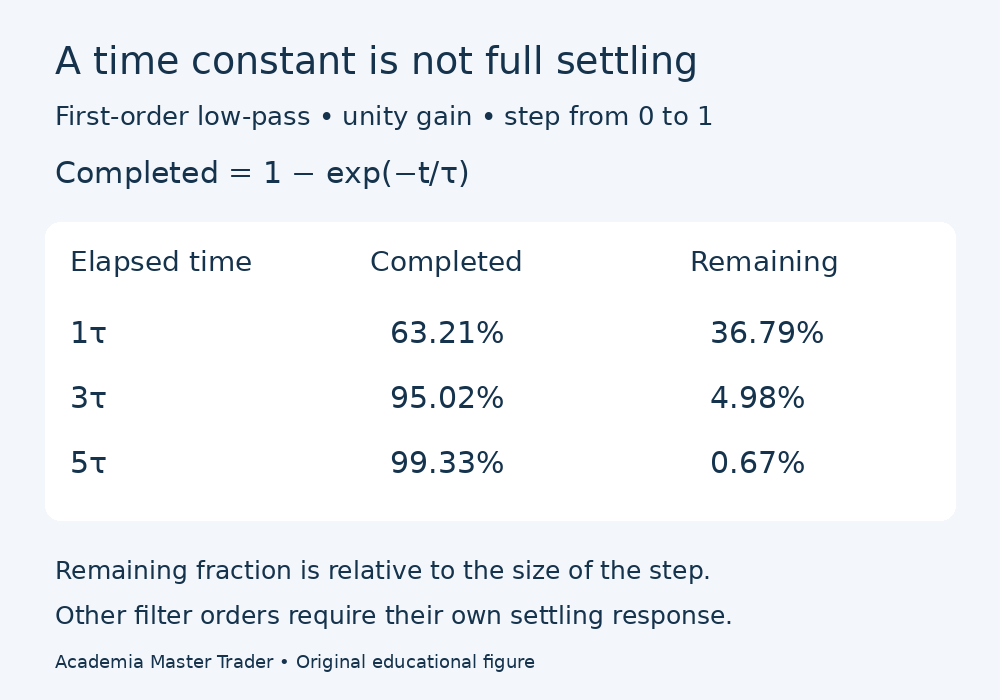
The normalized output is one minus the exponential of negative elapsed time divided by the time constant. The remaining fraction of the step is the exponential term itself.
After one time constant, the output has completed about 63.2 percent of the change. About 36.8 percent is still remaining. Calling that reading fully settled would hide a substantial part of the response.
These percentages describe the ideal filter response to this particular input history. They are not a specification for every instrument or every filter setting.
Three and five time constants describe different tolerances
After three time constants, the output has reached about 95.02 percent of its final change. The remaining fraction is about 4.98 percent. After five time constants, the completed fraction is about 99.33 percent and the remaining fraction about 0.67 percent.
The time needed therefore depends on what remaining fraction is acceptable. There is no single meaning of settled unless the tolerance is stated.
For the same first-order model, reaching a remaining fraction of one percent takes about 4.61 time constants. Reaching one tenth of one percent takes about 6.91 time constants. Both statements come from the same exponential response, with different thresholds.
The percentages refer to the size of the step. They are not automatically percentages of an arbitrary absolute reading, especially when a change begins from a nonzero baseline.
A practical time example keeps the units attached
Suppose the time constant is 100 milliseconds. One time constant is then 0.1 second, three time constants are 0.3 second and five time constants are 0.5 second.
Under the stated first-order assumptions, a reading taken 0.1 second after the step has completed only about 63.2 percent of the change. Waiting 0.5 second brings the remaining fraction below one percent of the step.
That calculation does not include a slow source, a mechanical adjustment or another filter elsewhere in the measurement chain. If the input itself continues changing, the ideal instantaneous-step example no longer describes the whole acquisition.
A stable-looking display can also be misleading when the update interval is long. Display refresh and filter settling are separate parts of the instrument's behavior.
Filter order changes the response
A higher-order filter is not obtained merely by relabeling the same first-order response. Cascading stages changes the time-domain approach to the final value as well as the frequency response.
Instrument documentation may define the displayed time constant in terms of an individual stage or another convention. The settling-time table for the selected filter is therefore more useful than applying a first-order multiplier to every setting.
Comparisons also need a clear constraint. Two filters with the same displayed time constant need not have the same bandwidth. Two filters with the same bandwidth need not have the same displayed time constant or the same step response.
The first-order numbers in the figure should not be transferred to a different filter shape without checking its response.
Slower filtering changes the measurement's pace
Reducing the measurement bandwidth can reduce integrated noise, but it also limits how quickly changes are followed. A parameter sweep that moves too soon can record part of the previous condition rather than the settled response to the new one.
A useful acquisition plan records the filter type, time constant, settling criterion and delay between a change and the reading. It also allows for any other response times that matter in the system.
The practical rule is to replace a vague instruction to wait one time constant with a defined tolerance and the response of the actual filter. A quieter reading and a settled reading are related goals, but they are not the same claim.
Academia Master Trader offers educational explanations with clear definitions and examples tied to their conditions. Discover our structure at academiamastertrader.com.br and continue learning with Aprenda.