Padding adds boundary values to an array without creating new observations
An array sometimes needs extra positions around its edges before another operation can use it. Padding supplies those positions according to a stated rule. It changes the size of the working array while keeping the original values within the expanded structure.
The added numbers do not become observations merely because they appear beside measured data. Their origin is the padding rule. Keeping that distinction visible helps readers understand which values came from the source and which were introduced during processing.
Width and value answer different questions
Consider the sequence two, five and eight. Adding one position before it and two positions after it produces a sequence with six positions. The padding width describes how much space is added on each side.
If the chosen constant is zero, the result is zero, two, five, eight, zero and zero. The first zero and the final two zeros are supplied values. The original sequence remains together in the middle, in its original order.
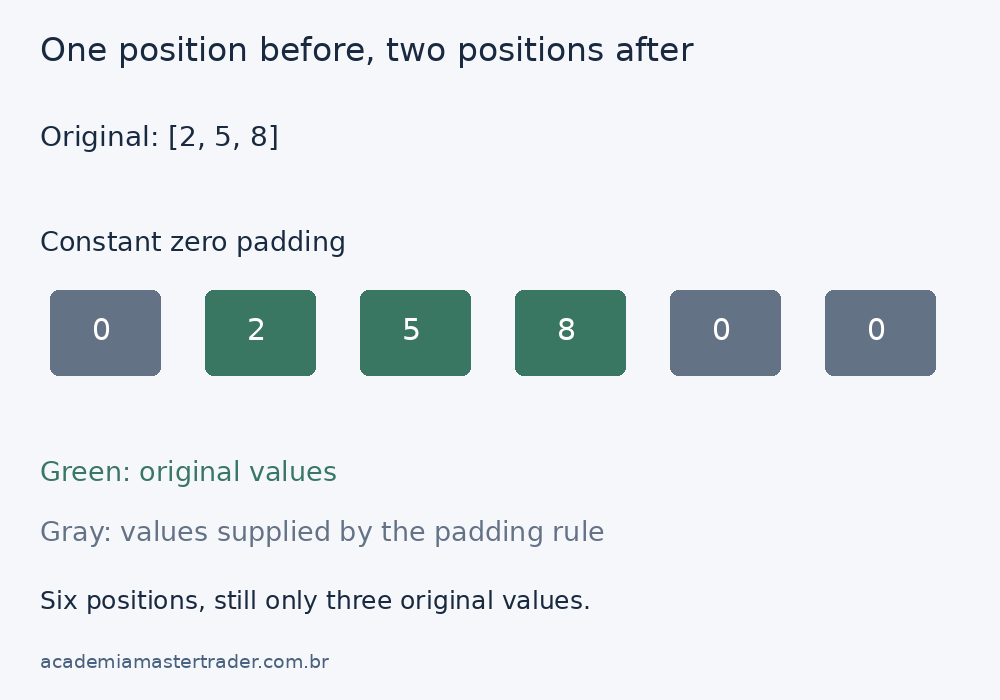
The width does not determine the numbers placed in the added positions. A different constant would produce the same expanded length with different boundary values. A clear description therefore states both the widths and the rule used to fill them.
Repeating an edge makes a different assumption
Another rule repeats the nearest edge value. With the same widths, the sequence becomes two, two, five, eight, eight and eight. Its length is still six, but its added positions differ from those in zero padding.
Neither rule discovers what happened before or after the original sequence. Zero padding supplies zeros, while edge padding extends the boundary values. The right choice depends on the purpose of the next calculation and the interpretation assigned to the array.
If a later result changes when the padding rule changes, that difference is part of the processing behavior. It should not be presented as a change in the original observations. The input data may be identical in both cases.
Reflection and wrapping are separate rules
Padding can also use reflection or wrapping. Reflection forms an extension from values mirrored near the boundary. Wrapping takes values from the other end of the sequence. These rules organize existing numbers in different ways.
Their names are not enough to describe every detail. NumPy offers both reflect and symmetric modes, whose treatment of the edge differs. Anyone reproducing a calculation needs the actual mode, rather than a general description such as mirrored padding.
Wrapping introduces a connection between the two ends of a sequence. That may fit a cyclic representation, but an ordinary list is not automatically cyclic. The processing choice needs an explanation separate from the fact that the operation is available.
Extra positions change the coordinate reference
Adding positions before a sequence moves the original elements to later indices in the expanded array. With one added position at the beginning, the original first element appears at index one when counting starts at zero.
A saved index from the original array cannot be reused without considering that shift. The numbers themselves may be unchanged, yet their positions within the larger array are different. Any associated labels or coordinates need a consistent mapping.
In a table, padding can add rows, columns or both. Each axis has its own before and after widths. The resulting shape should be stated explicitly so that the added border is not mistaken for additional source records.
Keep supplied values distinct throughout the workflow
In NumPy, pad takes an array, padding widths and a mode. The default mode is constant padding, and its default constant is zero. Those defaults are software behavior, not evidence that zero is meaningful for a particular dataset.
A separate indicator can identify which positions belong to the original array. This is useful when a supplied zero would otherwise look the same as an observed zero. Numeric equality does not establish a shared origin.
A reproducible explanation records the original shape, the padding widths, the mode and any values required by that mode. It also explains how the added positions affect later calculations. Padding then remains an explicit boundary construction, rather than an unexplained extension of the evidence.
Academia Master Trader shares educational material on numerical operations, data structures and reading results at academiamastertrader.com.br.