For a nonrelativistic electron, four times the accelerating voltage gives half the de Broglie wavelength
An electron accelerated through a larger voltage gains kinetic energy. Its momentum increases, and its de Broglie wavelength decreases. The relation is not generally an inverse proportionality between wavelength and voltage: in the nonrelativistic limit, wavelength is inversely proportional to the square root of the accelerating voltage.
That distinction changes a comparison immediately. Doubling the voltage does not halve the wavelength. To obtain half the wavelength under the assumptions below, the accelerating voltage must increase by a factor of four.
State what the accelerating voltage means
Consider an electron that starts with negligible kinetic energy and gains energy while moving through an electric potential difference. Let V be the positive magnitude of the accelerating voltage, and let e be the positive magnitude of the electron charge.
The kinetic energy gained is K = eV. This notation describes an energy gain. It does not mean that an electron gains energy for either direction of travel through any signed potential difference.
We neglect collisions, energy losses and any initial energy spread. We also restrict the calculation to kinetic energies much smaller than the electron rest energy. These conditions allow us to use the nonrelativistic kinetic-energy relation.
For an electron of mass m, that relation is K = p²/(2m), where p is the magnitude of its momentum. Combining it with K = eV gives p = √(2meV).
Use momentum rather than a photon energy rule
The de Broglie relation is λ = h/p, with h the Planck constant. Substituting the momentum gives λ = h/√(2meV) for the stated acceleration model.
The square root is part of the denominator. Leaving it out changes both the physical dependence and the dimensions of the expression. Momentum is not simply proportional to kinetic energy for a nonrelativistic massive particle.
It is also important not to replace p by K/c, as one could do for the energy and momentum of a photon. An electron has rest mass, and the photon relation does not supply its momentum from its kinetic energy.
The wavelength describes the electron's quantum wave behavior. It is not the diameter of a small electron sphere, and the formula does not assign a larger physical size to a slower electron.
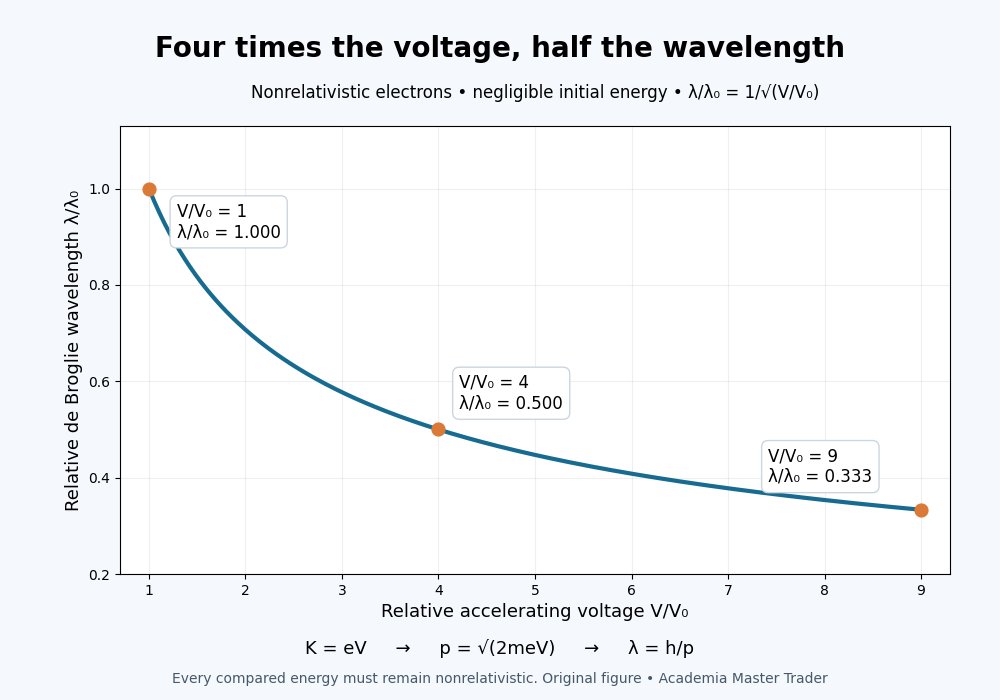
Compare ratios before calculating absolute values
Suppose the same electron species is accelerated from negligible initial energy through V₁ and V₂. The constants cancel when we divide the two wavelength expressions, leaving λ₂/λ₁ = √(V₁/V₂).
If V₂ = 2V₁, the wavelength ratio is 1/√2, approximately 0.707. If V₂ = 4V₁, the ratio is 0.5. If V₂ = 9V₁, it is one third.
The graph uses dimensionless ratios. Its horizontal axis is V/V₀, and its vertical axis is λ/λ₀, where λ₀ is the wavelength at a chosen reference voltage V₀. It therefore illustrates a scaling rule rather than a particular instrument's operating settings.
The reference voltage and every compared voltage must remain within the nonrelativistic range. A dimensionless graph does not remove the physical assumptions used to derive its curve.
Keep energy units and voltage units separate
An electron accelerated through 100 V gains 100 eV of kinetic energy in this ideal model. Increasing the voltage to 400 V gives 400 eV. The energy increases fourfold, while momentum doubles and wavelength falls by half.
Volt and electronvolt are different units. A volt measures electric potential difference; an electronvolt measures energy. Their numerical connection here comes from multiplying the voltage by the magnitude of one electron charge.
If initial kinetic energy is not negligible, use Kfinal = Kinitial + eV before calculating momentum. Ignoring that initial term can spoil the square-root voltage comparison even when the final speed remains nonrelativistic.
Know which relation survives at higher energy
The de Broglie relation λ = h/p still applies when relativistic momentum is needed. What must change is the approximation p = √(2mK), not the connection between wavelength and momentum.
At higher kinetic energies, a relativistic energy-momentum relation supplies p. The simple inverse-square-root voltage scaling is then no longer exact. Checking the energy range is therefore part of choosing the equation, not a correction to add after interpreting the result.
The practical sequence is to identify the energy gain, account for initial energy, choose the appropriate momentum relation and then evaluate h/p. This keeps voltage, kinetic energy, momentum and wavelength connected without treating them as interchangeable quantities.
Academia Master Trader shares educational content at academiamastertrader.com.br.