Selecting array positions follows an index list rather than a ranking of the values
A selection can change the order and number of entries in an array without calculating a new measurement. NumPy's take function retrieves elements using supplied indices. Those indices describe positions along a chosen axis, not a request to find the largest or smallest values.
The distinction matters when preparing a subset for another operation. An index list can select positions in any specified order and can select the same position more than once. The resulting entries therefore need an explanation of how they were chosen before anyone interprets them as separate observations.
The requested positions determine the output order
Consider the sequence two, five, eight, one. With positions counted from zero, its indices are zero, one, two, and three. Asking for indices two and zero retrieves eight followed by two, in that order.
The result has two entries because two positions were requested. It is not an ascending selection or a descending selection by definition. Its order comes from the index list. Reversing that list to zero and two would return two followed by eight.
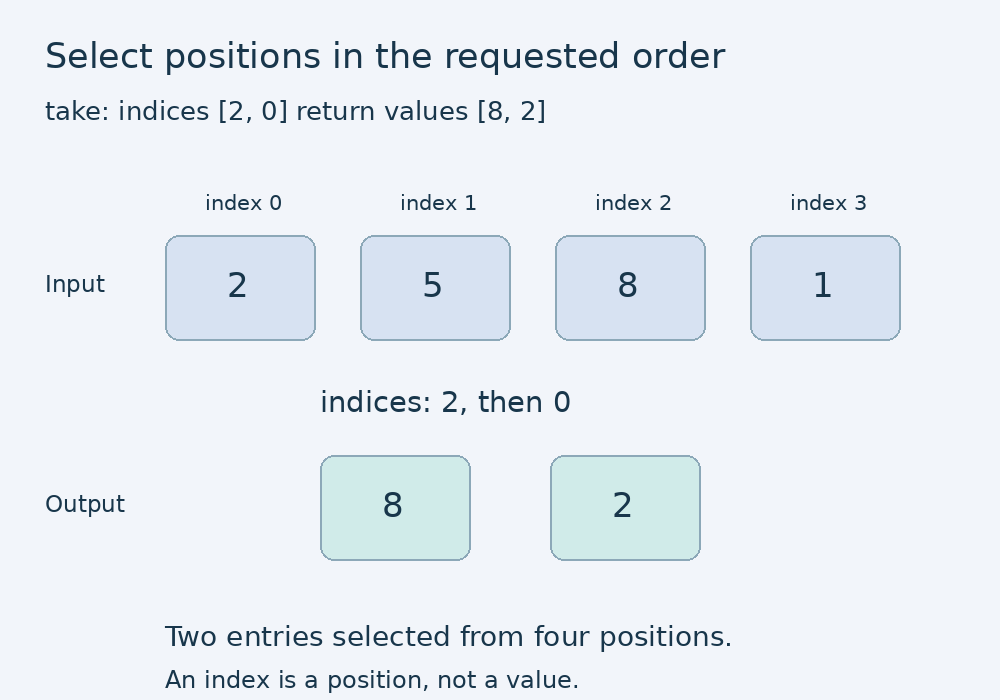
An index is different from a value. Requesting index two selects the element at the third position, which is eight in this example. It does not search for the number two. Keeping this difference explicit avoids an unclear description of what the operation retrieved.
Repeated indices repeat an existing entry
The index list can contain the same position more than once. If the requested indices are two, zero, two, the output is eight, two, eight. There are three output entries, but only two distinct source positions were selected.
This repetition does not create another measurement of eight. Both occurrences come from the same source position. A later calculation that counts output entries must not automatically describe that count as the number of independently collected observations.
Likewise, selection does not remove repetitions unless the supplied positions happen to do so. Take is not a deduplication instruction. Its job is to follow the index request, including repeated positions and the order in which those positions were given.
In a table, the selected axis matters
For a two-dimensional array, an explicit axis determines whether the indices refer to rows or columns. Selecting along axis zero chooses rows. Selecting along axis one chooses columns. The other direction remains part of the selected pieces.
Imagine a table with two rows and three columns. A one-dimensional list containing two column indices produces a table with two rows and two selected columns. A list containing one row index instead produces one selected row with three columns.
These results have different meanings and shapes even though both use the same selection function. A useful description gives the input shape, the index list, and the axis. Saying only that certain numbers were taken leaves out the positional rule that generated the result.
The default uses a flattened input
If axis is left at its default value of None, NumPy uses the flattened input array. The indices then refer to positions in that flattened sequence. They do not automatically refer to column numbers or row numbers in the original table.
This behavior can be useful when the intended selection is positional across the whole array. It is a different instruction from selecting columns separately for every row. The requested structure should decide which behavior is appropriate.
The shape of the indices also matters. NumPy allows indices arranged in more than one dimension, and those dimensions participate in the output shape. A simple account should state the actual index arrangement rather than imply that every selection returns a flat sequence.
Positions need to remain linked to their meaning
A position does not establish a record's identity by itself. If an array has been reordered, the same index can refer to a different record than before. Selection should therefore be explained in relation to the current input, not an earlier arrangement remembered from another step.
Separate labels or dates do not follow a selection automatically. When values and their descriptions are stored in different objects, the workflow must preserve the required correspondence. Equal lengths alone do not establish that the entries remain aligned.
The selected values keep their units. Taking an element expressed in seconds does not convert it to minutes, and retrieving a position does not calculate a mean or infer a trend. A clear report separates source positions, output entries, and original observations so that the selection is understood as a structural choice rather than new evidence.
Academia Master Trader shares educational material on numerical operations, data structures, and the interpretation of results at academiamastertrader.com.br.