Taking a rigid submerged object deeper does not automatically increase its buoyant force
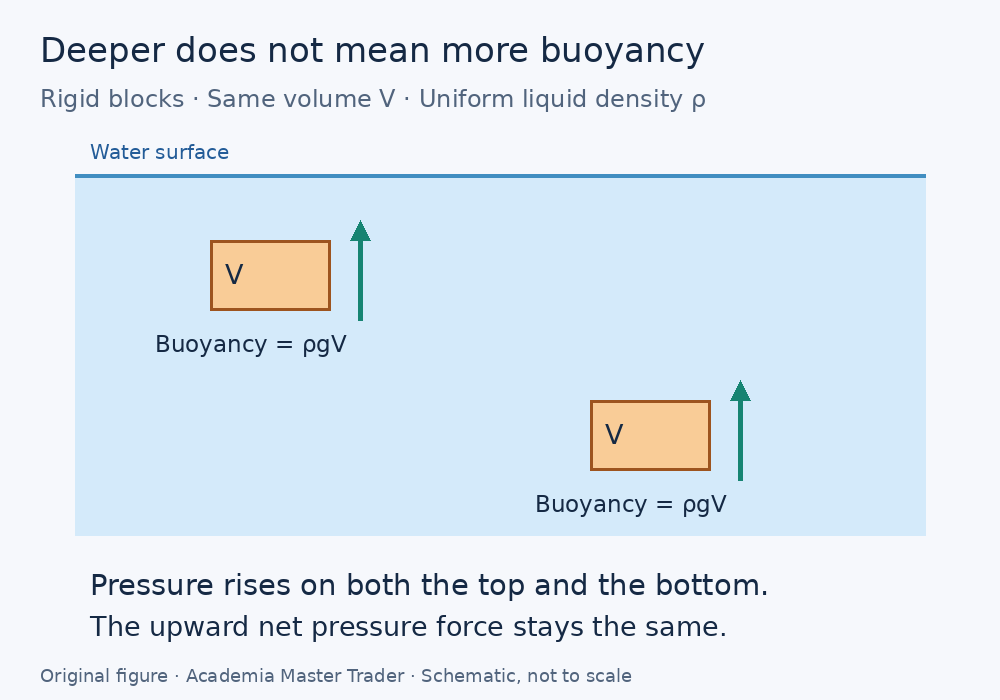
Water pressure increases with depth, but that does not mean a rigid object experiences a larger buoyant force simply because it is moved farther below the surface. In a liquid of uniform density, a fully submerged object of fixed volume displaces the same volume of liquid at either depth.
Archimedes' principle connects buoyant force to the weight of the displaced fluid. The pressure at one point on the object is not enough to determine that force. What matters is the combined effect of pressure over the entire surface.
Higher pressure is not the same as a larger pressure difference
Consider a rectangular block held below the surface of still water. Its upper face is horizontal, and its lower face is a vertical distance H beneath it. Let the area of each of those faces be A.
The upward pressure force on the lower face is larger than the downward pressure force on the upper face. With constant density ρ and gravitational acceleration g, the difference in pressure between these faces is ρgH.
Multiplying by A gives the net upward force, ρgHA. Since HA is the volume V of the block, this becomes ρgV. Horizontal pressure forces on opposite sides cancel in this simple arrangement.
Now lower the entire block without changing its orientation or volume. The pressure on its top rises, but the pressure on its bottom also rises. Their difference remains ρgH. The net buoyant force therefore remains unchanged within the model.
A numerical comparison
Suppose the block displaces 0.002 cubic metres of water, equivalent to two litres. Use a water density of 1000 kilograms per cubic metre and g equal to 9.81 metres per second squared for this example.
The displaced water has a mass of two kilograms. Its weight is 19.62 newtons, so the buoyant force on the block is also 19.62 newtons. Holding the same fully submerged rigid block deeper does not change that result if the water density remains the same.
This calculation does not yet tell us whether the block rises, sinks or stays at rest. For that, we must compare buoyancy with its weight and any other forces. A support, string or external push can keep an object stationary even when buoyancy and weight are unequal.
Complete submersion matters
A partly submerged object is different. If it moves downward and more of its volume enters the water, it displaces more water. Its buoyant force can increase because its submerged volume increases.
Once a rigid object is fully beneath the surface, further downward movement no longer adds submerged volume. That distinction separates a change in immersion from a change in depth after complete submersion.
For an object floating freely in static equilibrium, buoyancy balances weight. The displaced volume adjusts to the weight of the object and the liquid density. This is not the same situation as a fully submerged object held at a chosen depth by an external support.
Why a flexible object may behave differently
The fixed-volume assumption is important. A flexible object containing gas can shrink as surrounding pressure increases. If its displaced volume decreases, its buoyant force can decrease too, even while the surrounding pressure becomes larger.
Real liquids can also change density with depth, temperature or composition. When density is not uniform, the simple constant-density comparison needs adjustment. The conclusion here applies to a rigid body in a liquid whose density is effectively unchanged over the depths considered.
The useful habit is to ask what changed: surrounding pressure, displaced volume, liquid density or the object's weight. These are separate quantities. For equal displaced volumes in the same uniform liquid, deeper pressure alone does not provide extra buoyancy.
Academia Master Trader shares educational content at academiamastertrader.com.br.