The angle between two beams changes the spacing of their interference fringes
Two overlapping light beams can produce bright and dark fringes whose spacing is much larger than the optical wavelength. The fringe spacing depends on how the beams cross, as well as on their wavelength. It is not automatically equal to one wavelength or half a wavelength.
A simple model makes the geometry explicit. Consider two monochromatic plane waves of the same frequency in a uniform medium. Let them meet symmetrically about a central direction, with a full crossing angle theta. The fringe variation is measured along the transverse direction that joins their wavevector tips.
State the wavelength and the full angle
Let lambda be the wavelength in the medium. The magnitude of each wavevector is 2 pi divided by lambda. In the symmetric arrangement, the transverse wavevector difference has magnitude 2 times that wavevector magnitude times sin(theta/2).
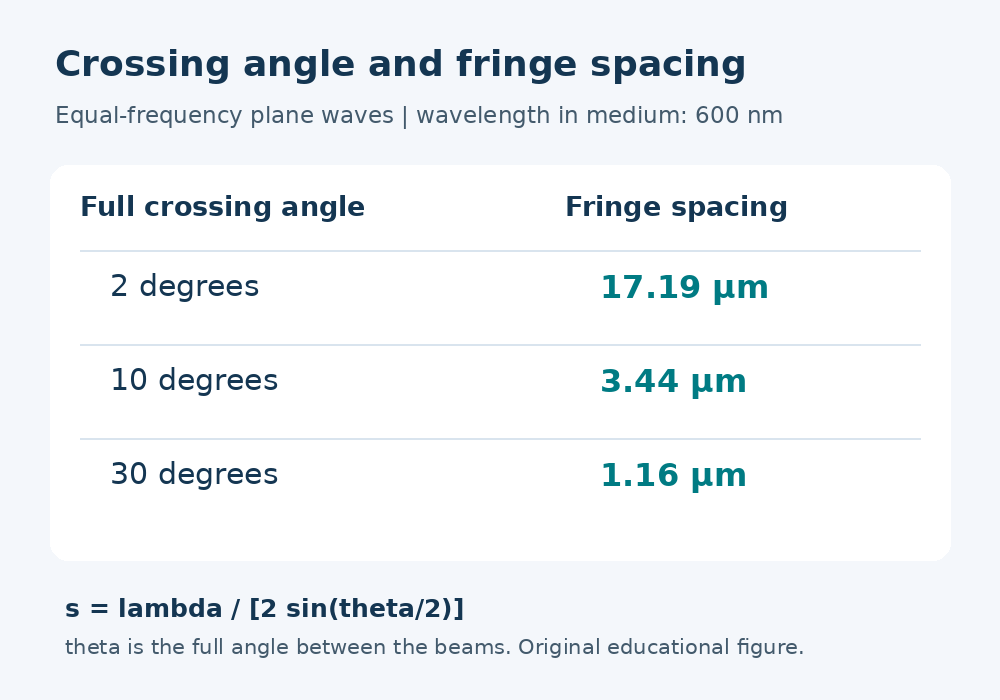
A full fringe period corresponds to a relative phase change of 2 pi. The resulting spacing is s = lambda/[2 sin(theta/2)]. Here theta is the full angle between the beams, not the angle of either beam relative to the central direction.
This distinction matters because each beam is tilted by only theta/2 in the symmetric construction. Inserting the half-angle as though it were the full crossing angle would produce a different spacing. A numerical angle should therefore come with its geometric definition.
Follow the geometry with three angles
Choose a wavelength in the medium of 600 nanometres. At a full crossing angle of 2 degrees, the calculated fringe spacing is about 17.19 micrometres. That is nearly 29 wavelengths, even though the interference comes from light with a wavelength of only 0.60 micrometres.
At a full crossing angle of 10 degrees, the spacing becomes about 3.44 micrometres. At 30 degrees, it becomes about 1.16 micrometres. The wavelength has not changed. The larger crossing angle creates a larger wavevector difference and a more rapid spatial change of relative phase.
The values refer to spacing in the defined fringe direction. If a screen cuts the fringe pattern at another orientation, a distance measured along that screen may include a geometric projection. The observation plane must be specified before comparing a measured spacing with the formula.
A small-angle approximation needs radians
When theta is small and expressed in radians, sin(theta/2) is approximately theta/2. The spacing then becomes approximately lambda/theta. This simplified form is useful near parallel propagation.
The angle must not be inserted numerically in degrees into that approximation. For example, 2 degrees is about 0.0349 radians. Using 0.60 micrometres divided by 0.0349 gives about 17.19 micrometres, consistent with the more complete expression at the stated precision.
As the crossing angle approaches zero, the predicted spacing grows. At exactly zero angle, the transverse fringe variation of this symmetric model disappears. It is clearer to describe a spatially uniform relative phase there than to imagine a finite screen displaying an ordinary fringe of infinite width.
Geometry alone does not ensure visible contrast
The expression describes the spatial phase relation under the model assumptions. Observing a stable intensity pattern also requires temporal and spatial overlap, sufficient mutual coherence and non-orthogonal polarization states.
Unequal beam intensities can reduce the contrast. Finite beam sizes limit how much of the ideal plane-wave pattern is illuminated. Frequency differences can make the pattern move rather than remain stationary. These effects do not turn the crossing angle into a wavelength, but they do change what an observation shows.
The useful reading habit is to keep wavelength, full crossing angle, fringe direction and observation plane separate. A fringe spacing becomes meaningful when the geometry supporting it is stated.
Academia Master Trader supports clear definitions and visible assumptions when learning physical relationships. Explore the structure at academiamastertrader.com.br and continue with Aprenda.