The position of a maximum is different from its value and from the identity of its record
A search for the largest number can return the number itself or the position where it occurs. Those answers serve different purposes. A value describes magnitude. A position describes where to look within a particular arrangement of observations.
Neither answer automatically names the underlying record. To connect the largest value with a date, product or other identifier, the relationship between the numeric sequence and its associated fields must remain intact.
One largest value can occupy several positions
Consider the sequence four, nine, two, nine and six. Its maximum value is nine. With zero-based indexing, nine occurs at positions one and three. A procedure that returns only the first maximum position reports one.
The returned one is not the maximum value. It is the index of the first occurrence selected by the procedure. Reading the element at that index recovers nine, provided the sequence has not changed between the search and the lookup.
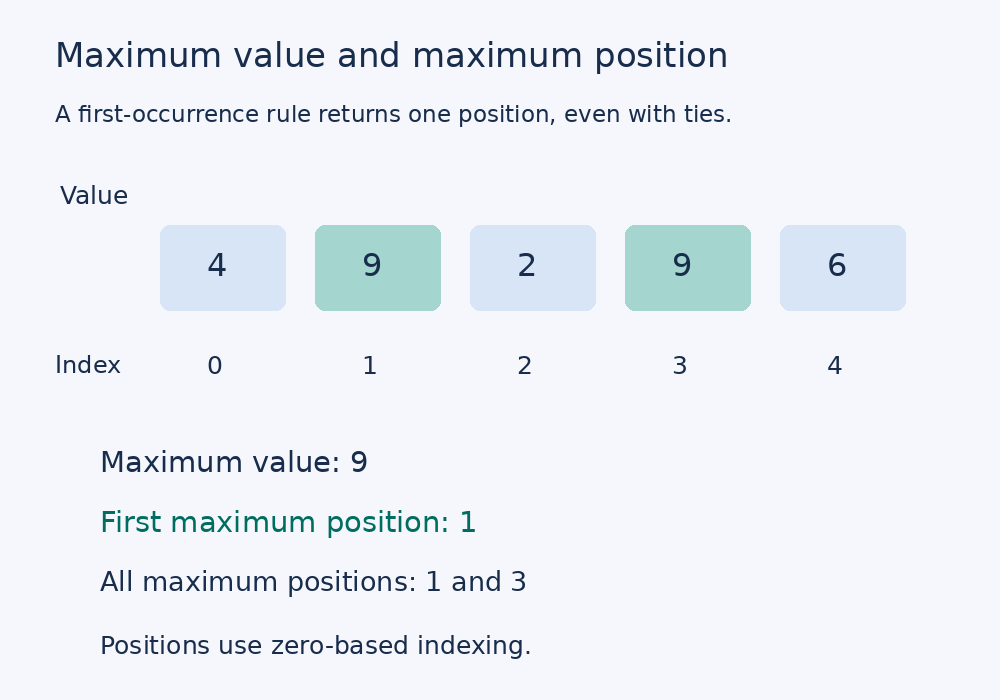
The word first also needs context. It refers to the order in which the sequence is examined. If the records are rearranged, another record with the same maximum value may become the first occurrence. The numeric maximum remains nine while the selected record can change.
A single returned index therefore does not prove that the maximum is unique. When every tied record matters, the workflow needs a way to identify all positions equal to the maximum rather than retaining only the first one.
An index belongs to a particular arrangement
Suppose each number belongs to a labeled record. Position one identifies the second element in the current sequence, not a permanent record identifier. Sorting, filtering or inserting rows can change which record occupies that position.
A stable identifier can preserve the connection across those changes. The index can help retrieve the identifier at the moment of the search, but the two should not be stored or presented as though they were interchangeable.
This distinction also matters when a table displays row numbers beginning at one while a calculation uses indices beginning at zero. Index one corresponds to the second displayed element under that convention. The numbering system should be stated before the result is interpreted.
A table adds a choice of direction
For a table with several rows and columns, a maximum search may operate within each row, within each column or across all elements. Each choice answers a different question and can produce a differently shaped result.
A search within each row returns a column position for that row. A search within each column returns a row position for that column. Those positions are local to the selected direction; they do not by themselves provide a complete pair of row and column coordinates.
A search across a flattened view can return one index into a single sequence. Turning that number back into table coordinates requires the table shape and the flattening convention. A flat index should not be read directly as a row number.
The comparison needs a meaningful variable
The largest number is useful only when the values are comparable. Searching across columns that mix temperature, distance and counts may produce an integer position, but that does not give the selected magnitude a common meaning.
Even within one variable, the maximum identifies an extreme of the available observations. It does not establish why that observation is large, whether it is typical or whether the same ordering will hold in another collection.
Missing or special values also need an explicit handling rule. Different procedures can treat them differently. Before interpreting a returned position, confirm which observations were eligible and how missing entries were handled.
Preserve the tie rule in the explanation
An output such as maximum value nine, first occurrence at zero-based index one makes the main distinction visible. If the application also needs the record identity, that identity should be retrieved from the associated record rather than inferred from the number one.
When ties are resolved by an additional criterion, such as an earlier timestamp, the criterion becomes part of the selection rule. It should be applied deliberately instead of being silently replaced by whichever record happens to appear first.
A clear result keeps magnitude, location and identity separate. This makes it possible to use an index for its intended purpose without giving a single selected position more meaning than the calculation supports.
Academia Master Trader shares educational material about data, ordering and numerical interpretation at academiamastertrader.com.br.