The same optical power can produce different peak intensities across a beam
A power reading tells us how much optical energy crosses a surface each second. It does not, by itself, tell us how that power is distributed across the beam. A broad beam and a narrow beam can carry the same total power while having very different intensities near their centers.
The transverse profile matters as well as the width. A uniform circular profile and a Gaussian profile do not put the same fraction of their power near the axis. Before dividing a power by an area, it helps to identify which area and which kind of intensity the calculation is supposed to describe.
Power and local intensity answer different questions
Here, optical intensity means power per unit area through a plane perpendicular to the propagation direction. Its units can be watts per square meter. Total optical power is measured in watts and is obtained by integrating that intensity over the whole transverse plane.
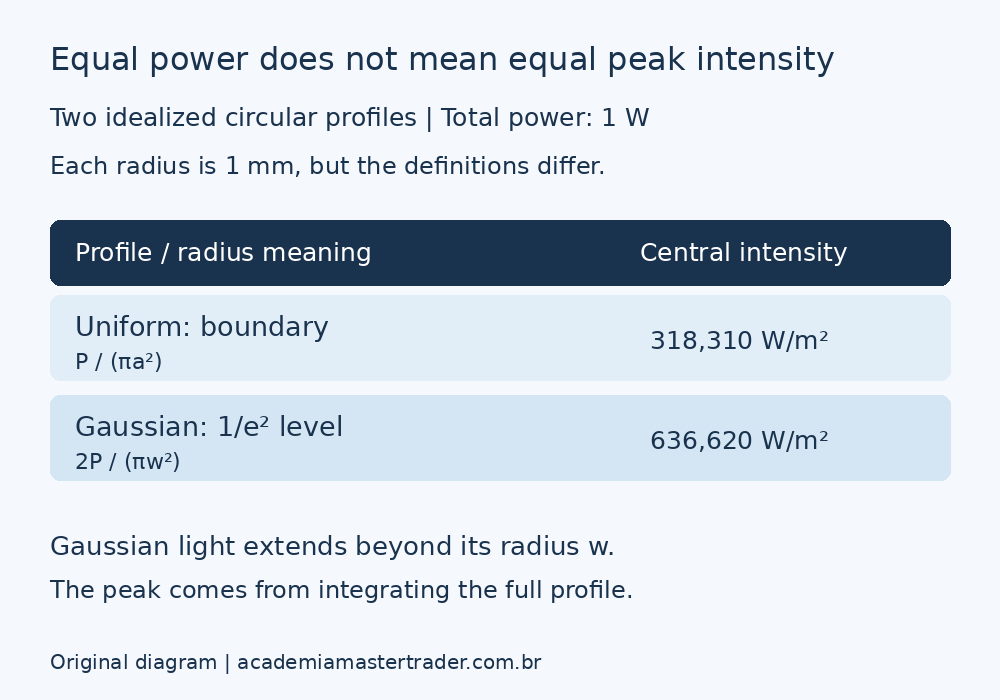
For a uniform circular beam with radius a and zero intensity outside its circular boundary, the intensity inside is P divided by πa². It has the same value at every point inside that idealized circle. The boundary is part of the model, rather than a universal feature of a real beam.
A Gaussian beam is different. Its intensity decreases smoothly with distance from the axis. The conventional radius w is the distance at which the intensity reaches 1/e² of its central value, about 13.5 percent. The profile continues beyond that radius, so the circle of radius w does not contain all the power.
The Gaussian peak contains a factor of two
For a circular Gaussian intensity profile, the central intensity is I0 = 2P / (πw²). The radial dependence is I(radius) = I0 exp[-2r²/w²]. Integrating this profile over the entire transverse plane gives the total power P and fixes the factor of two in the peak formula.
Using P / (πw²) instead gives half the Gaussian peak. It is a convenient power-to-area ratio, but it is not the intensity on the axis. The distinction is about the profile and its normalization, not about a change in the measured total power.
Consider two mathematical examples with P = 1 watt. A uniform circular profile with a = 1 millimeter has an intensity of about 318,310 watts per square meter inside its boundary. A Gaussian profile with w = 1 millimeter has a central intensity of about 636,620 watts per square meter.
The numerical radius and total power match in those examples, but the meaning of the radius does not. One radius marks the uniform model's boundary; the other marks a specified level on a smooth Gaussian profile. The comparison illustrates that a width number needs a profile definition alongside it.
Changing the radius changes the peak quadratically
Within the circular Gaussian model, keeping P fixed while doubling w reduces the peak intensity to one quarter. Halving w raises it by a factor of four. This follows directly from the squared radius in the denominator and does not require any increase in total power.
Radius and diameter must also stay distinct. If a reported width is a diameter, its radius is half that number. Substituting a diameter into a formula that requires w would make the calculated peak four times smaller than the value obtained with the proper radius.
These are relationships within a specified model. They are not device settings or promised operating results. A beam with an uneven profile or several transverse modes may have peaks away from the axis and needs a description suited to its actual spatial distribution.
Spatial peaks and temporal peaks are separate
For a steady beam, the discussion above concerns variation across space. For a pulsed beam, power also varies with time. Average power alone cannot determine the largest instantaneous intensity without information about the temporal profile as well as the spatial profile.
A clear description therefore names the measured power, the width convention, the transverse profile and whether the power is steady, average or time-dependent. Those details keep an integrated quantity separate from a local one and make comparisons between beam specifications much more meaningful.
Continue learning at academiamastertrader.com.br and on the Aprenda page.