The same RMS voltage and current can deliver different average power when their phase changes
Multiplying an alternating voltage by an alternating current requires more care than reading two meter values. Two loads can have the same RMS voltage and RMS current yet absorb different average power. The missing information is how the voltage and current line up in time. For sinusoidal signals at the same frequency, their phase difference supplies that information.
This is a useful distinction between the size of a changing quantity and its relationship with another quantity. RMS values describe effective magnitudes. They do not, by themselves, describe whether large positive voltage coincides with positive current, or whether part of each cycle returns energy from the load toward the source.
Start with instantaneous power
Using the passive sign convention, current is positive when it enters the terminal marked positive for voltage. The instantaneous power absorbed by a load is p(t) = v(t)i(t). Positive power means energy enters the load. Negative power means energy leaves the load at that moment. The average is found over a whole cycle, rather than from one selected instant.
Let v(t) = √2 Vrms cos(ωt) and i(t) = √2 Irms cos(ωt − φ). Here φ is the current lag relative to voltage, and both signals are pure sinusoids in steady state. Their average power is P = Vrms Irms cos φ. The factor cos φ is the power factor for this sinusoidal case.
The product Vrms Irms is called apparent power, S, and is expressed in voltamperes, VA. Average active power P is expressed in watts, W. Both have the same physical dimensions, but the different unit names keep their roles clear. They coincide numerically when the power factor is one; they need not coincide otherwise.
A comparison with fixed RMS values
Suppose a theoretical load has 120 V RMS across it and carries 2 A RMS. Its apparent power is 240 VA. If voltage and current are in phase, φ = 0° and P = 240 W. This is the behavior of an ideal resistor with these values.
Now compare a different load with the same RMS values but a 60° phase lag. Since cos 60° = 0.5, the average active power is 120 W. Neither RMS reading has changed. What changed is the timing of the current relative to the voltage, and therefore the average of their instantaneous product.
For an ideal purely reactive load with a 90° phase difference, the average is zero. That does not mean its current is zero. It means that the energy absorbed during parts of a cycle is returned during other parts, leaving no net energy absorbed over a complete cycle. Real components can also dissipate energy and are not perfectly reactive.
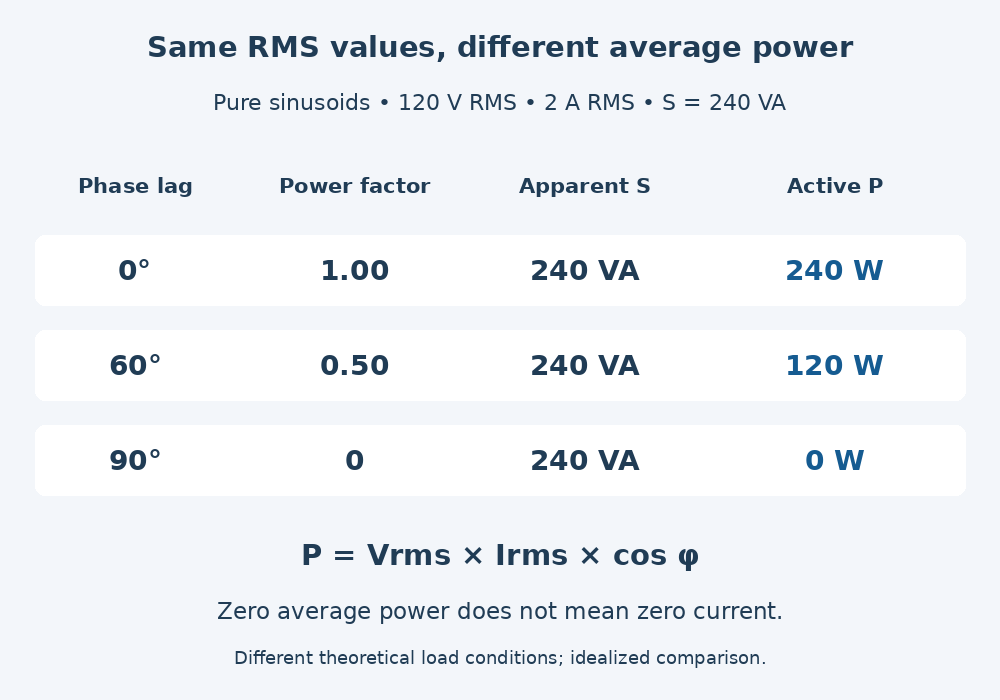
These are three different load conditions, not a claim that one unchanged resistor can freely choose its phase. Keeping both RMS values fixed while changing the phase generally requires a different impedance. The comparison isolates the role of timing without treating the loads as identical devices.
The cycle contains more than its average
Multiplying the two sinusoidal expressions gives p(t) = S[cos φ + cos(2ωt − φ)]. The first term sets the average. The second oscillates at twice the electrical frequency and averages to zero over a complete cycle. This explains how a steady average power can coexist with a changing instantaneous power.
For the 60° case, p(t) ranges from −120 W to 360 W, while its average is 120 W. A negative interval describes energy returning under the chosen sign convention. It does not contradict a positive net transfer over the whole cycle. For the in-phase resistor, the range is instead 0 W to 480 W, with an average of 240 W.
Energy also needs a time interval. If the 60° condition remains steady for 10 seconds, the net energy absorbed is 120 W × 10 s = 1200 J. Multiplying 240 VA by 10 seconds does not give the net absorbed energy in that case. Apparent power is not a substitute for average active power in that calculation.
Keep the sinusoidal assumption visible
The simple power-factor expression cos φ assumes sinusoidal voltage and current at the same frequency. With distorted waveforms, true power factor is still P/(Vrms Irms), but a single phase angle generally does not capture every effect. The RMS definitions remain useful; the shortcut needs its stated conditions.
This is a conceptual comparison, not wiring advice or a claim about a particular appliance. Its central lesson is narrow: before turning RMS readings into watts, check whether voltage and current are in phase and whether the sinusoidal model applies.
Continue your educational path at academiamastertrader.com.br and on the Aprenda page.