The uncertainty principle gives a lower bound, not an automatic equality
For position and momentum along the same axis, the quantum uncertainty relation is σxσp ≥ ℏ/2. It limits the product of two spreads associated with a quantum state. It does not say that every state has exactly the smallest allowed product.
That inequality sign matters. If a position spread is known, we can calculate a lower bound for the momentum spread. We cannot claim to have found the actual momentum spread unless we also know enough about the state.
Define what the spreads mean
Here σx is the standard deviation of position and σp is the standard deviation of the momentum component along that same x axis. The constant ℏ is the reduced Planck constant, equal to h/(2π).
A standard deviation describes the width of a probability distribution around its mean. It is not the same as the largest possible deviation, the full width of a distribution, or an instrument's smallest scale division.
The relation concerns the distributions predicted for measurements on identically prepared quantum systems. Position measurements and momentum measurements can be made on separate sets with the same preparation. We do not need to assign both outcomes to one undisturbed particle in a single measurement.
Keeping this statistical meaning explicit prevents a common mix-up. A statement about quantum state spreads is not simply a statement about poor laboratory equipment or a careless measurement technique.
Read the inequality in the right direction
For a finite, positive position spread, rearranging the relation gives σp ≥ ℏ/(2σx). The quantity on the right is a lower bound.
If σx is reduced by half, that lower bound doubles. The new state must still lie on or above the allowed boundary. Its actual momentum spread might be larger than the bound.
The reverse statement needs care too. A broad position distribution allows a small momentum spread, but does not require one. Large spreads in both quantities are compatible with the inequality.
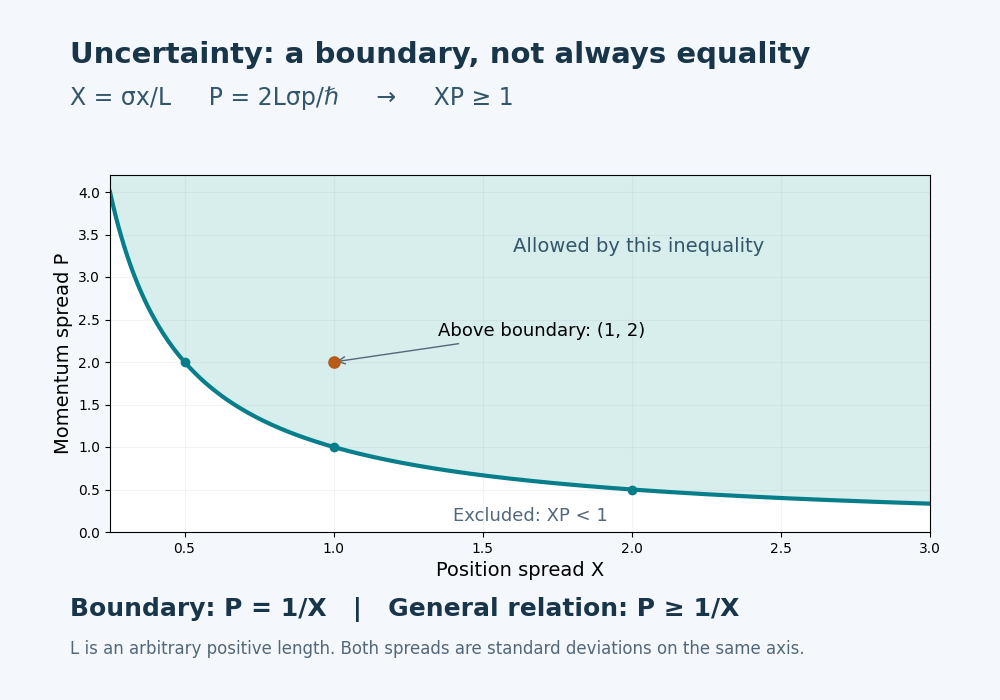
The figure uses dimensionless ratios so that this distinction is visible without choosing a particular particle or a numerical value for Planck's constant.
Build a useful comparison scale
Choose an arbitrary positive reference length L. Define X = σx/L and P = 2Lσp/ℏ. Substituting these definitions into the uncertainty relation gives XP ≥ 1, or P ≥ 1/X.
At X = 1, the minimum allowed P is one. At X = 0.5, the minimum is two. At X = 2, the minimum is one half.
These numbers describe the boundary curve. A point such as X = 1 and P = 2 also satisfies the uncertainty relation because its product is two. It lies above the boundary rather than on it.
The area below the curve is excluded by the relation. Being above the curve passes this particular condition, although the inequality alone is not a complete description of a quantum state.
Equality needs a suitable state
A suitable minimum-uncertainty Gaussian wave packet can attain σxσp = ℏ/2. This is an important example, not a license to replace the inequality with an equality in every problem.
Other states have larger products. Even a familiar-looking probability curve does not by itself specify every feature of the wave function needed to determine both spreads.
If a question explicitly asks for the minimum momentum uncertainty compatible with a given σx, using ℏ/(2σx) is appropriate. If it asks for the actual uncertainty of a specified state, the state's momentum distribution or equivalent wave-function information must be used.
Writing the word minimum beside the result keeps those two tasks separate. It also makes clear which conclusion came from the bound and which would require more information.
Do not confuse the mean with the spread
A mean momentum of zero does not imply zero momentum uncertainty. A distribution can be centered on zero while containing both positive and negative momentum outcomes.
Likewise, moving the center of a position distribution does not necessarily change its width. The uncertainty relation concerns spreads, not simply where the average position or average momentum happens to be.
Start by naming the axis and defining the standard deviations. Then keep the inequality until a minimum-uncertainty assumption is justified. This makes the principle a precise statement about quantum distributions rather than a vague claim that nothing can be measured.
Academia Master Trader offers educational content at academiamastertrader.com.br.