Thermal radiation emitted by a surface is not the same as its net heat transfer
A warm surface emits thermal radiation, but it also absorbs radiation arriving from its surroundings. The emitted power alone is therefore not generally the net rate at which the surface transfers energy outward. A complete radiative balance must account for both directions.
This distinction matters even at thermal equilibrium. A surface can emit substantial power while absorbing the same amount, leaving zero net radiative transfer. Zero net transfer does not mean that emission has stopped.
Begin with the power emitted
For an idealized gray surface of area A at absolute temperature T, the Stefan-Boltzmann law gives the emitted power as Pemit = εσAT⁴. The symbol ε is emissivity and σ is the Stefan-Boltzmann constant.
Emissivity is dimensionless. In this model it lies between zero and one, with one describing a blackbody. The constant σ is approximately 5.67 × 10⁻⁸ W/(m²·K⁴). Temperature must be in kelvin.
Calling the surface gray means treating its radiative properties as independent of wavelength over the range relevant to the model. Real materials can have wavelength-dependent properties, so an effective emissivity must suit the conditions being considered.
The fourth power belongs to absolute temperature. Doubling T while keeping A and ε fixed multiplies emitted power by sixteen. Doubling a numerical temperature in degrees Celsius does not support that conclusion.
Add the radiation absorbed from the surroundings
Consider a small opaque gray object completely enclosed by much larger blackbody surroundings at a uniform temperature Ts. Assume the object's surface is at a uniform temperature T and that its emissivity can be treated as constant.
For this model, the absorbed power is Pabs = εσATs⁴. The outward net radiative power is therefore Pnet,out = εσA(T⁴ − Ts⁴).
The sign convention is explicit: a positive value means net energy transfer outward from the object. If T exceeds Ts, the value is positive. If T equals Ts, it is zero. If T is below Ts, the negative value indicates net radiative heating of the object.
This expression is not simply the Stefan-Boltzmann emission formula with a different label. It subtracts the absorbed incoming radiation. More complex surroundings, partial enclosure, or several surfaces at different temperatures can require a more detailed radiation model.
Compare emission and net transfer with one example
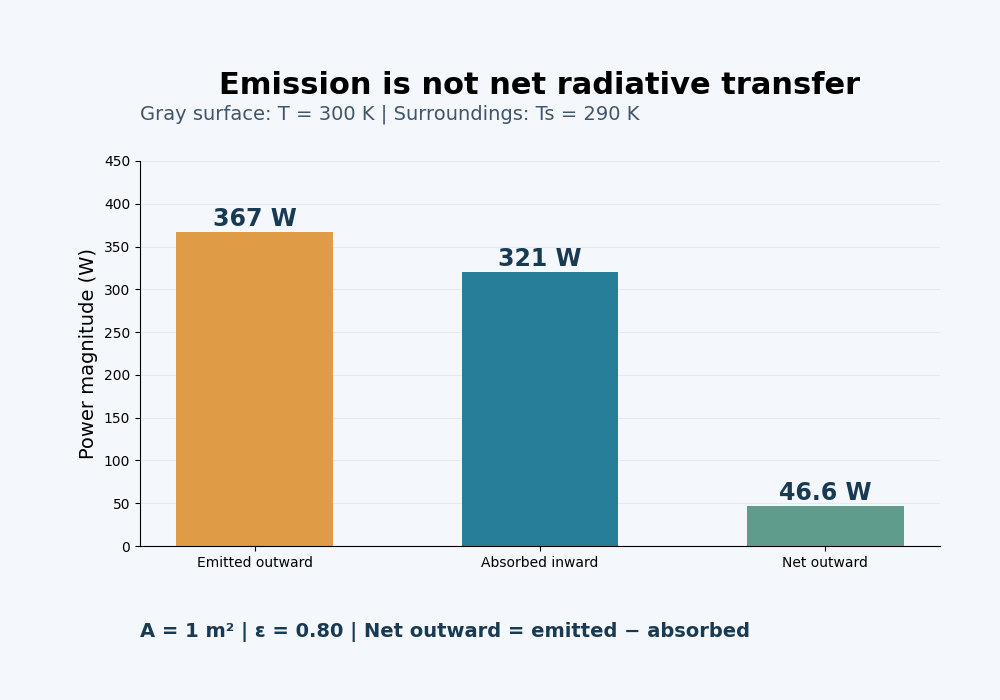
Take a hypothetical gray surface with A = 1 m², ε = 0.80, and T = 300 K, enclosed by surroundings at Ts = 290 K. Using the rounded value of σ above, its emitted power is approximately 367 W.
Its absorbed power is approximately 321 W. The outward net radiative transfer is only about 46.6 W, the difference between those two larger values.
If the surroundings instead rise to 300 K while the object's temperature remains 300 K, the emitted power stays approximately 367 W. Absorption also becomes approximately 367 W, making the net radiative power zero.
The object has not become a surface that does not radiate. The incoming and outgoing transfers have become equal. The example is a calculation within the stated enclosure model, not a measured product rating.
Do not raise a temperature difference to the fourth power
The correct difference is T⁴ − Ts⁴, not (T − Ts)⁴. These expressions are mathematically different. For the example, the surface-to-surroundings difference is 10 K, but inserting 10⁴ would not reproduce the balance.
A useful factorization is T⁴ − Ts⁴ = (T − Ts)(T + Ts)(T² + Ts²). It makes clear that the result depends on both the temperature difference and the absolute temperature level.
Two pairs of temperatures with the same difference can therefore produce different net radiative powers. The area and emissivity must also remain fixed for a meaningful comparison.
For a sufficiently small temperature difference around a common absolute temperature T0, a first-order approximation gives T⁴ − Ts⁴ ≈ 4T0³(T − Ts). That approximation has a limited range; it does not replace the full expression in every calculation.
Keep radiation separate from the full energy balance
An object can also exchange energy through conduction and convection. The net radiation calculated here is only one contribution. It is not automatically the total heating or cooling power of the object.
Finding how quickly its temperature changes would additionally require information about energy storage and all relevant transfers. A radiation formula by itself does not determine a cooling time.
The reliable sequence is to name the model, calculate emission and absorption consistently, and state the sign of their difference. A surface can radiate strongly while its net radiative transfer is small or zero.
Academia Master Trader presents educational material at academiamastertrader.com.br.