Time dilation starts by identifying the clock that measures proper time
A time-dilation calculation needs more than a speed and a formula. It needs two clearly identified events and a statement of which clock is present at both. That clock supplies the proper time for the comparison considered here.
In special relativity, two inertial frames can assign different time intervals to the same pair of events. This does not require a faulty clock. The difference follows from how time and position measurements relate between frames in relative motion.
Choose two events at one moving clock
Imagine a clock carried by a spacecraft moving at constant speed relative to a laboratory. Event A is one tick of that clock. Event B is a later tick of the same clock. We ignore gravitational effects and any acceleration during this interval.
In the spacecraft's rest frame, both events happen at the same location. The clock stays beside itself, so it directly records the interval between A and B. We call this interval Δτ, the proper time.
In the laboratory frame, the clock moves between those two ticks. Events A and B therefore occur at different laboratory positions. The laboratory assigns a coordinate-time interval Δt using its synchronized clock system.
The events have not changed. What changes is the reference frame used to assign their times and positions. Keeping the event pair fixed is essential when comparing the two intervals.
The Lorentz factor connects the intervals
For this constant-velocity comparison, Δt = γΔτ, where γ = 1/√(1 – v²/c²). Here v is the speed of the spacecraft relative to the laboratory, and c is the speed of light in vacuum.
For a massive clock moving below light speed, γ is at least one. If v is nonzero, the laboratory coordinate-time interval is larger than the proper-time interval recorded by the spacecraft clock.
This means fewer spacecraft-clock seconds pass during a given laboratory interval than would pass on a laboratory clock at rest. It does not mean that the person beside the spacecraft clock experiences their own seconds as stretched or defective.
At speeds much smaller than c, the factor is very close to one. The difference becomes larger as v approaches c, but the formula does not provide a rest frame for a photon or a way for a massive clock to reach light speed.
A numerical example with both clocks named
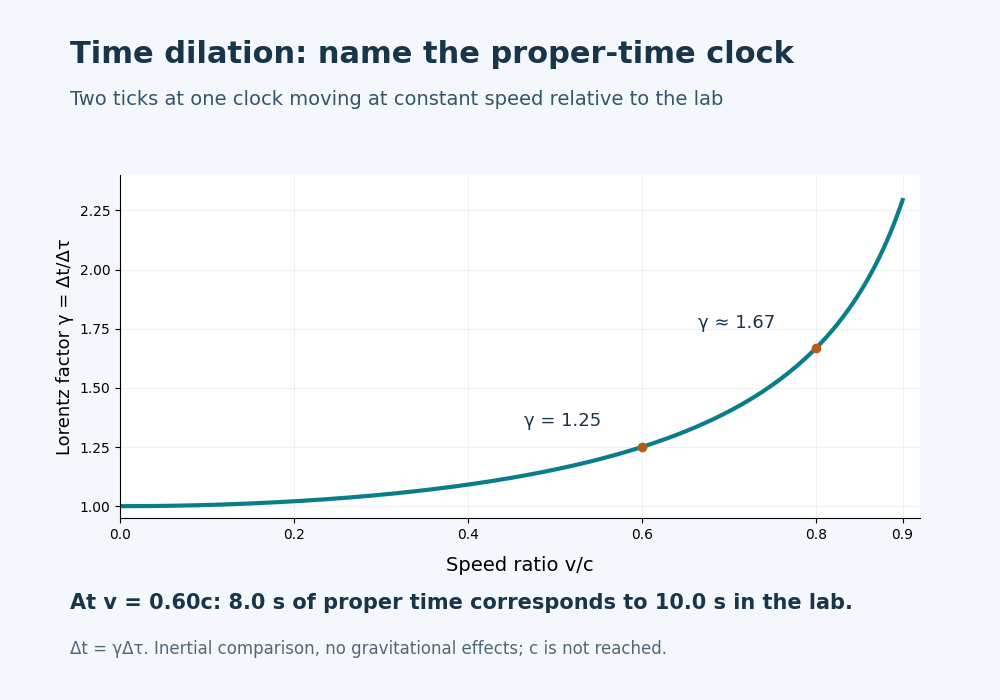
Let the spacecraft clock record Δτ = 8.0 s between the chosen ticks. If the laboratory measures its speed as 0.60c, then γ = 1/√(1 – 0.36) = 1.25.
The laboratory assigns Δt = 1.25 × 8.0 s = 10.0 s to the same two events. The proper-time clock records eight seconds while ten seconds of laboratory coordinate time separate those events.
The reverse calculation is equally useful. If the laboratory interval is given as 10.0 s, dividing by 1.25 yields the spacecraft clock's 8.0 s. Multiplying instead would use the relationship in the wrong direction.
The graph plots γ, not either clock's absolute reading. At 0.80c, the factor is approximately 1.67. To obtain an interval, multiply the proper time by the factor for the stated speed.
This is not simply a signal-arrival delay
A distant observer may receive light signals from the moving clock at intervals affected by the changing travel distance. Those raw arrival intervals involve an additional signal-propagation issue.
Time dilation compares intervals assigned within reference frames after the measurement procedure accounts for where and when the events occur. A camera recording received flashes does not automatically display Δt without further analysis.
Separating these ideas prevents a common mix-up: the relativistic relationship between clock rates is not merely the delay caused by light taking time to reach an observer.
Do not switch the event pair halfway through
An observer in each inertial frame can describe the other frame's clocks as running slowly. Applying that statement consistently requires attention to simultaneity and to which events are being compared.
Our calculation follows two ticks of one spacecraft clock. It is not a complete analysis of a journey that turns around and reunites two travelers. Such a journey needs its separate path segments and frame changes accounted for.
Start with the events, identify the clock present at both, and label its reading as proper time. Then state the relative speed and use Δt = γΔτ. With those choices visible, the arithmetic becomes short and the physical meaning stays attached to the correct clocks.
Academia Master Trader offers educational content at academiamastertrader.com.br.