Total internal reflection needs more than a large incident angle
A ray meeting a transparent boundary at a large angle does not automatically undergo total internal reflection. The direction of travel between the two media matters as well. In the simple optical model considered here, the light must approach the boundary from the higher refractive index side, and its incident angle must exceed the critical angle.
We will use a flat boundary between transparent, nonabsorbing media with ordinary positive refractive indices. Angles are measured from the normal, the line perpendicular to the boundary. These conditions keep the discussion focused on the usual ray description of total internal reflection.
Begin with the two refractive indices
Let n1 describe the medium containing the incoming ray and n2 the medium on the other side. Snell's law relates the incident and refracted angles through n1 sin θ1 = n2 sin θ2.
When n1 is greater than n2, the refracted ray bends away from the normal. Its angle θ2 is larger than the incident angle θ1. Increasing θ1 then brings the refracted direction closer to the boundary.
The critical angle is the incident angle for which the refracted angle reaches 90 degrees. In the ray description, that limiting refracted direction lies along the boundary. It does not point straight through the boundary along the normal.
Calculate the threshold before comparing angles
Setting sin θ2 equal to one gives sin θc = n2/n1. Thus θc = arcsin(n2/n1), with the condition n1 greater than n2.
For an illustrative pair n1 = 1.50 and n2 = 1.00, the critical angle is approximately 41.8 degrees. These are assumed model values, not a claim about the exact refractive index of every sample of a named material.
At an incident angle of 30 degrees, Snell's law gives a refracted angle of approximately 48.6 degrees. The ray is below the critical threshold, so there is a propagating refracted ray as well as reflection at the boundary.
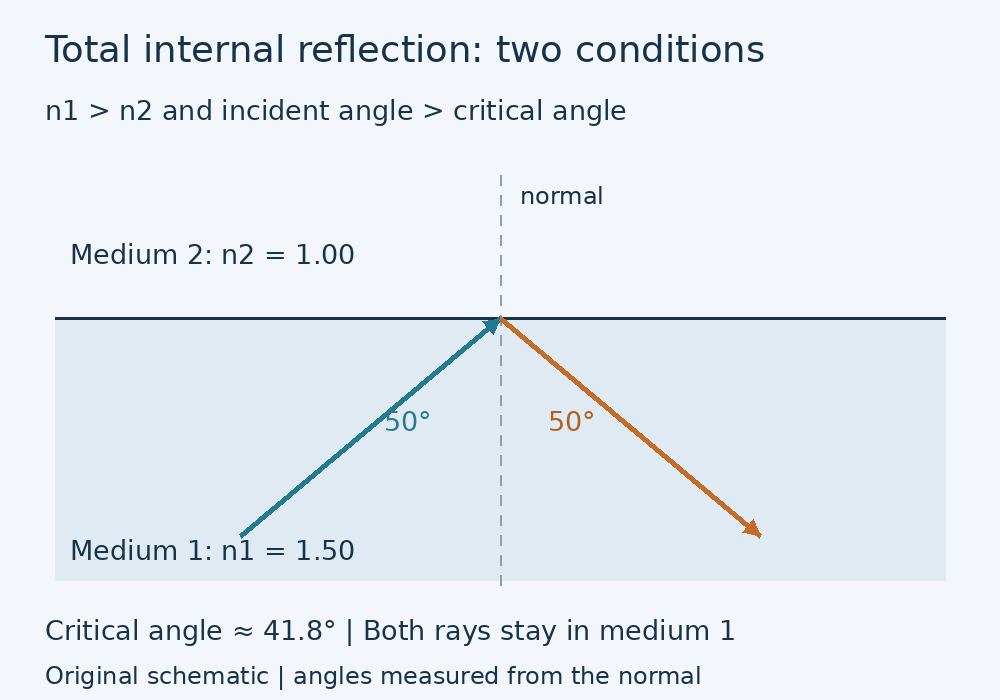
At an incident angle of 50 degrees, the same calculation would require sin θ2 to be greater than one. There is no real refracted-ray angle with that value. The incident ray is above the critical angle and undergoes total internal reflection in this model.
Equality is the limiting case
It helps to keep three cases separate: below the critical angle, at the critical angle, and above the critical angle. The usual condition for total internal reflection is θ1 greater than θc.
At equality, the refracted direction is the grazing limit of 90 degrees. Saying only that the incident angle is large hides the threshold and leaves the angle convention unclear.
In the figure, the incoming and reflected rays remain in medium 1. Their angles to the normal are equal, following the law of reflection. Total internal reflection changes whether there is a propagating refracted ray into medium 2; it does not replace the reflection-angle rule.
Reversing the media changes the conclusion
Now send a ray from n1 = 1.00 toward n2 = 1.50. The refracted ray bends toward the normal. The ratio n2/n1 is greater than one, so it cannot define a critical angle through the formula above.
There is no total internal reflection of this ordinary type in that direction, even if the incident angle is large. Partial reflection can still occur. The absence of total internal reflection does not mean that the boundary reflects no light at all.
This is why the word internal matters. The ray must be on the appropriate side of the index change, not merely near a transparent surface.
Keep the scope of the ray picture clear
The diagram describes directions, not the full electromagnetic field near the boundary. Saying that no propagating refracted ray carries energy away into medium 2 is more precise than imagining that every field must vanish there.
Real optical systems also depend on their materials, geometry, and surface conditions. The ideal example does not provide a universal efficiency figure for a finished device.
For a clear conclusion, identify the incoming medium, compare the two refractive indices, calculate the critical angle when it exists, and measure the incident angle from the normal. Those steps explain why one large angle can produce total internal reflection while another does not.
Academia Master Trader publishes educational material at academiamastertrader.com.br.