Turning a half-wave plate by 10 degrees can turn linear polarization by 20 degrees
The mechanical angle of a half-wave plate is not generally the same as the change in the direction of linear polarization. Under the right conditions, rotating the plate by a small angle produces twice that change in the output polarization direction. Understanding the reference directions makes this factor of two easier to use correctly.
Consider an ideal half-wave plate at its design wavelength. The input is linearly polarized, and the light travels along the intended direction through the plate. We describe all transverse orientation angles from the same fixed reference, viewed using one consistent convention along the beam.
A half-wave delay changes the relative phase
The plate has two perpendicular principal axes, commonly called the fast and slow axes. An input field can be resolved into components along those axes. An ideal half-wave plate introduces a relative phase delay of 180 degrees between the two components.
The output remains linearly polarized. Its direction is the reflection of the input polarization direction about either principal axis, with linear polarization directions understood modulo 180 degrees. An axis is a line, not an arrow with a unique forward end.
If the input direction is alpha and the fast-axis direction is beta, the output direction is alpha out = 2 beta minus alpha, modulo 180 degrees. This expression keeps both reference angles visible instead of treating the plate's dial reading as the output angle itself.
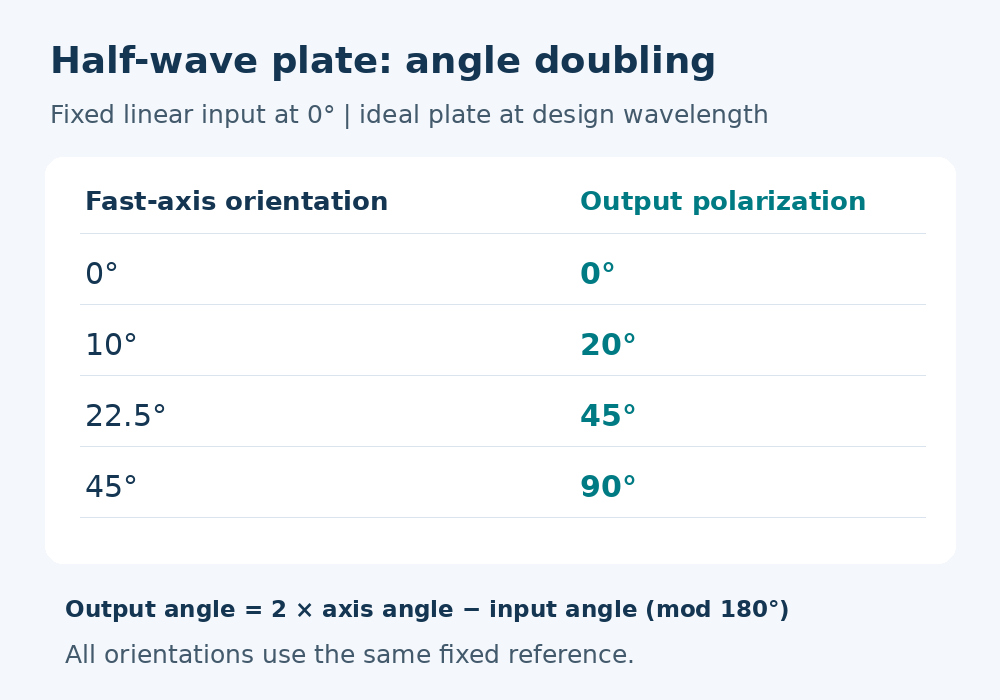
Keep the input fixed while rotating the plate
Set the input polarization direction to zero degrees. When the fast axis is also at zero degrees, the input lies along one principal axis, so the output polarization direction remains unchanged.
With the fast axis at 10 degrees, the output direction becomes 20 degrees. At a fast-axis orientation of 22.5 degrees, the output becomes 45 degrees. At 45 degrees, the output becomes 90 degrees, perpendicular to the original input direction.
These examples use the same fixed input. That condition matters. If the input direction changes as well as the plate orientation, the output must be calculated from both values. The simple statement about twice the plate rotation no longer describes the entire change by itself.
For example, take an input direction of 30 degrees and a fast axis at 40 degrees. The output is 50 degrees. The plate axis is 10 degrees from the input, and the output has turned by 20 degrees relative to the input. The output is not at 80 degrees merely because the plate axis reads 40 degrees.
A polarization rotation is not a beam steering angle
The angles above describe the direction of the electric field's linear oscillation in the transverse plane. They do not describe a 20-degree change in the direction that the beam travels.
A plate can change the polarization state while the beam continues along essentially the same propagation direction. Any lateral displacement or angular deviation caused by a particular real component belongs to a separate geometric description.
Likewise, an ideal half-wave plate is not a linear polarizer. It changes the relative phase between components rather than selecting one component and removing the other. The polarization direction can change without the ideal model requiring a corresponding reduction in total power.
The operating conditions still matter
The half-wave relation assumes the intended relative phase delay at the wavelength being used. A real plate has a specified wavelength range and acceptable incidence conditions. Its phase delay can depend on wavelength, temperature and construction.
If the retardance differs from a half wave, the output need not remain exactly linear. The neat angle relation is then not a complete description of the polarization state.
The useful habit is to label the input direction, plate-axis direction and output direction separately. State the common reference and the operating wavelength before interpreting a rotation. The factor of two then becomes a result of a defined optical model rather than a rule attached to any rotating piece of glass.
Academia Master Trader supports clear definitions and visible assumptions when learning physical relationships. Explore the structure at academiamastertrader.com.br and continue with Aprenda.