Two separated lenses do not always have the sum of their individual focusing powers
A pair of converging lenses can have the same individual focal lengths in two arrangements and still produce different equivalent focusing powers. The space between the lenses matters. Adding their powers is a useful approximation for thin lenses close together, not a rule that applies unchanged at every separation.
This distinction concerns dioptric power, the reciprocal of effective focal length. It does not concern the rate at which light carries energy. The word power appears in both contexts, so keeping the units visible helps keep the ideas separate.
Define power before combining lenses
For a thin converging lens in air, a positive focal length of 0.20 metres corresponds to a dioptric power of +5 reciprocal metres, or +5 dioptres. A second thin converging lens with a focal length of 0.50 metres has a power of +2 dioptres.
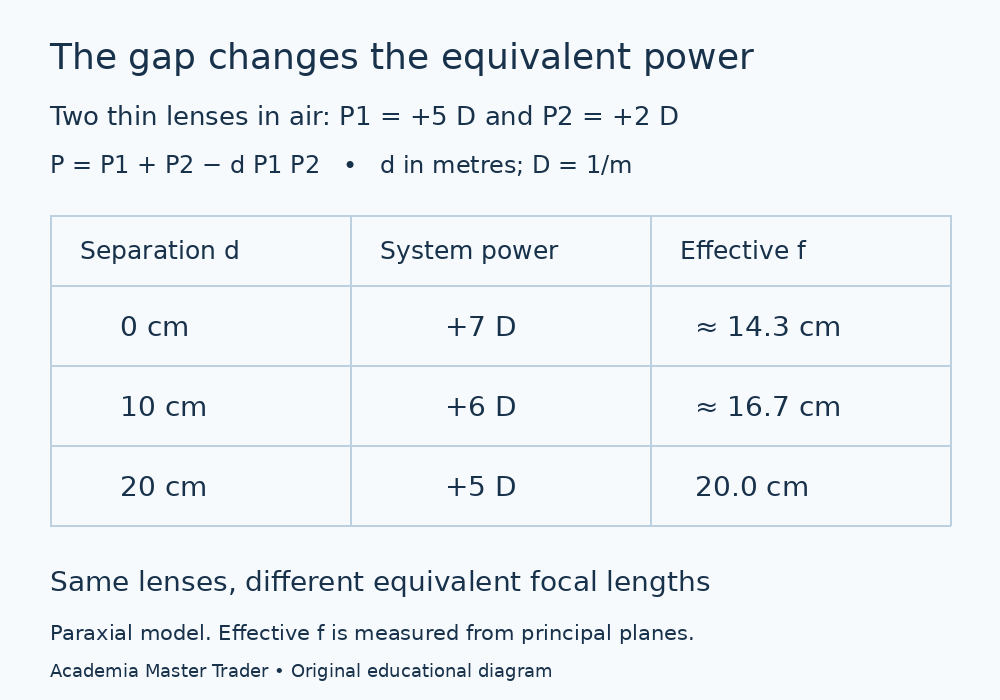
Write these powers as P1 and P2. When the lenses are effectively in contact, their equivalent power is P1 + P2. In this example that is +7 dioptres, giving an equivalent focal length of about 0.143 metres.
For two thin lenses separated by a distance d in air, the paraxial expression becomes P = P1 + P2 − d P1 P2. Here d is expressed in metres and both individual powers are expressed in reciprocal metres. The result is again in reciprocal metres.
Follow the separation term numerically
For the +5 and +2 dioptre lenses, the product P1 P2 is 10 reciprocal square metres. At a separation of 0.10 metres, the correction d P1 P2 is therefore 1 reciprocal metre. The equivalent power is +6 dioptres rather than +7.
The reciprocal of +6 dioptres is approximately 0.167 metres, or 16.7 centimetres. At a separation of 0.20 metres, the correction reaches 2 dioptres. The equivalent power is then +5 dioptres, with an effective focal length of 0.20 metres.
Nothing in this calculation changes the individual lens powers. The first lens remains +5 dioptres and the second remains +2. The different result describes the pair as a system, including the propagation distance between its elements.
Why a gap changes the combination
The second lens acts on rays after they have already travelled beyond the first lens. During that travel, their positions relative to the optical axis change. The second lens therefore encounters a different ray geometry when its position changes, even though its own optical properties remain the same.
The separation term captures that interaction within the thin-lens paraxial model. It is not a subtraction of transmitted energy. A lower equivalent dioptric power does not mean that a corresponding fraction of optical watts has disappeared.
The sign of the correction also depends on the individual lens powers. The positive-positive example shown here should not be carried over unchanged to every combination of converging and diverging lenses. The signed expression, with its stated convention, is the appropriate starting point.
Effective focal length is not a distance from any chosen surface
A two-lens system has principal planes that generally do not coincide with the lens surfaces. Its effective focal length describes the system through those reference planes. It should not automatically be interpreted as the distance from the second lens to the focus of incoming parallel rays.
A calculation of a physical image position requires the corresponding reference information. Likewise, thick lenses, other surrounding media, and larger ray angles require a model appropriate to those conditions. The numbers in the table illustrate thin lenses in air and small angles around a common axis.
The useful habit is to state the individual powers, the separation and the model before giving a combined value. A simple addition then remains available where its approximation fits, without becoming a universal rule.
Academia Master Trader encourages clear definitions and visible assumptions when learning physical relationships. Explore the structure at academiamastertrader.com.br and continue with Aprenda.