Two standard deviations can differ because they divide by different counts
A standard deviation describes spread around a mean. Its calculation includes a choice that is easy to overlook: the denominator used before taking the square root. Two programs can use the same observations and still return different standard deviations if their denominator conventions differ.
The difference does not automatically indicate a transcription mistake or a broken calculation. It may mean that one result divides the sum of squared deviations by the number of observations, while the other divides by one less. A useful comparison starts by identifying that convention.
Three values make the distinction visible
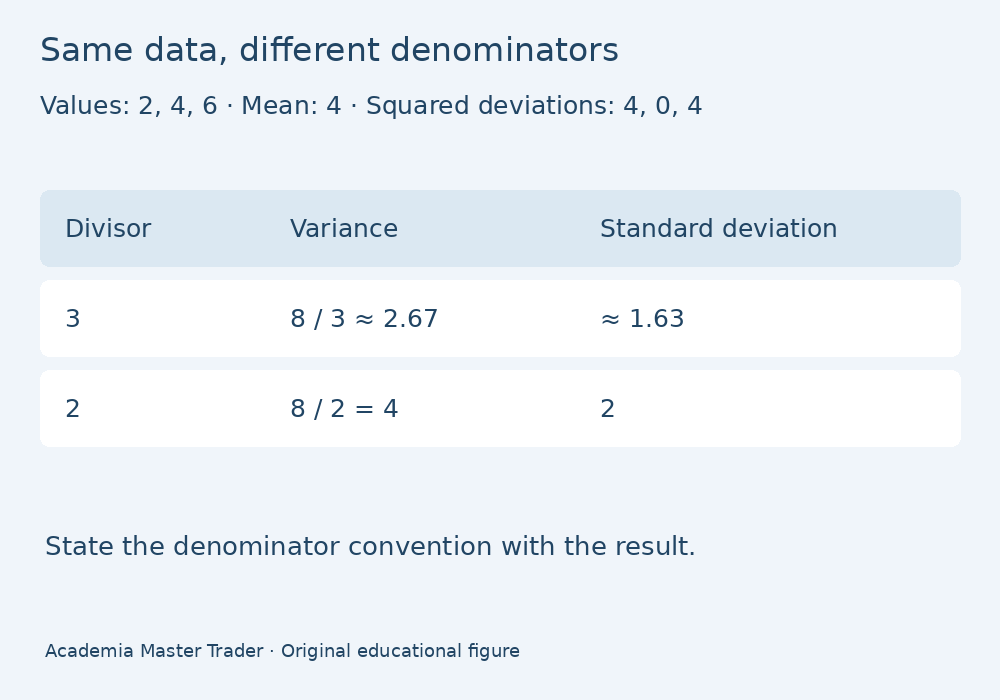
Consider the values two, four and six. Their mean is four. The deviations from that mean are minus two, zero and two. Squaring those deviations gives four, zero and four, with a total of eight.
Dividing eight by three gives a variance of about 2.67. Its square root is about 1.63. Dividing the same total of eight by two gives a variance of four and a standard deviation of two. The input values and their mean are identical in both calculations. Only the denominator has changed.
The intermediate variance and the final standard deviation should not be confused. Variance has squared units; standard deviation returns to the unit of the original observations. In this numerical example, the values have no assigned physical unit, so the illustration focuses on the arithmetic.
The denominator follows the purpose
Dividing by the full count describes the spread of the listed values using that count as the denominator. It is often called the population convention. This label should not be taken to prove that a dataset actually contains every member of a real population. The calculation alone cannot establish how the data were collected.
Dividing by one less than the count is commonly used when a sample is used to estimate a population variance and the mean has been estimated from that same sample. Under the relevant sampling assumptions, the resulting variance estimator is unbiased. That statement concerns variance, not an automatic guarantee that its square root is an unbiased estimator of population standard deviation.
Neither label settles every analysis. The intended quantity, the sampling structure and any weighting must be understood first. A setting chosen for one task should not be copied into another task merely because both outputs are called standard deviation.
A parameter can encode the choice
Some software expresses the denominator as the observation count minus a correction. In NumPy, the parameter named ddof supplies that correction. A value of zero uses the full count. A value of one uses the count minus one. Other software may expose a different option or choose a different default.
A report should state the convention rather than rely on the reader knowing the program's default. Recording the count, the correction and the treatment of missing values makes the result easier to reproduce. It also helps explain a difference between a spreadsheet and a separate analysis script.
The count must refer to the observations actually included in the calculation. If a procedure omits missing entries, the effective count can be smaller than the number of rows in the file. If a table contains several variables, the valid count may differ between columns.
Small samples make the distinction larger
For a fixed set of nonconstant values, the standard deviation using count minus one is larger than the version using the full count. With three observations, as in the example, the difference is easy to see. With larger counts, the relative effect of this one-unit denominator change becomes smaller.
That does not make the convention optional. A small numerical difference can still matter when results need to agree across reports. Conversely, a visible difference in a small dataset does not show that either calculation is inherently invalid. The question is whether each calculation matches its stated purpose.
A denominator also needs to be positive for this ordinary calculation. With only one valid observation, dividing by count minus one does not produce an ordinary finite sample variance. A program's warning or missing result at that point carries information about the available data and the chosen rule.
A clear summary therefore names the observations, the valid count and the denominator convention alongside the result. Standard deviation becomes easier to interpret when its arithmetic is attached to the question it was meant to answer.
Academia Master Trader shares educational material about data, scales and measurements at academiamastertrader.com.br.