Unequal electric charges still exert equally strong forces on each other
A larger electric charge does not exert a stronger force on its partner than the partner exerts back. In the electrostatic point-charge model, the two forces have equal magnitudes and opposite directions. This remains true when the charges have different magnitudes and when the objects carrying them have different masses.
The distinction matters because force, electric field and acceleration describe different things. Confusing them can make a perfectly symmetric interaction look unequal. Coulomb's law gives a useful way to separate these ideas with one calculation.
One interaction, two receiving objects
For two stationary point charges in vacuum, the force magnitude is F = k |q1 q2| / r². Here q1 and q2 are the charges, r is their separation and k is Coulomb's constant, approximately 8.99 billion N m²/C².
The charge values appear as a product. Swapping their labels leaves that product unchanged, and the separation is the same whichever object we start from. The law therefore gives the same force magnitude for both members of the pair.
If the charges have the same sign, they repel. If their signs differ, they attract. The sign determines the directions, not an exception to the equality of the two magnitudes. Each force acts on a different object along the line joining the charges.
A numerical example with unequal charges
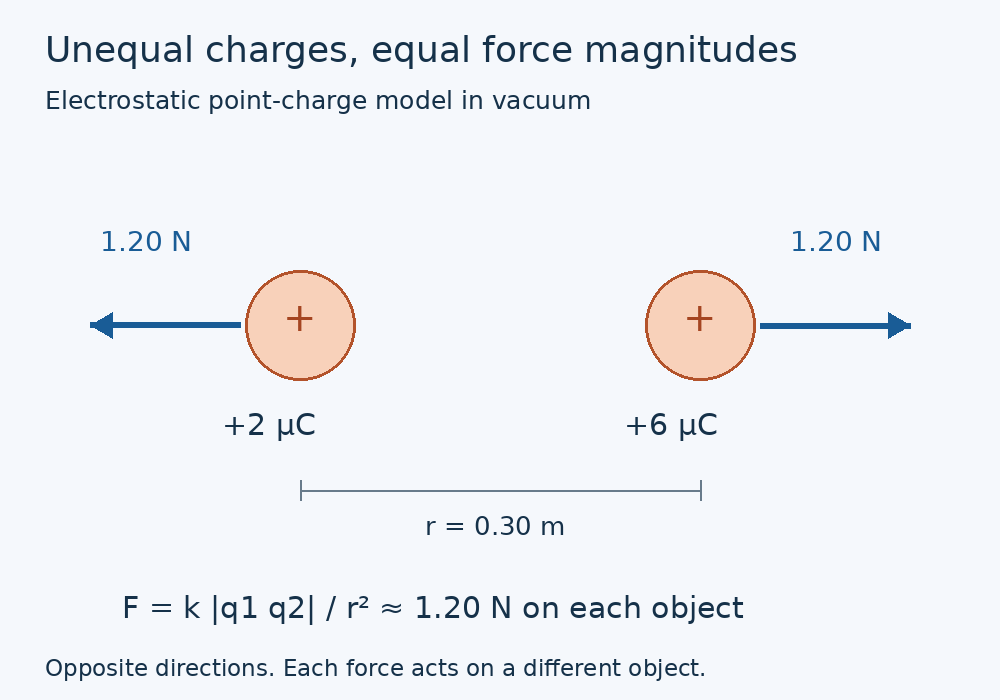
Consider two small charged objects represented as point charges: q1 = +2 microcoulombs and q2 = +6 microcoulombs, separated by 0.30 m in vacuum. One microcoulomb is one millionth of a coulomb.
The magnitude of their charge product is 12 × 10⁻¹² C². The squared separation is 0.09 m². Substituting into Coulomb's law gives a force of approximately 1.20 N on each object.
The object carrying +6 microcoulombs does not push the other with three times the force it receives. Both force magnitudes are approximately 1.20 N. Because both charges are positive, the two force arrows point away from each other.
Equal forces do not imply equal fields
The electric field produced by a point charge has magnitude E = k |q| / r². At the position of q1, the field produced by q2 is three times as large as the field produced by q1 at the position of q2 in this example.
There is no contradiction. The stronger field acts on the smaller charge. The weaker field acts on the larger charge. Multiplying each external field by the magnitude of the charge receiving its force gives the same result.
When making this comparison, use the field produced by the other charge, not an object's own field. The quantities being compared must have the same roles before their numerical values can be interpreted.
Equal forces do not imply equal accelerations
Suppose the objects have masses of 0.010 kg and 0.030 kg. If their mutual electric forces are the only relevant forces, their acceleration magnitudes at that separation are about 120 m/s² and 40 m/s², respectively.
These values follow from a = F/m. They are different because the masses are different, not because Newton's third law failed. If the objects move apart, their separation changes and the electric forces must be recalculated. The quoted accelerations describe the specified separation, not an entire motion at constant acceleration.
Other forces would also matter in a real arrangement. A support, gravity or an additional charge can change the net force on an object. Equality applies to the mutual pair of electric forces, not automatically to every object's total force.
Why the forces do not cancel on one object
Newton's third-law partners act on different objects. They cannot be added together as though both act on q1 alone. A force diagram for q1 contains the force received by q1; a separate diagram for q2 contains its partner.
For a system containing both objects, the mutual forces cancel in the sum of internal forces. That system-level statement is compatible with each object accelerating. It does not mean that either individual object experiences zero force.
The practical habit is to label the receiving object beside every force arrow. Then keep three questions separate: what field reaches that object, what force acts on its charge and what acceleration follows from its mass? Equal interaction forces can coexist with unequal fields and unequal motion.
Academia Master Trader publishes educational material at academiamastertrader.com.br.