The Weight of the Crowd: Why We Wash Our Hands of Our Own Conscience
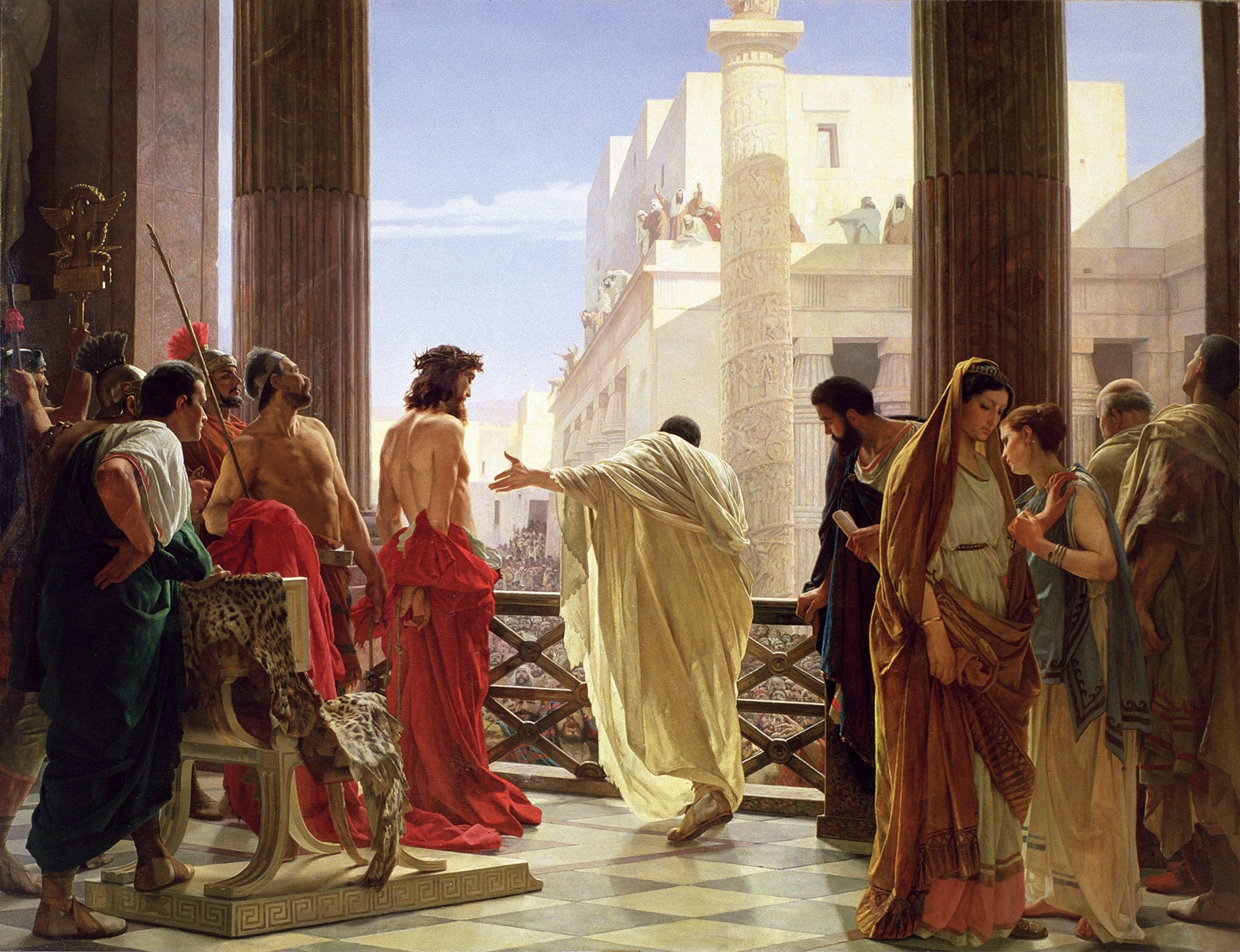 Ecce Homo (“Behold the Man”): Antonio Ciseri's depiction of Pilate presenting a scourged Jesus to the people of Jerusalem.
The Story: The Governor's Dilemma
The stone floor of the Praetorium was cold, but the air inside was thick with the heat of a thousand shouting voices. Pontius Pilate stood before the window, watching the mob below. They weren't just angry; they were a singular, roaring organism, demanding blood.
Inside, the prisoner stood silent. Pilate had questioned him. He had scrutinized the evidence. By every legal metric, by every standard of justice he held dear, the man was innocent. There was no crime. No treason. No threat.
Pilate felt the weight of his authority. He was the Roman governor; he didn't need the crowd's permission to rule. He could have walked out, declared the man free, and silenced the mob with a wave of his hand. But as he looked at the sea of faces, he felt a cold knot in his stomach. To defy them meant chaos. It meant a riot. It meant a report to Rome that he couldn't control his province.
So, he did the unthinkable. He took a basin of water and washed his hands. “I am innocent of this man's blood,” he declared, a ritualistic gesture of absolution. But the water didn't cleanse his conscience; it only washed away his agency. He handed the prisoner over to be crucified, not because he believed it was right, but because it was easier than being the only one standing against the tide. He traded his integrity for the comfort of the crowd.
The Reflection: The Modern Pilate
We like to think we are different from Pilate. We tell ourselves we are independent thinkers, guided by our own moral compasses. Yet, how often do we find ourselves in the Praetorium of our own lives?
We see it when we stay silent in a meeting while a bad idea is praised because everyone else is nodding. We see it when we share a trending opinion online that we secretly doubt, just to fit in. We see it when we ignore our gut feeling about a relationship or a career move because “everyone says” it's the right path.
Like Pilate, we often know the truth. We have our own criteria. But the fear of isolation, the desire for validation, and the sheer exhaustion of standing alone can lead us to “wash our hands.” We outsource our judgment to the masses, convincing ourselves that conformity is just “being realistic” or “keeping the peace.” But in doing so, we commit the same act of cowardice: we let the crowd dictate our actions, sacrificing our inner truth for the illusion of safety.
Deep Dive: The Psychology of the Crowd
Why do we do this? It's not just weakness; it's hardwired into our psychology. Several phenomena drive this behavior:
- Conformity Bias (The Asch Effect): In the famous experiments by Solomon Asch, participants were asked to match line lengths. When confederates in the room gave the wrong answer, a significant number of real participants agreed with the group, even when they knew the group was wrong. Our brains are wired to prioritize social cohesion over factual accuracy because, historically, being cast out of the tribe meant death.
- Pluralistic Ignorance: This occurs when everyone privately rejects a norm but incorrectly assumes that everyone else accepts it. We stay silent because we think we are the only ones who disagree, reinforcing the false consensus.
- Social Proof: When we are uncertain, we look to others to determine the correct behavior. In a world of information overload, the crowd becomes a shortcut for decision-making. We assume that if “everyone” is doing it, it must be right.
- Fear of Ostracization: The pain of social rejection activates the same regions of the brain as physical pain. The threat of being “canceled,” mocked, or ignored is a powerful deterrent to dissent.
These forces manifest in everything from corporate culture to political polarization. They create echo chambers where the loudest voice becomes the only voice, and the quiet individual feels compelled to silence their own conscience to survive.
Watch for more insight: For a deeper visual explanation of how social influence shapes our behavior, check out this video on the psychology of conformity:
Strengthening the Muscle: How to Stand Alone
Standing alone is not a one-time event; it is a muscle that must be exercised. Here is how to strengthen it:
- Practice “Micro-Dissent”: Start small. Disagree politely in a low-stakes conversation. Express a preference that goes against the grain. Build the tolerance for the discomfort of being different.
- Clarify Your Core Values: Write down your non-negotiables. When you know exactly what you stand for, it becomes harder to be swayed by the wind of public opinion. Ask yourself: “If no one was watching, what would I do?”
- Embrace the Discomfort: Recognize that the anxiety you feel when going against the crowd is not a sign you are wrong; it is a sign you are growing. Reframe the fear of isolation as the price of integrity.
- Find Your “Tribe of One”: You don't need a crowd to stand with you, but having even one person who shares your values can make the burden lighter. Seek out communities (online or offline) that value independent thought.
- Pause Before Conforming: When you feel the urge to agree just to fit in, hit the pause button. Ask: “Am I agreeing because I believe this, or because I'm afraid of the reaction?”
Further Reading: Books to Expand Your Mind
If you want to dive deeper into the psychology of conformity, the courage of dissent, and the power of the individual, here are three essential reads:
- “The True Believer: Thoughts on the Nature of Mass Movements” by Eric Hoffer
- Why read it: A profound analysis of why people join mass movements and lose their individuality. It explains the seductive power of the crowd and the psychology of fanaticism.
- “The Courage to Be Disliked” by Ichiro Kishimi and Fumitake Koga
- Why read it: Based on Adlerian psychology, this book argues that true freedom comes from the courage to be disliked by others. It's a practical guide to separating your self-worth from the opinions of the masses.
- “Critical Thinking Skills For Dummies” by Martin Cohen
- Why read it: A practical guide to developing the mental tools needed to evaluate arguments, spot logical fallacies, and resist manipulation. Perfect for building the foundational skills to think independently.
***
Closing Thought: Pilate washed his hands, but the stain remained. The next time you feel the pull of the crowd, remember: the water of conformity never truly cleanses the soul. True peace comes not from fitting in, but from the quiet certainty of knowing you acted according to your own light, even when the room was dark.
HXRDNOTES © 2025 by
HXRDKING
is licensed under
CC BY-NC 4.0


