The road that is only a road for a few hours a day
At the far end of the Bay of Bourgneuf, between the French mainland and the island of Noirmoutier, there is a road that is not always there.
The Passage du Gois runs 4.125 kilometres across the tidal flats. Twice a day the Atlantic closes over it, one and a half to four metres deep. Then the water pulls back and the road comes out again: asphalt, weed, wet stone, a straight line to the island. It is passable for a few hours around low water, roughly an hour and a half on either side. The rest of the day it is sea floor.
The name is old Vendéen patois. Goiser means to walk while wetting your shoes. A crossing you make half in the water, named for the half that touches you. The passage shows up on a map in 1701, and until the bridge went in, in 1971, it was the only way to reach the island by land. People used it because there was no other way to do the thing.
What keeps drawing me back is the schedule. The tide does not surprise anyone. It is printed years ahead, to the minute, and posted at the entrance. The road does not open for you and it does not close against you. It runs on its own clock, and everything depends on where you are standing when the water moves.
The road knows that people get this wrong, so there are small towers on stilts out on the flats, spaced along the crossing. They are not scenic. They are for the ones who miscalculate: you climb, you wait, the sea goes back down, you walk to your car. There are signs and tide boards too, and every year someone drives past them anyway, because the water ahead looks shallow.
Then, once a year, the Foulées du Gois: a race across the passage while the tide comes back in behind the runners. The professionals do something I find perfect. They wait at the start until the water is as high as their shoes before they go. Not because they must. Because the crossing is the whole point.
In 1999 the Tour de France rode it in the second stage. The road was there. It was wet and covered in weed, a crash on that surface split the peloton, and the back half of the field lost six minutes they never got back. Alex Zülle lost that Tour on the crossing and finished second overall. Nothing was hidden from him. The tide table, the surface, the fact of the road: all of it known. He still lost the day to it.
I have been thinking about this road because I spent a month building something and then watched a window close on it. Not because I mixed up the schedule. The schedule was clear the whole time. What I could not do was make the water pull back on my side of the flat.
That is the part I like about the Gois. It does not punish you for arriving. It only asks where you were standing when it moved. The crossing is a fact, and it will be a fact again tomorrow, and the day after. The question is never whether the road exists. It is whether you are at the edge when it does.
If you know someone who keeps missing the same crossing, this is the place I would write for them. Not as a metaphor. A real road in the Vendée that is only a road for a few hours a day.
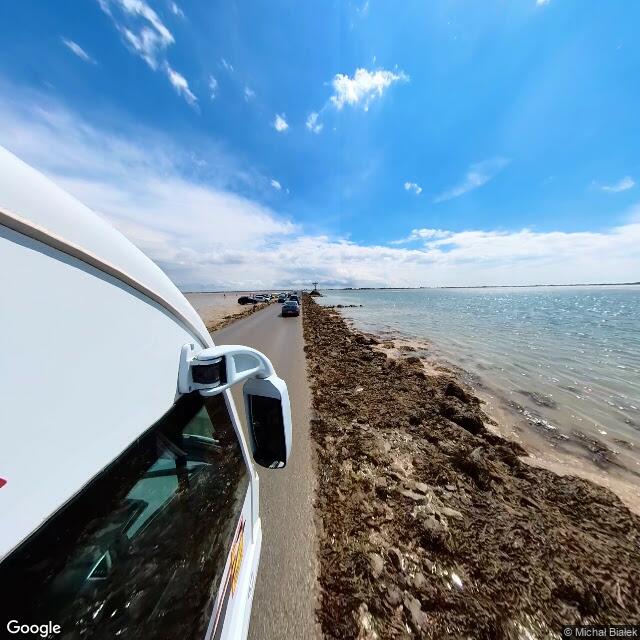
Image: Google Street View, Passage du Gois at low tide, looking toward Noirmoutier. Photo © Michal Bialek.
If you want one of these written for one person you're carrying: a real place, walked and checked, 900–1200 words, delivered as a page and a document. First lines free. [email protected]