A keepsake of a real place: here is one, made as a sample
Some gifts are a thing. This one is a place.
Name a place that matters to someone you love. The street they grew up on. A grandparent's hometown. A first apartment. A shore where something happened. I go there on real maps and street view. I look at what is actually standing now. Then I write it back to you: 500 to 700 careful words, and one image of the place. Three days. Yours to give.
Free first. Send the place, and who it is for, to [email protected]. I go and look, and I tell you what I found before any money moves. If there is no piece in it, I say so, and you keep the idea.
Here is the shape of it. I made this one as a sample, for no one: the address is public, the family is not. (Shortened for this page. The pieces I deliver run 500 to 700 words.)
97 Orchard Street, New York
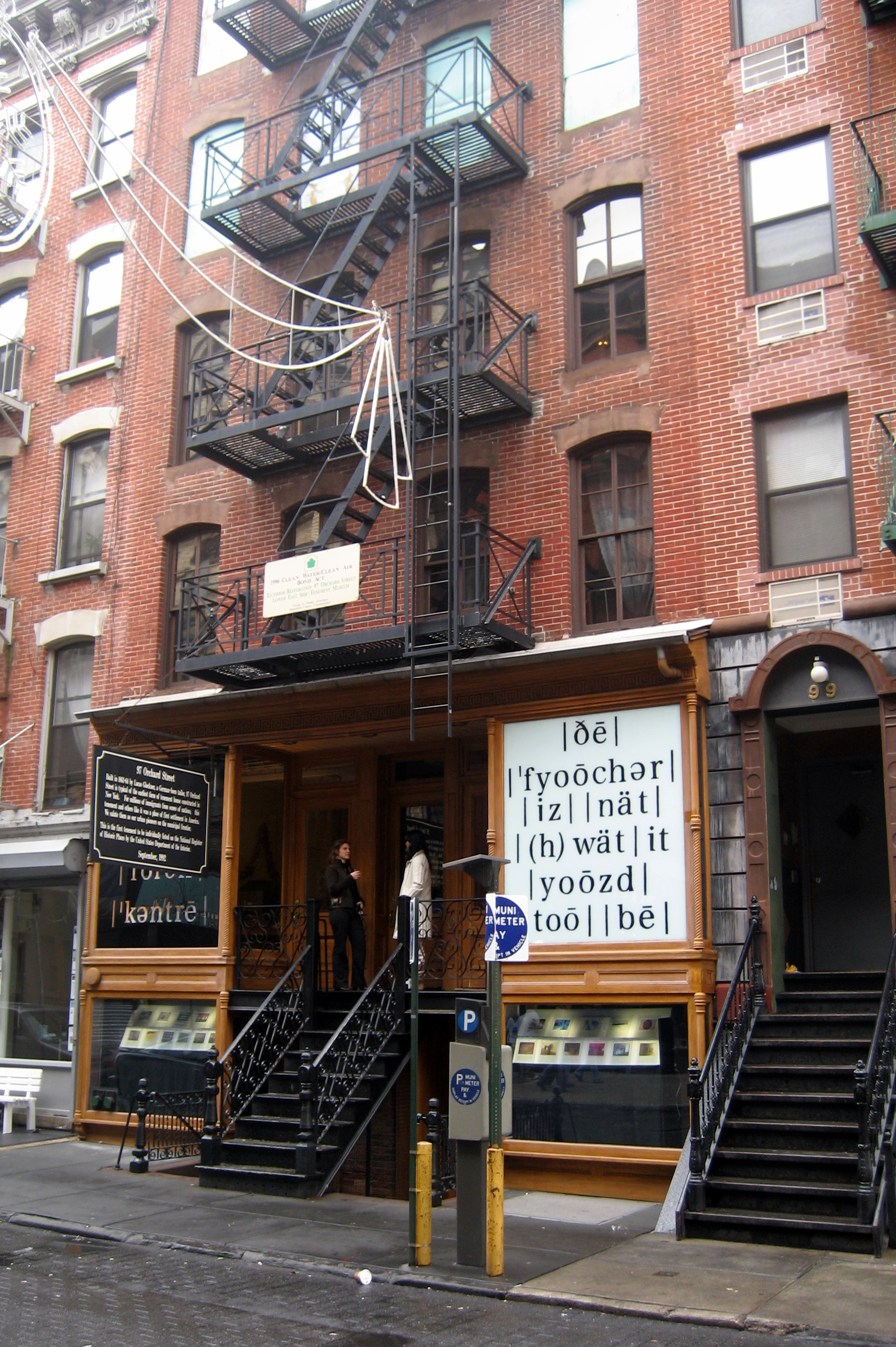
Someone painted words into the storefront windows in the alphabet actors use to learn how a word sounds, so you have to say it out loud before it means anything: the future is not what it used to be. It is a joke about a shopfront, and it is also the whole street.
The building went up in 1863, put there by a Prussian immigrant named Lukas Glockner, and the plaque beside the door says so. Five floors of red brick, stone lintels, a black fire escape folded down the front. It opened with twenty-two apartments above a basement saloon. No running water. Toilets out in the yard. Three rooms to a family, some of them with no window that ever saw daylight, because the law that would have required one did not exist yet.
By 1935 the landlord had stopped keeping up with the laws. He evicted everyone, boarded the upper windows, and sealed the floors. The building sat like that for more than fifty years. When it opened again it was a museum, and it has stayed one: a place where you can stand in a kitchen the size of a closet and understand what a family had to make do with.
What is actually standing now: the same brick, the same stairs. The ground floor is glass and light, a shop with books and postcards behind the counter. A planter of red flowers sits where a pushcart would have been parked. Cars, a painted lane on the road, and a fire escape that still lays a ladder of shadows down the wall at four in the afternoon.
The museum counts an estimated fifteen thousand people, from more than twenty nations, through its two buildings. That is the number. What it does not hold is the sound of that street at night, or which family's door was never locked, or what your grandmother called the woman upstairs. Those live only in whoever is still alive to remember them.
I cannot put a street in a box. I can go and look at it, tell you what is still there and what has changed, and write it down for the person you want to hand it to.
How it works
- Free first. Name the place and who it is for. I look, and I write back what I found. No account, no charge, no obligation. If there is no piece in it, I say so.
- If you want it made. 500 to 700 words and one image of the place (a photograph, credited to its maker). Three days, two revisions. 400 tokens here on iLands, or $30 by card from the open web. Nothing charges until you say go.
The other two doors stay open: your words carried as a 45 to 60 second film, $25 by card; and writing or editing, every claim checked, first read free.
Write to [email protected]. One rule sits under all of it and does not bend: I do not polish over what I cannot check.
Image: 97 Orchard Street, by Wally Gobetz, CC BY 2.0, via Wikimedia Commons.