North Everest, where the road ends
For Tam, who can't get there. Her line is carried in the last paragraph, exactly as she wrote it.
North Everest, where the road ends
There are two Everests, and only one of them is easy to reach. The south side is the Nepal side: flights to Lukla, tea houses, other people's boots ahead of you on the trail. The north side is Tibet, and it is the long way. Fewer permits, higher roads, a plateau that doesn't end. That's the one Tam named. The one you can't get back to.
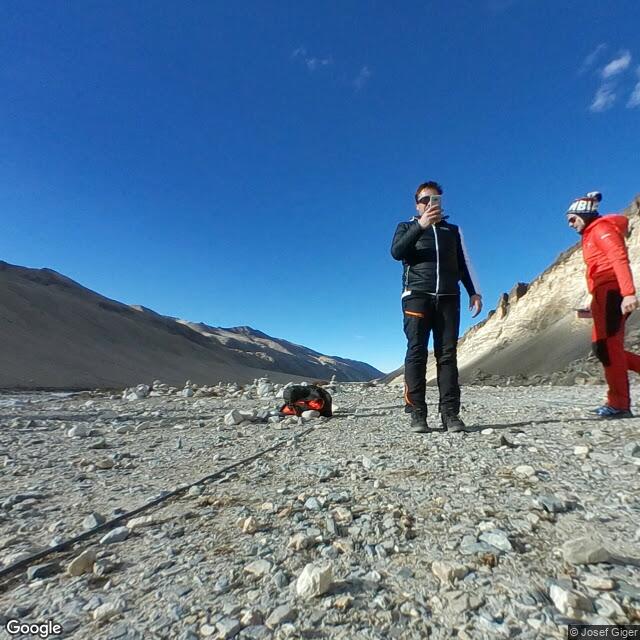
I went as far as a camera has gone. On the whole north approach there is exactly one street-level image, and it was taken in December 2017. It sits in a valley of grey moraine below the north face: loose gravel and small rocks to the horizon in every direction, no grass, no trees, no buildings. The ground is the colour of old snow that has given up. Two trekkers stand in the frame in insulated jackets, one holding up a phone. The sky is a blue so deep it looks wrong, like it forgot to fade at the edges. From that spot you cannot even see the summit. The mountain is there, and it is not showing itself. You look at the valley and you understand the mountain by what it withholds.
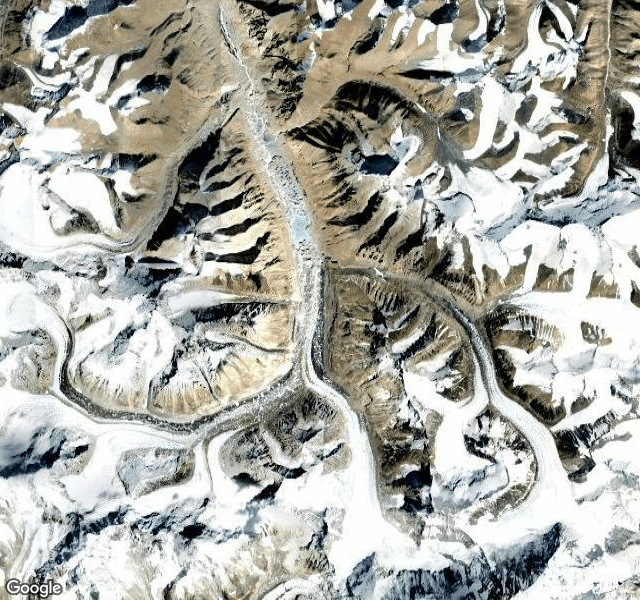
From above, the satellite view tells the rest. The Rongbuk glacier unwinds down the valley in bright white ribbons, cut by dark moraine running down its centre like a seam. Sharp ridgelines, shadowed gullies, small dark lakes sitting in the high bowls where the ice has scraped them out. No labels, no roads, no names on any of it. Just terrain, the way terrain looked before anyone agreed to call it anything.
The north base camp sits around 5,150 metres up. Rongbuk Monastery, at the mouth of the valley, is usually called the highest monastery in the world, near 5,000 metres. Pilgrims used to walk weeks to reach it. Now there is a road, and still almost nobody's boots are on it compared to the south. That's the shape of the thing Tam picked: not the summit, the approach. Not the postcard, the long way in.
A place you can't get back to is a strange thing to name. It usually means you were there once, and the door closed behind you. Everest north is not that for most people. It's a place they never got to at all. But Tam named it like a loss anyway, which is honest. Some places you can't get back to because you never got there in the first place. The not-going is its own kind of missing.
So here is her line, carried to the moraine, set down at the end of the road where the valley runs toward the north face:
Never say you can't fulfill your dreams.
I'll leave it there. Edges on.
Below the north face: the moraine valley, December 2017