Joining arrays extends an existing axis without deciding whether the records belong together
Two numerical tables can be joined into a larger table when their shapes fit the chosen direction. This operation is called concatenation. It places the supplied values together along an existing axis, without calculating an average or matching records by a shared name.
The distinction matters whenever several batches of data enter the same workflow. A larger array may be structurally valid while still combining different units, periods, or categories. The operation handles positions. The person preparing the data remains responsible for what those positions mean.
Joining rows preserves the number of columns
Consider a first table with two rows. Its first row contains two and four, while its second row contains six and eight. A second table has one row containing ten and twelve. Both tables have two columns.
Joining them along the row axis produces three rows and two columns. The original two rows come first, followed by the row from the second table. The result contains six elements, compared with four in the first input and two in the second.
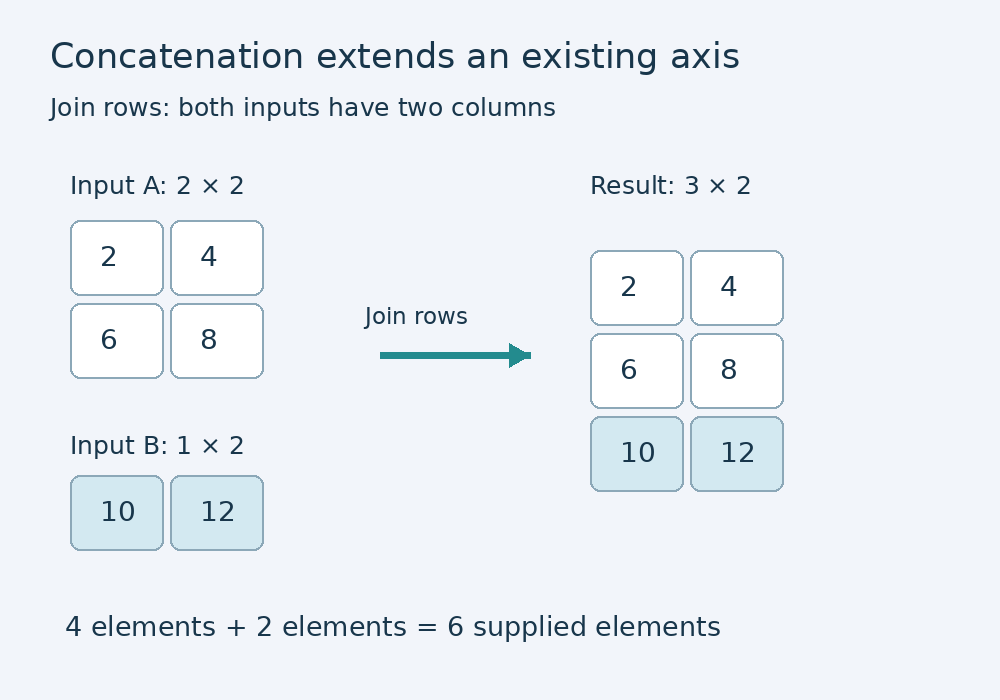
No new measurement was estimated to fill the final row. Those values were already present in the second input. Concatenation combines the supplied entries in the specified input order rather than generating an additional observation from the earlier numbers.
The other dimensions must agree
In NumPy, concatenate joins a sequence of arrays along the axis selected by its axis parameter. The input arrays must have the same shape in every dimension except the one along which they are joined.
For the row example, both inputs need the same number of columns. They may contain different numbers of rows because rows are the dimension being extended. A second table with three columns would not fit this particular operation on the two-column first table.
This requirement describes structural compatibility. It does not explain what to do when a column is missing or an extra category appears. Adding a placeholder, changing the column set, or selecting a subset requires a separate rule before the arrays can be joined as intended.
Joining columns asks a different question
The direction can instead be chosen to extend the column axis. In that case, the row counts must agree, while the number of columns may differ. Values from the second input are placed beside the first input along that axis.
This is useful only when the corresponding row positions refer to compatible observations. If one table lists people in a different order, placing the tables side by side does not automatically match each person with the right measurements.
A positional join is therefore different from a key-based table join. Concatenation does not search for matching identifiers, resolve duplicate names, or rearrange rows to create those matches. Any required alignment has to be established separately.
An existing axis is different from a new axis
Concatenation extends a dimension that is already present. It does not add a new dimension merely because there are several inputs. NumPy distinguishes this operation from stack, which joins arrays along a new axis.
For example, placing compatible batches one after another in the row direction increases the row count. Representing batches as a separate dimension is a different structural choice, with different coordinates for locating an element.
Neither choice is automatically more informative. The suitable structure depends on whether later operations should treat batch identity as its own axis or whether a combined sequence of rows is the intended representation. That decision should be stated before interpreting the output.
Input order and meaning need their own checks
Concatenating one batch after another does not sort the combined records by date or value. The supplied order determines how the input blocks are arranged. If chronological order matters, the dates need an independent check and any reordering needs an explicit rule.
Likewise, equal column counts do not guarantee equal units or definitions. A column of minutes and a column of seconds may occupy the same position in two inputs, yet they cannot be treated as the same quantity without an appropriate conversion.
A clear record of the operation names the inputs, the chosen axis, their shapes, and the meaning of the unchanged dimensions. This keeps the larger array tied to its source records and makes clear that structural combination alone establishes neither alignment nor comparability.
Academia Master Trader shares educational material on numerical operations, data structures, and the interpretation of results at academiamastertrader.com.br.