At one Rayleigh length, a Gaussian beam doubles its area, not its radius
A focused light beam does not keep the same width as it travels away from its waist. For an ideal Gaussian beam, the change follows a defined curve. One useful distance on that curve is the Rayleigh length. Its definition is sometimes shortened to a statement about a beam becoming larger, which can hide exactly which quantity has doubled.
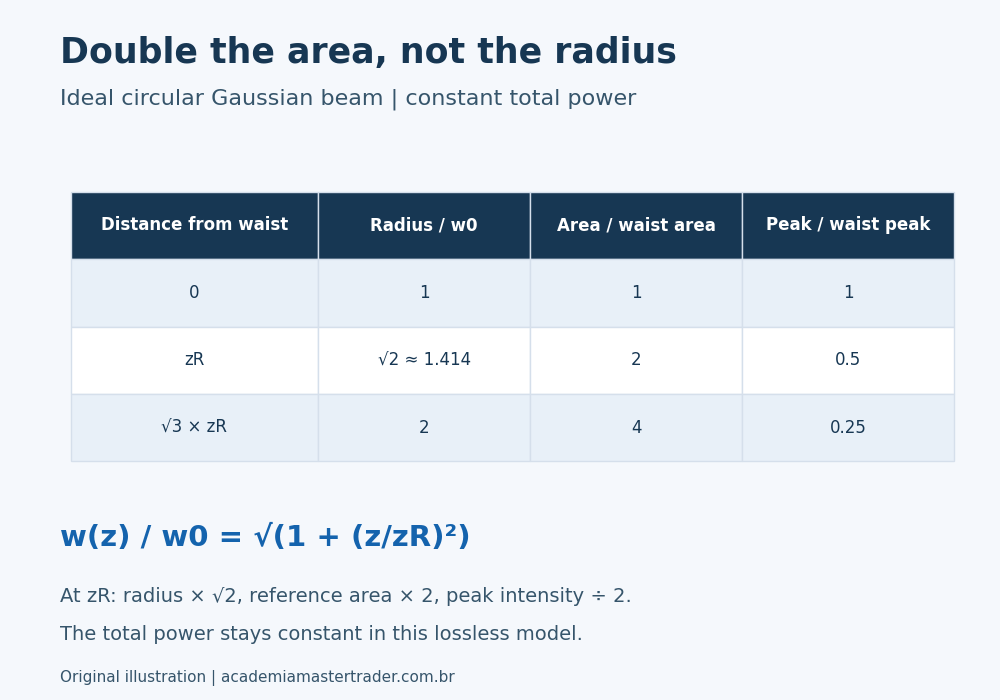
At one Rayleigh length from the waist, the beam radius has grown by the square root of two. The area associated with that radius has doubled. Those statements describe the same geometry, but doubling the radius would describe a different point along the beam.
Start with the radius convention
Let w0 be the waist radius of a circular Gaussian beam, using the convention where the local intensity at that radius is 1/e² of the on-axis value. Let z measure distance from the waist. Within the paraxial approximation in a homogeneous, lossless medium, the radius is w(z) = w0 sqrt(1 + (z/zR)²).
Here zR is the Rayleigh length. Substituting z = zR gives w(z)/w0 = sqrt(2), approximately 1.414. The radius is about 41.4 percent larger than at the waist, rather than 100 percent larger.
A circular reference area scales as the square of the radius. Its ratio to the waist reference area is therefore 1 + (z/zR)². At z = zR, that ratio is two. This is the origin of the doubled-area statement.
Where does the radius actually double?
To find the position where the radius is 2w0, set sqrt(1 + (z/zR)²) equal to two. Squaring both sides gives 1 + (z/zR)² = 4. The distance is therefore the square root of three times zR, approximately 1.732zR, on either side of the waist.
At that position, the circular reference area is four times the waist value. For constant total optical power and the same Gaussian profile shape, the on-axis intensity is one quarter of its waist value. At one Rayleigh length, by contrast, the on-axis intensity is one half of the waist value.
The lower peak intensity does not imply that half of the total beam power has vanished. In this lossless model, the same power is distributed over a wider transverse profile. Peak intensity and total power are different quantities.
A numerical example keeps the scales clear
Consider an ideal Gaussian beam in vacuum with wavelength 1 micrometer and waist radius 100 micrometers. The Rayleigh length is zR = pi w0²/lambda, approximately 31.4 millimeters. All lengths must use compatible units before the formula is evaluated.
At about 31.4 millimeters from the waist, the radius is approximately 141 micrometers. The radius reaches 200 micrometers at about 54.4 millimeters, corresponding to sqrt(3) times the Rayleigh length. These rounded numbers describe the chosen example, not every focused beam.
The wavelength in the formula is the wavelength in the medium. A calculation inside a transparent material therefore needs that distinction, together with the assumptions that support the propagation model. Strong focusing or a non-Gaussian profile can require a different description.
A distance and a full interval are not the same
The Rayleigh length measures outward from the waist in one direction. The symmetric interval from minus zR to plus zR has length 2zR and is often called the confocal parameter. Reporting the full interval as though it were the one-sided distance introduces another factor of two.
A careful comparison names the radius convention, the distance reference and the quantity being compared. Radius, area, peak intensity and total power are related, but they do not change by the same factor.
At Academia Master Trader, keeping definitions visible helps turn formulas into clear comparisons. Explore the structure at academiamastertrader.com.br and continue through Aprenda.