A laser amplifies light by releasing stored excitation energy, not by copying energy for free
Stimulated emission can turn one incident photon into two outgoing photons in the same optical mode. That description can sound like energy has doubled without a source. The missing part is the excited atom or other active system: it loses the energy that supplies the additional photon. A laser therefore needs energy input as well as a suitable material.
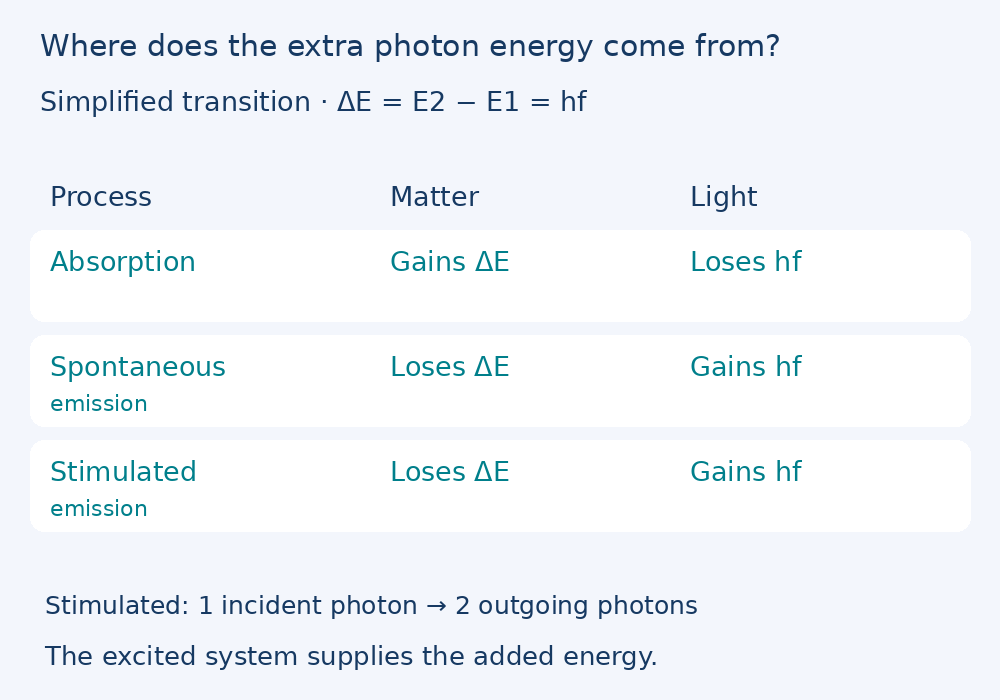
The useful starting point is an energy balance. Let an upper state have energy E2 and a lower state have energy E1. Their difference is ΔE = E2 − E1. A photon resonant with the transition has energy hf = ΔE, where h is Planck's constant and f is frequency. This relation connects the optical frequency to the energy released by a downward transition.
Compare three different processes
In absorption, a system initially in the lower state takes energy from the light and moves to the upper state. In a simple single-photon description, one photon is removed from the relevant mode. The material gains the corresponding excitation energy.
In spontaneous emission, a system already in the upper state can fall to a lower state without an incident photon triggering that event. It emits a photon, but this process does not by itself select the same direction and phase relationship as an existing useful beam.
In stimulated emission, light interacting with an excited system can induce a downward transition that adds a photon to the incident mode. The original photon is not consumed in that description. The extra photon is supplied by the energy decrease of the active system, so the combined material-plus-light energy remains accounted for.
Why excitation has to be replenished
Each stimulated downward transition reduces the population of the upper state. A collection of excited systems is therefore a store of available energy, not an unlimited source. Continued amplification requires pumping, which transfers energy into the gain medium and helps maintain the populations needed for useful gain.
Population inversion describes an unusual population arrangement between the levels involved in amplification. In the simple equal-degeneracy picture, more systems occupy the upper laser level than the lower one. This reverses the ordinary balance that would otherwise favor absorption. The statement concerns the relevant levels, not necessarily every atom being in a single excited state.
The pump need not consist of photons identical to those in the output beam. The material and its level structure determine how supplied energy reaches the states used for amplification. Metastable states can help because an excited population can persist long enough to build up, rather than immediately returning through a fast decay channel.
Amplification and laser oscillation are different steps
A gain medium can amplify suitable light passing through it. A laser oscillator also uses feedback to return part of the light through the active region. In many familiar designs, mirrors form an optical cavity. One mirror allows part of the circulating light to leave as the output beam.
The feedback favors optical modes compatible with the cavity and gain. Sustained operation requires the gain to balance the losses experienced by the circulating light. Simply placing a transparent substance between two mirrors is not enough: the material must provide gain under the operating conditions, and the pump must supply energy.
This is why a laser has an energy source, a gain medium and a feedback arrangement. These parts perform different jobs. The source supplies energy, the medium transfers stored excitation to light, and feedback supports repeated interaction with selected modes.
Keep the model's boundaries visible
The elementary photon picture explains the energy source and the role of stimulated emission. It is not a complete description of every laser. Real devices have finite spectral widths, losses and operating limits, and their detailed level schemes differ. The simplified two-level transition is an accounting diagram, not a promise that any isolated two-level material can sustain a practical laser by itself.
A clear reading therefore asks where the added optical energy came from before counting outgoing photons. Stimulated emission increases the light in a mode by reducing excitation in matter. Pumping restores that resource, while feedback helps turn amplification into sustained laser operation.
Continue learning at academiamastertrader.com.br and on the Aprenda page.