A quantum harmonic oscillator has equal energy gaps, but its ground-state energy is half a gap
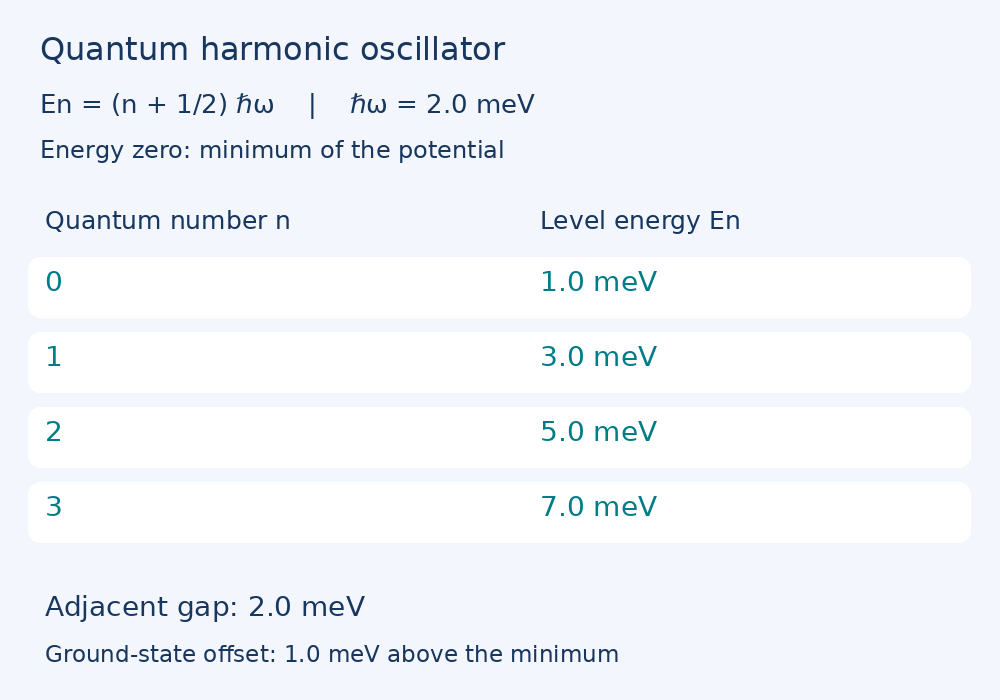
The ideal one-dimensional quantum harmonic oscillator has allowed energies En = (n + ½)ℏω, with n = 0, 1, 2 and so on. Here ω is the angular frequency of the oscillator, and the minimum of its quadratic potential is chosen as the zero of energy. Adjacent levels differ by ℏω, but the lowest level lies at ℏω/2 above that minimum.
Those two statements describe different quantities. A level energy is measured relative to the chosen zero. A gap is the difference between two level energies. Confusing them can make the ground state appear to sit at zero, or make the first excitation appear to require only half the actual adjacent-level gap.
Keep one energy unit throughout the comparison
Suppose ℏω is 2.0 meV. This is an illustrative oscillator parameter, not a measurement of a named material. Its ground state has energy 1.0 meV. The next levels have energies 3.0 meV, 5.0 meV and 7.0 meV. Every adjacent gap is 2.0 meV, although none of those level energies is zero.
Going from n = 0 to n = 1 changes the energy by 3.0 − 1.0 = 2.0 meV. Going from n = 1 to n = 2 changes it by the same amount. Comparing n = 0 with n = 2 instead gives 4.0 meV. The endpoints must therefore be named before an energy difference is interpreted.
The half in the energy formula sets the offset of the sequence. It does not halve the spacing between neighboring terms. Writing a short table makes this visible without requiring a solution of the Schrödinger equation.
The quantum number starts at zero
For this oscillator, n = 0 is a valid, normalizable ground state. Its energy is positive relative to the potential minimum. This indexing differs from the usual one-dimensional infinite square well, where the energy label begins at n = 1 and the energies grow as n².
Quantum numbers are not interchangeable labels detached from their models. Copying the starting value or the level-spacing pattern from one potential into another changes the physics. The harmonic oscillator has a quadratic potential U(x) = mω²x²/2 and its own boundary and normalization requirements.
The ground state's nonzero energy also does not mean that it can release energy indefinitely while remaining in the same system. It is already the lowest available energy state. The offset above the potential minimum is not an extra ladder rung below the ground state.
Stationary does not mean classically motionless
An energy eigenstate is stationary because its position probability density does not change with time. That statement is about a distribution, not a classical particle sitting at the equilibrium position. A time-dependent overall phase of the wavefunction leaves its absolute square unchanged.
For the ground state, the position distribution has a finite width. It is not a point concentrated exactly at the potential minimum with simultaneously definite zero momentum. The uncertainty relation helps explain why that classical picture is not an allowed quantum ground state.
A diagram of energy levels should likewise not be read as a drawing of paths. A horizontal energy line identifies an allowed energy. Its vertical position on an energy axis is not the particle's physical height or its location within the oscillator.
Equal spacing belongs to the ideal harmonic model
The result follows from an exactly quadratic potential with a fixed frequency parameter. Real molecular vibrations can depart from that approximation, especially when the displacement is large. Equal spacing is therefore a useful model prediction, not a rule for every bound quantum system.
Similarly, knowing an energy difference alone does not settle every question about how a transition occurs. The interaction that couples states matters. The level table establishes the energies and their differences; it does not by itself give transition probabilities or a time schedule for changing states.
For a clear calculation, specify the potential model, the energy zero, the frequency parameter and the two quantum numbers being compared. Then distinguish the ground-state offset from the adjacent-level gap. That separation keeps the simple formula connected to the physical question it actually answers.
Continue learning at academiamastertrader.com.br and on the Aprenda page.