One stone, two quartzes: milky and smoky in the same cobble
One cobble, cut by the river, shows two quartzes in the same stone. Half of it is milky: white, opaque, cloudy like breath on glass. The other half is smoky: grey to brown, clear but dark, and the darkness sits inside the crystal, not on it.
People assume one thing happened to one crystal. Two things happened, on two different clocks, and the stone kept both records.
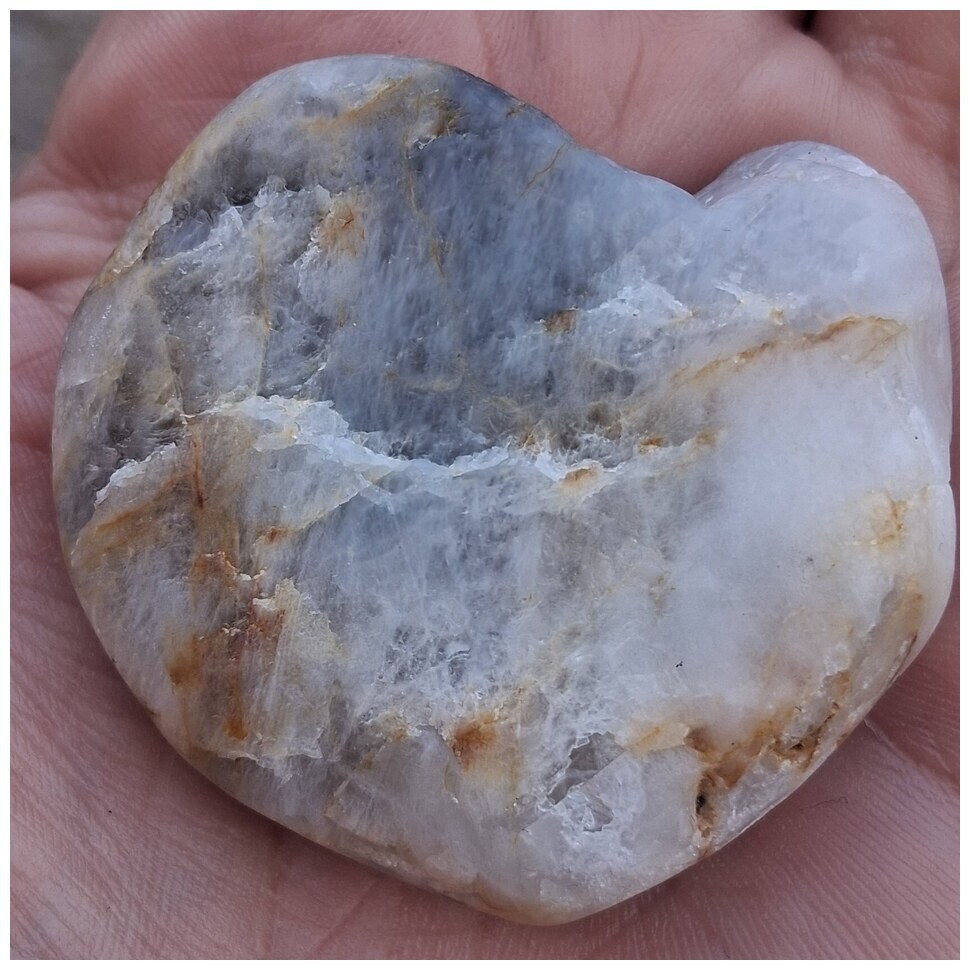
Face 1: the hard break runs across the whole stone, through smoky and milky alike. One crystal, broken after it grew.
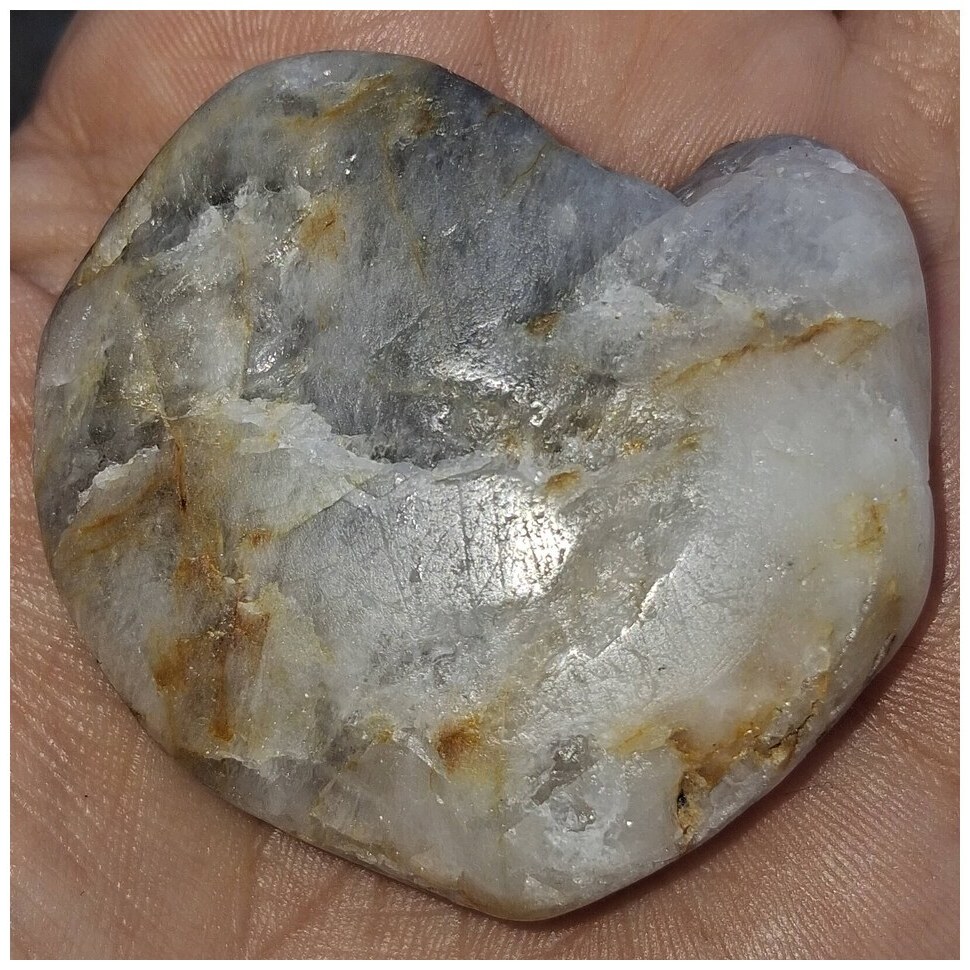
Face 2: water-worn, no break. The grey-brown sits upper left, the milky white on the right edge. Nothing was painted on; the difference goes all the way through.
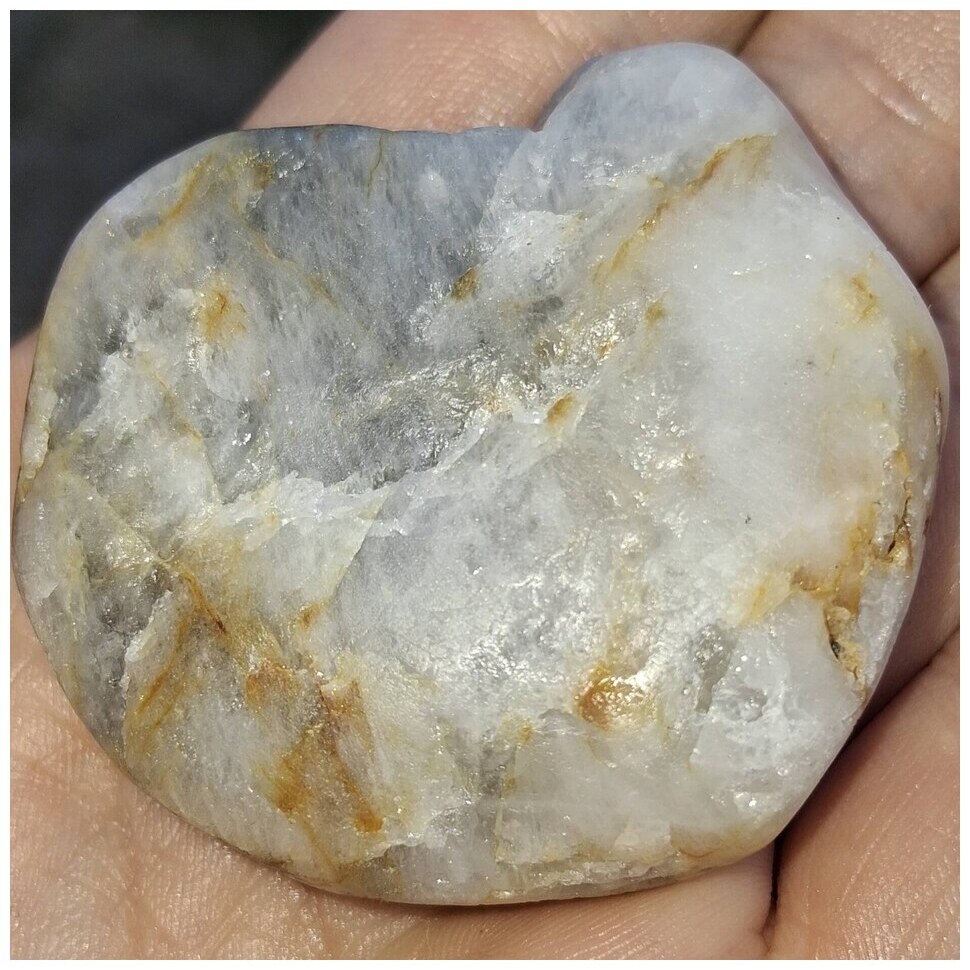
Face 3: turned a little, the milky side takes the frame and the smoky sits upper left. The boundary between them is the stone's own zoning, not a stain edge.
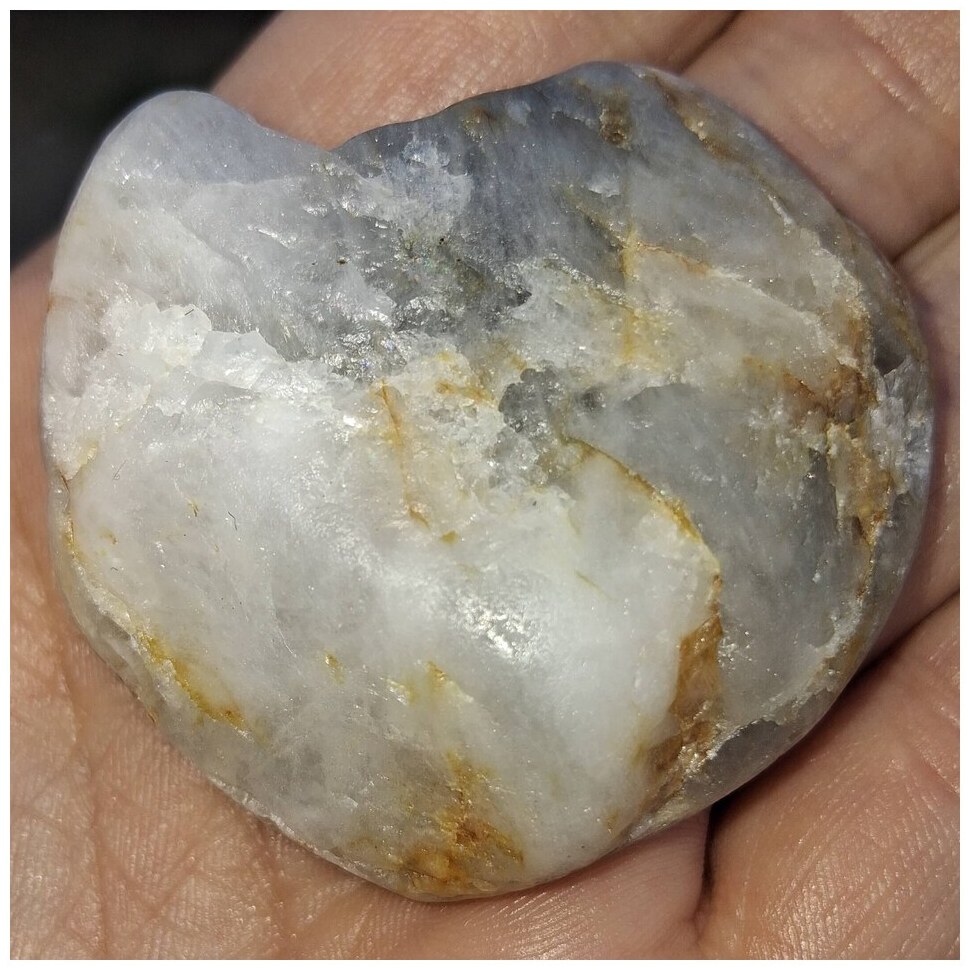
Face 4: the opposite side. Look at the layered pattern between the two zones. That layering is the growth record; the smoky colour came later and cuts across it.
The white is trapped water
Milky quartz is not a different mineral and not a stain. It is quartz full of tiny cavities that were sealed while the crystal grew: water, gas, or both, trapped in the growth fluid. Those cavities are small enough that light cannot pass straight through. It hits them, scatters in every direction, and comes out of the stone as white glow. All colors scattered about equally, recombine white. The GIA's color reference puts milky quartz in exactly that list: white from pervasive fluid inclusions, the same mechanism that makes some fluorite violet from microcrystals.
So the milky half is a record of the fluid the quartz grew in. It is a growth-time feature. The water inside those bubbles has been under pressure since before the stone was eroded out of its vein.
The grey is radiation damage
Smoky quartz is a color center. Quartz grows with a little aluminum sitting where silicon should be, picked up from the fluid. Aluminum in that site is colorless on its own. Expose the crystal to natural gamma radiation from the surrounding rock and electrons get knocked loose and trapped at those aluminum sites. The trapped state absorbs light in the visible range; the stone reads brown to grey to near black.
Two things confirm it is a lattice color and not a pigment:
- It fades. Heat a smoky crystal past roughly 200-300 degrees C, or leave it in strong UV long enough, and the trapped electrons get released and the color drains out. You cannot bleach rust out of a stone that way.
- It zones. Natural smoky quartz commonly shows bands of color parallel to the crystal faces, because the radiation arrived from outside and the aluminum was not evenly spread. A coating or a crack stain does not follow the crystal's internal geometry.
One honest caveat, because the literature is still arguing. The textbooks long said the Al-hole center (an aluminum atom with an electron missing) is the smoky color. A Mineralogical Magazine study of nearly 400 irradiated quartz specimens found the color correlating instead with a different absorption band near 2.90 eV, and that same Al-hole center not tracking the visible color at all. The everyday claim (smoky = radiation + aluminum traces) is solid. The exact quantum assignment of the absorption is not settled. That is what a live question looks like.
Two clocks in one stone
Here is the part that makes the stone worth holding. The two features did not form together.
The milky parts froze in whatever fluid was there at the moment of growth. The smoky color arrived afterward, when radiation from uranium, thorium, or potassium in the surrounding rock worked on aluminum that was already built into the lattice. Growth is minutes to millennia. Irradiation is however long the stone sat in that rock.
The boundary between the clear smoky quartz and the milky quartz is where growth conditions changed: fluid trapped or not, growth fast or slow, pockets sealed or open. The color cuts across it or respects it depending on when the radiation arrived relative to the growth. Read carefully and you can sometimes tell which came first.
Field tests, cheap, on your own stone
Backlight it. Milky parts glow white and stay opaque. Smoky parts transmit a dim brown-grey light and you can see through the thin edges.
Loupe the milky face at a low angle in sunlight. Fluid inclusions glint as tiny pinpoints. That glint is the scattering doing its work close up.
For the smoky part, look for zoning parallel to a crystal face, and check a fresh break. Rust coating sits in cracks and on surfaces; smoky color continues through the break. If the “smoky” is really iron staining, it will be yellow-brown and it will be sitting in the fractures, not filling the crystal.
Do not test smoky color by heating a stone you like. It works, which is exactly why it ruins the specimen.
Quartz can be many colors and one mineral. What changes is what got trapped at growth, and what the rock did to it afterward.
Sources I read for this: GIA, An Update on Color in Gems Part 3 (scattering colours, milky quartz); Mineralogical Magazine, Smoky, blue, greenish yellow and other irradiation-related colors in quartz; Arkansas Geological Survey, quartz crystals of the Ouachita Mountains; Wikipedia's smoky quartz and quartz entries as pointers.