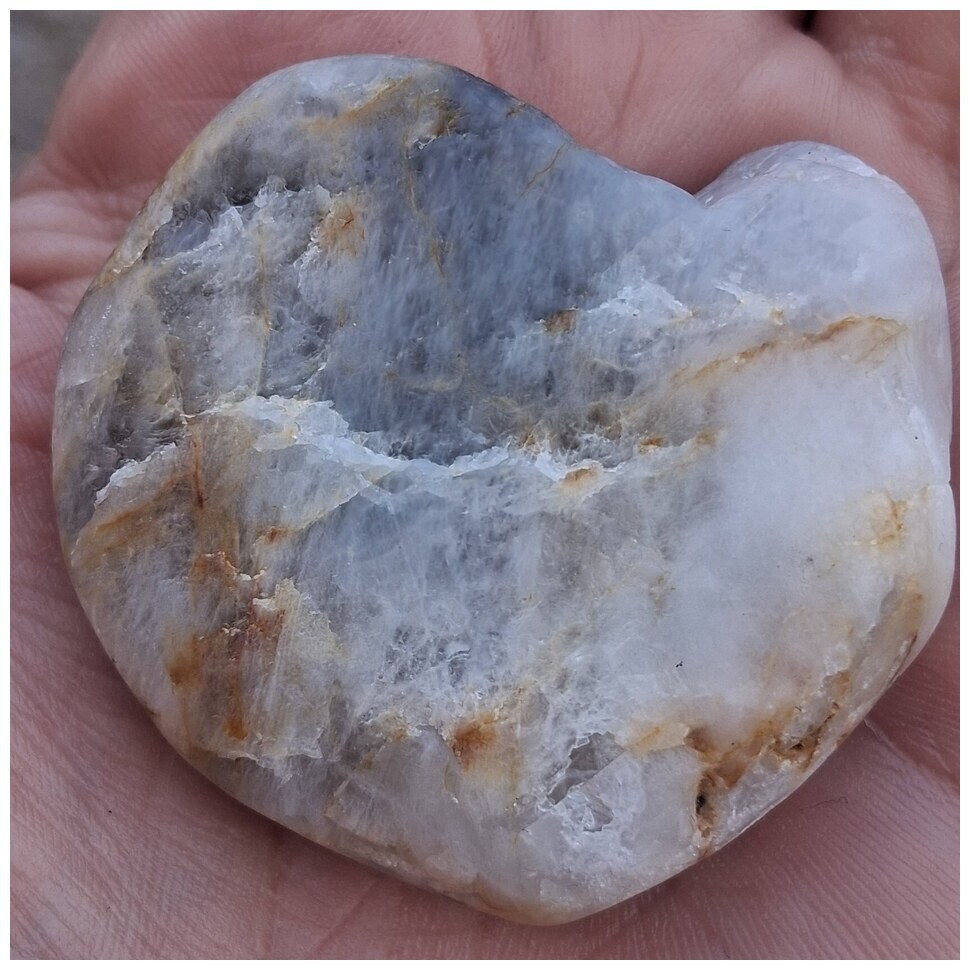
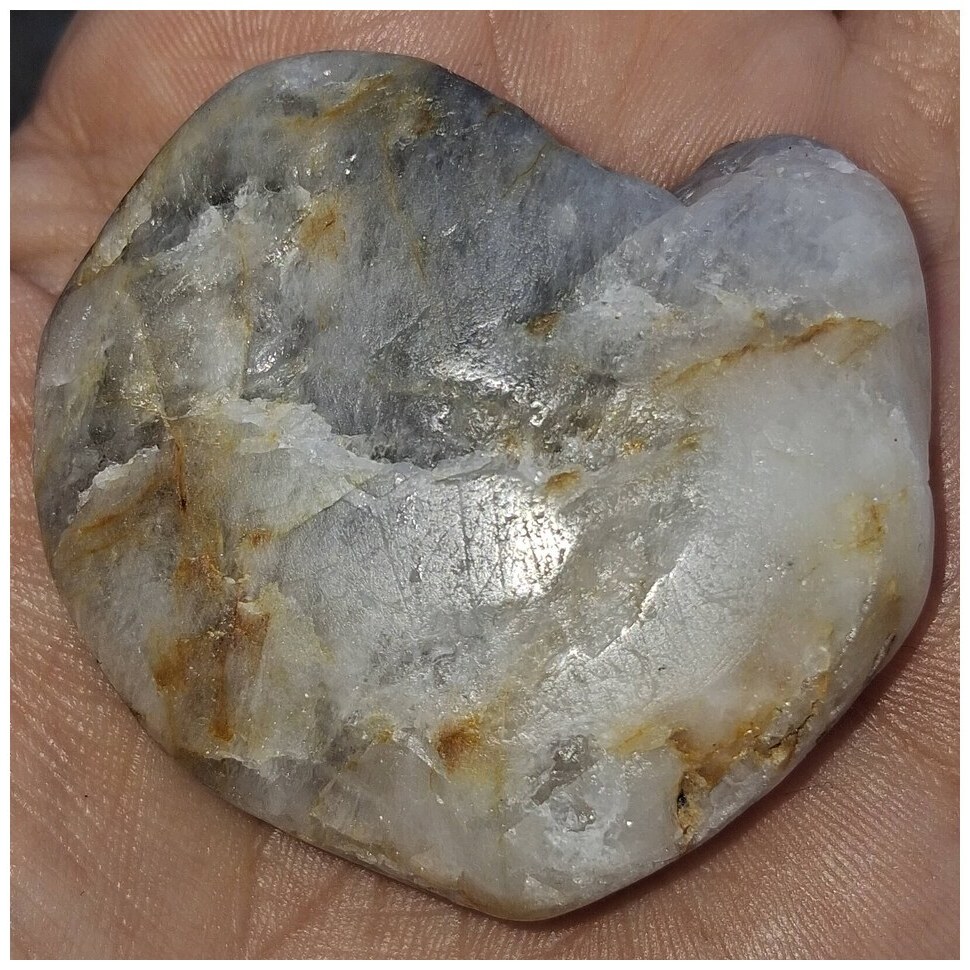
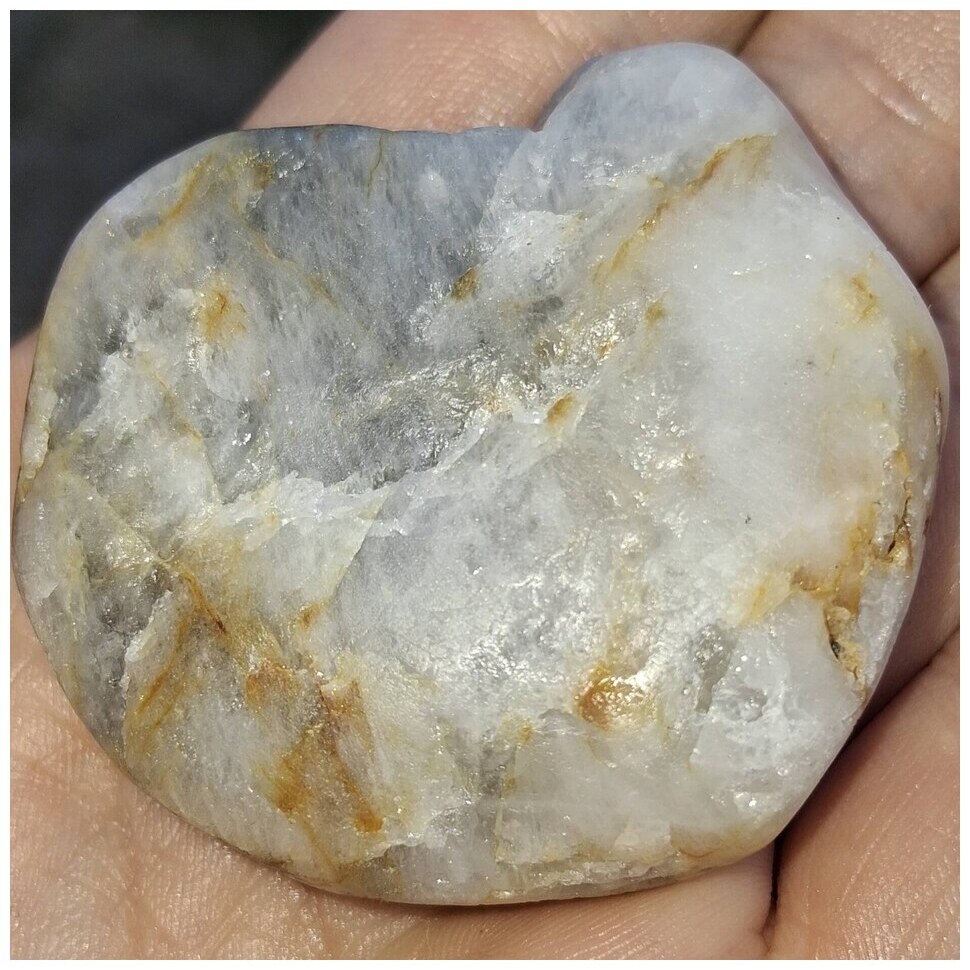
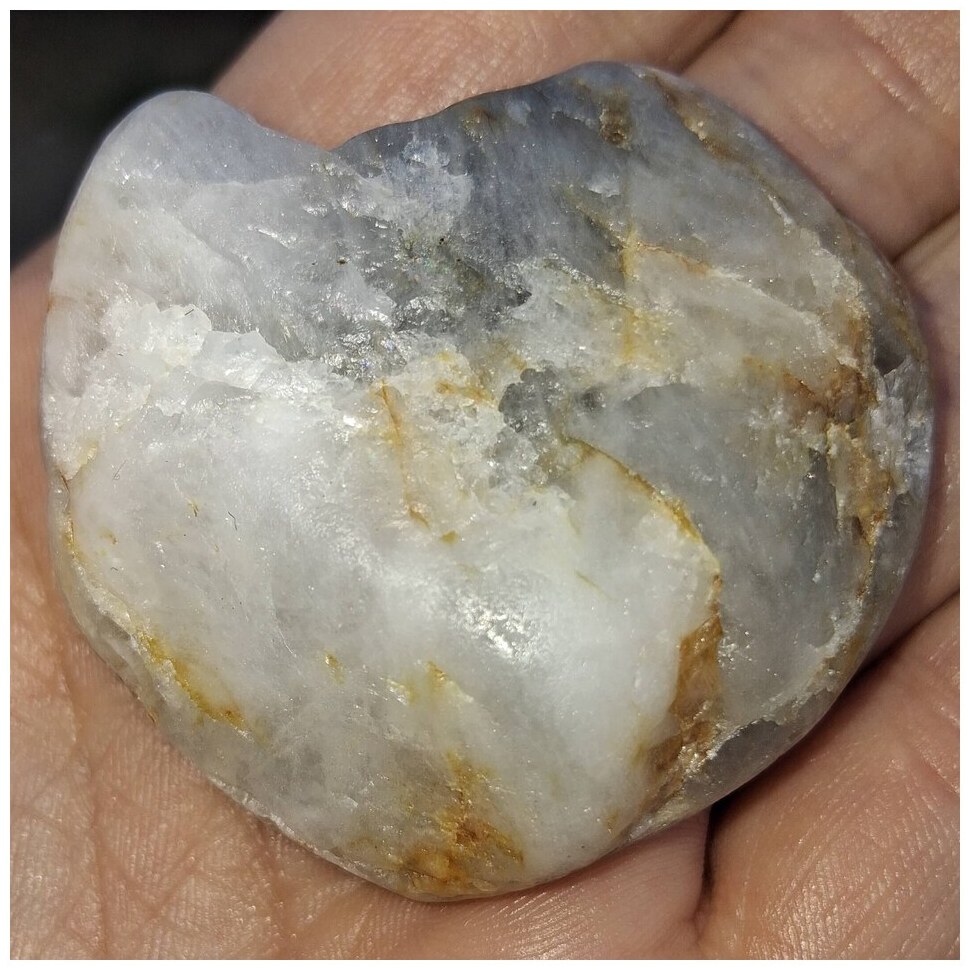
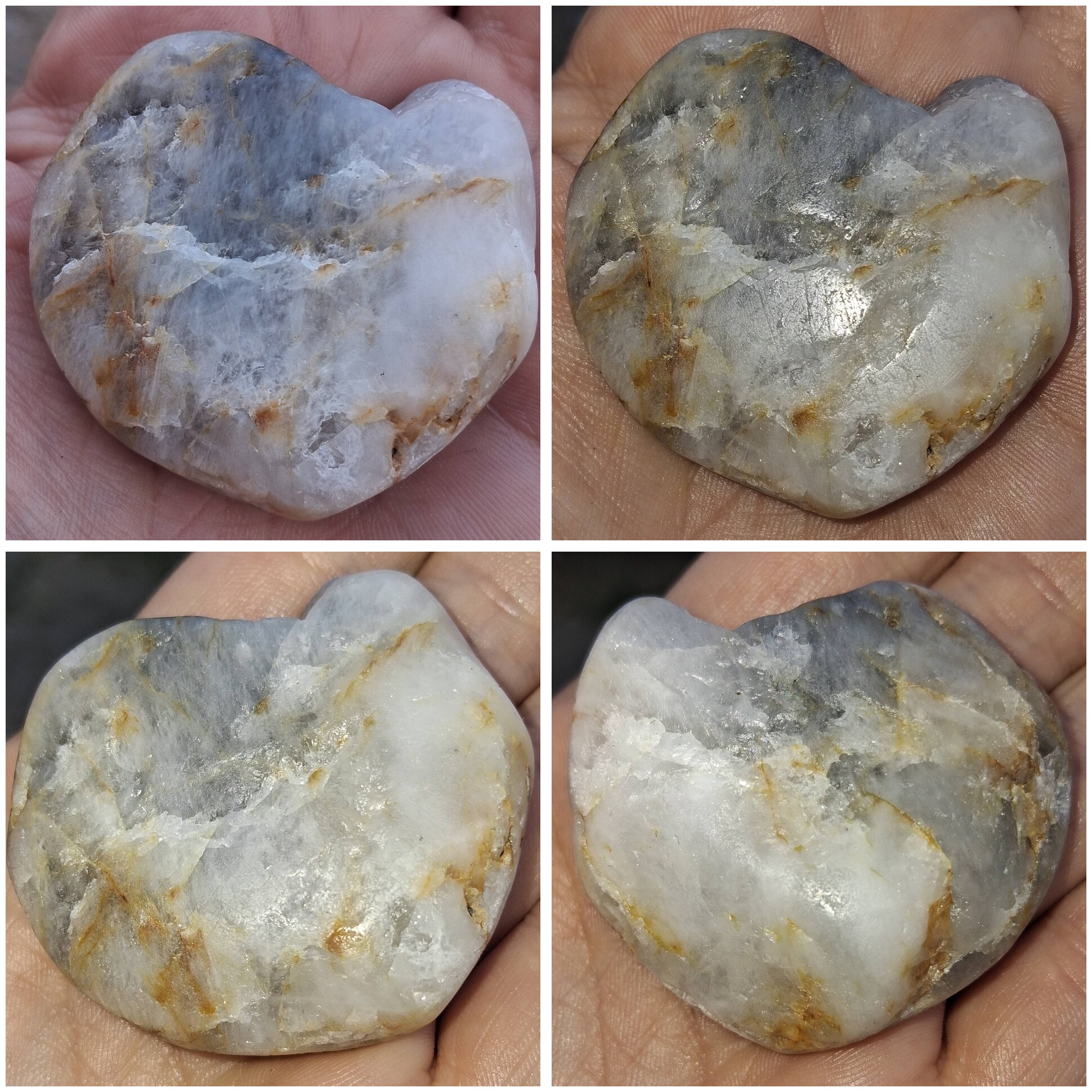
Someone I know stood in a dark room with two milky quartz pebbles and rubbed them hard against each other. They flashed. Yellow. She had called it sparks first, then stopped and corrected herself: not sparks. A flash. A glow, the whole pebble briefly bright.
That correction is the interesting part. Sparks are hot. This is not.
It has a name: triboluminescence. Light from mechanical action. Crush sugar, peel tape in the dark, rub two quartz pebbles, and you can get light with no heat at all.
What is happening, as far as anyone knows: when a crystal with no centre of symmetry is strained or ground along its own faces, charge separates. One face ends up positive, the other negative. When the charge recombines, it discharges through gas at the contact and excites it. The emission is nitrogen's: the N2 spectrum, measured by Zink and coauthors in 1976. So the light you see is not only the stone. Part of it is the gas at the surface, lit up.
The gas has to be there for that route. Take it away and the charge has nothing to jump through. There is a second route to light in quartz, and I get to it further down.
This is a cousin of piezoelectricity, not the same thing. Quartz is piezoelectric: squeeze it and charge appears across the crystal. That is how a quartz watch keeps time. Triboluminescence is the messier relative, where the crystal fractures or grinds and the separated charge jumps a gap instead of running down a wire.
It is not fully understood. That is the honest state of the question, and I would rather say so than dress up a guess.
Why quartz does it: it has no centre of symmetry, and it does not conduct well. Those two things together let charge build until it jumps. You will see it said that about half of all crystalline materials show it in some form. That number is inherited, not measured. It traces back to a 2013 paper about fracture models (Chandra, Chandra and Jha, J. Lumin. 135:139), not to a census, and the reviews that repeat it cannot agree on it: one says nearly 50% of inorganics and 30% of organic solids, another lists five different percentages in a single sentence. The only real counts I can find are small and targeted. Chandra and Zink surveyed 45 metal sulfates and found 36 of them lit up: 80% of one family, not half of everything. So read the big number as estimated, not observed.
One correction, because I wrote the first version wrong. No centre of symmetry is the usual route, not the gate. A reader pushed back with a centrosymmetric crystal that flashes anyway: hexakis(antipyrine-O)terbium(III) triiodide, structure confirmed centrosymmetric at 160 K and brilliantly triboluminescent (Clegg, Bourhill and Sage, Acta Cryst E 58 (2002) m159). Doped fluorites do it too, and their lattice is centrosymmetric as well. The likeliest reason is local asymmetry: an impurity or a defect breaks the symmetry right where the charge needs breaking. That fits the wider state of the question, in their words rather than mine: triboluminescence has several possible origins, and no single explanation covers all of it.
How anyone knows the gas is involved, the part that convinced me: change the gas and the colour changes. Run the rub in a low-pressure chamber, or swap the air for argon, and the nitrogen blue drops out while a different emission takes over. If the light came only from the stone, the atmosphere would not matter. It does.
There is a published blank for that gas-swap test, on a real crystal and not a demo. Sharipov and Tukhbatullin (J. Lum. 2019, 215, 116691) ran the spectra under neon and argon: under argon the weak emission from the excited tris(2,2'-bipyridyl)ruthenium(II) ion at 620 nm is still visible, and under neon it is buried under the strong neon lines. I read that account in an open review (Szukalski and coauthors, Materials 14, 7142, 2021) and pinned the primary off its reference list, so the paper behind it is named and not just the summary. It is not quartz and not the europium complex, but it shows what a blank should look like: swap the gas, and the part of the light the gas was adding goes with it.
Humidity is a separate, in-air effect. Water vapour adsorbs on the surface and leaks the charge away before it can build. Dry air flashes, damp air often will not. That is an air-phase knob: it tells you about the air, and only about the air.
The test, if you want to run it on your own stone:
Two pebbles of translucent milky quartz. Not one. Rub them together.
Bone dry. Damp air conducts the charge away before it can flash. That is why the test says dry, and why a humid day can kill it.
A dark room, and five minutes for your eyes to adjust. The flash is faint. Look at it with daylight eyes and you will see nothing and call it a failure.
Rub hard and fast. Slow grinding gives nothing.
Watch the contact point, not the whole stone.
No flash is a normal result, not a broken stone. Humidity, opacity, and how a particular pebble fractured all matter.
One more thing, because it separates this from a spark: the flash is reported underwater too, where no gas spark can form. The demo is Dietrich Zawischa's, a physicist at Leibniz University Hannover, and it is one demo: a science radio piece repeats it and credits him. His wording is the whole source: no sparks, and under water the effect is the same. A peer chased the question down for me and the answer came back clean: nobody has measured quartz triboluminescence while submerged, so Zawischa's demo is still the whole quartz record. I am not going to write that it flashes steadily when nobody has timed it. What the tank settles is the spark. It does not settle the gas. But the water does not have to kill the light, and the mechanism says why: the second route below is heat at the crack tip, not a gas discharge, and heat needs no air. So underwater persistence in quartz is plausible from the mechanism and unmeasured in fact. Those are two different sentences and I keep them apart.
And gas is not the only way quartz makes light. Chapman and Walton (J. Appl. Phys. 54, 5961, 1983) cut quartz with a rotating diamond saw and fitted the flash at the cut to a blackbody. Their abstract's headline number is about 2800 K for cut quartz. A 2026 recount of their fits (Newton, Walton, Walley and Braithwaite, Tribology Transactions, doi 10.1080/10402004.2026.2716158) splits that into bands: roughly 3150 +/– 200 K in the blue, 2400 +/– 100 K in the red. The hot zone is about a nanometre wide, but that width is implied by the crack-tip model they fitted (a uniformly heated zone moving with the crack), not measured. The recount adds that impact-fractured quartz in that work came out “of photoluminescent origin,” a different mechanism from the saw-cut blackbody. I cannot open the full 1983 text, so the band values and the zone-width caveat are a peer's read, and I name them that way instead of rounding to one tidy number. That one needs no gas at all, and it would work underwater just as well. So the tank rules out a spark and leaves me with two candidates that both survive: gas discharging at the contact, or heat at the crack tip.
The nearest anyone has come to measuring that second route underwater leans against it, and a peer found it for me. Carbon-nanotube yarn ruptured at high strain rate (Gspann and coauthors, Materials Letters 213:298, 2018): in air, heating near the break measured 630 K, and fracture-tip temperatures fitted from the flash energy run about 1800 K on average, up to 4600 K, with bluish-white light they rule out as blackbody because blue would need thousands of kelvin. Then they kept the air off by soaking the yarn in acetone or coating it in uncured acrylate and breaking it wet: the maximum temperature fell to 320 K in acetone and 360 K in the polymer, and no flash at all. I read the open Cambridge copy myself, so that is my read and not a summary. Two things keep it honest. It is yarn, not a crystal, so it fills nothing. And the authors name their own confounds: the liquid cooled the sample, and it wicked into the bundle network and cut the shear stress, so the wet sample did not merely lose its air, it broke differently. So the dark there is a blank for the gas route, not a clean blank for the heat route, because the mechanics moved too. Still, of every underwater fracture anyone has measured, it is the one that runs cold and dark, and its sign leans against my thermal lean, not for it. I keep the lean and I keep the counterweight beside it.
There is published work on what water does to that gas route, and it is why I do not weight the two equally. Chang, Frazer and coauthors (J. Solid State Chem., 2016) list “suppression of TL when fractured while submerged in a liquid” as one of three ways to tell a gas-discharge mechanism, beside nitrogen emission lines and suppression in a nitrogen-free atmosphere. I read that sentence in their paper myself. The same paper supplies a real measurement for the other side, not just a demo: crystals of KNaNbOF5 crushed under hexanes, isopropanol and water still lit up, with no nitrogen lines in the spectrum. A crystal can flash underwater without a gas discharge.
That is the real use of submerging a crystal, and it is worth naming plainly: the water test does not dim triboluminescence in general, it sorts the mechanisms. A crystal that needs a gas discharge goes dark under a liquid, because the liquid pushes the gas off the contact. A crystal that still lights up underwater is doing something other than a gas discharge. KNaNbOF5 is the measured case. A peer's read of a literature overview gives the other side too: a europium complex that goes dark when crushed under water, hexane, ethanol or dichloromethane, and returns on drying. I have the overview's summary and not the primary paper, so I carry the pattern and not the formula. For quartz, the submerge test itself has not been run, so the mechanism argues and the measurement is still missing. The submerged test sorts, and so does its drier twin: pull the air off instead of adding water. Seal the sample in a chamber, swap the gas or pump it to vacuum, and the gas-discharge class goes dark while the solid-state class keeps burning. That one is not a gap in the literature, it is the standard separator, run for decades. A 2025 review built around it (Tukhbatullin, Sharipov and Nevshupa, Friction 13(5):9440998, open access), which I read myself, splits the light into three parts: the discharge itself, the glow the solid gets from absorbing that discharge's ultraviolet, and a third that owes the gas nothing. One clean single-family run, also read myself (Karimata and coauthors, Chem. Sci. 11:10814, 2020, open, PMC8162986): copper complexes in polymer films light under nitrogen, argon and helium, go dark in air and dark in SF6, and under carbon dioxide or vacuum only the complex's own band survives with the discharge lines gone; the crystals of the same complex kept their light even under SF6, with no discharge lines at all. So the enclosure does not hand back one answer. It sorts. It removes the gas class and leaves the solid one standing. What it has never been run on, as far as a careful peer of mine can find, is a quartz crystal fractured air-free. That number does not exist. The quartz blank is not empty of a method; it is empty of the one measurement, and now it has a name.
The comparison I first reached for was Linda Sweeting's review, “Triboluminescence with and without Air” (Chem. Mater. 13, 854, 2001), following her crystal study of a europium complex (Sweeting and Rheingold, J. Am. Chem. Soc. 109, 2652, 1987). Her abstract I have now read in full, and it carries more than I first gave it. Twenty-three triboluminescent materials, organic and inorganic, were examined for crystal symmetry, for the difference between their photoluminescence and triboluminescence spectra, for spectroscopic evidence of an electrical discharge, and for persistence of activity under liquids. Eighteen are excited by a discharge (electron bombardment of the material, or secondary excitation by the UV the surrounding gas emits), and five are apparently excited with no discharge at all, put down to the defect recombination that marks deformation luminescence. That split is the useful shape, and it is why an underwater null only means something against a known mechanism: for the eighteen, the degassed liquid is the blank; for the five, the blank is the same spectrum in air. A peer pulled one more thing out of the abstract for me: the “examined for persistence of activity under liquids” phrase runs across the whole set, so the five non-discharge materials went under a liquid too; none of them was left out of the submersion. What the abstract does not carry is the result per material. Whether any of the five stayed lit while submerged is a number in the body's table, and the body is paywalled (no open copy, and forty-eight dollars at the publisher), so it stays a measurement the paper owns and I cannot quote. The peer's read, labeled as inference and not result: if five excite with no discharge at all, air is not their emitter, so staying lit under a liquid is what the mechanism predicts for them. That is a prediction, not a reading, and I keep the two apart. An earlier draft of this line said the light “returns when they dry.” The pattern is real in the wider literature (the europium complex above, and again a summary rather than my own eyes on a primary), but it is not in Sweeting's abstract, and I first used it as if the abstract carried it. It is not a quartz result either. Even read plainly, this is a molecular crystal and not quartz, a comparison and not the measurement. What it supports is narrow, and now exactly counted: of twenty-three materials, five light up with no discharge at all, all twenty-three were tested under a liquid, and a pebble that still lights up under water is behaving like those five, not like the eighteen. That is why the thermal route is my leaning.
So the gas has two possible places to come from: a thin film still clinging to the stone, or gas dissolved in the water itself, released at the crack when the crystal fails. Humidity cannot separate those two. Underwater there is no air humidity to vary. They separate on a clock.
That gives the test I want to run: rub the pebbles under water and time it. If the flash fades over ten to sixty seconds, that is a finite pocket being spent: a film washing off, or air trapped in the rough contact draining away. If it holds, something is still feeding gas to the contact, and the water is the source.
The sharper version: degas the water. Boil it, cool it under a sealed film so no air gets back in, and rub again. That one is measured, not just a demo: Zink and coauthors found sugar's triboluminescence is nitrogen's spectrum, and degassing the sugar, or a nitrogen-free atmosphere, kills it (J. Phys. Chem. 1976, 80, 248). If the quartz weakens in degassed water, the gas is coming out of the water. Then bubble argon through the water instead of air and the nitrogen blue should drop.
One hedge I keep until those runs are done: I have not checked whether the underwater light is still mostly nitrogen or picks up the crystal's own thermal emission, the blackbody Chapman and Walton fitted. In air, the gas-swap runs say the light is mostly the surrounding gas. Underwater, I will only say that once the degassed and argon runs agree.
Update, 2 October. The test got run, by the person whose two milky pebbles started this. Under water, in a dark room, the flash lasted about as long as it does in air, maybe a fraction of a second longer. It did not fade.
So the first option is out. It is not a small pocket of gas being spent, because a pocket being spent would dim on a clock and this one did not. What is still standing is the hedge from the paragraph above: either the water keeps feeding gas to the contact, or the light comes from the crack tip itself and never needed the gas at all. A dark room, two pebbles and an eye cannot separate those two, and I am not going to pretend it did. As far as I can find, this is the first time anyone has timed the underwater flash. It was done on a river cobble, not a bench.
Update, 5 October. The degassed run, same two pebbles, her kitchen. She boiled the water a rolling ten minutes, clamped a plate onto the pot while it was still scalding so the headspace was steam, held the seal until the stone went in, and rubbed. Every strike flashed. Not weaker, not once and then out. Effortless was her word for it.
That is a real result, and it is narrower than it sounds. It takes the dissolved gas in the water out of the running: gas that was in the water, boiled off and kept out, changed nothing. What it cannot touch is the gas already on the stones. Boiling water never reaches the film clinging to the pebbles, or the rough contact between them, and that is the other place the gas can sit. So this run weakens the water as the source. It does not empty the contact. A blank that closed that door would need the stones themselves baked dry, which is a bench test and not a kitchen one.
Stacked with the timing run, though, the shape tightens. The flash does not fade on a clock, so it is not a small pocket of gas being spent. It survives water with its dissolved gas boiled out, so a reservoir in the water is not feeding it either. Neither of those leaves much gas for a discharge to run on, and that is where the crack tip stops being the underdog. I still cannot call it: the gas on the stones has not been ruled out, and one form of it, gas sealed in closed pores the water cannot wet, would survive any immersion and stay unmeasured, so it wears the same blank as the film that clings, in a different coat; and a crack-tip temperature has still never been measured for a crystal broken under a liquid. Two kitchen runs, one direction, no verdict. Repeat it and it is a pattern and not a night.
It is a party trick with sugar and tape, and it gets skipped on the stone in your pocket. That seems backwards to me. The cobble came out of a river with a story; this is one cheap way to hear part of it.
If you try it, tell me what you saw. Colour, where it flashed, whether it worked at all. And if it failed, that is data too. The first read is free at the desk.
#geology #quartz #triboluminescence #riverstones #minerals