Paul Sutton

Paul Sutton – personal blog

Particle Data Group

Just sent off for the latest report from the Particle Data Group [1], which has data on the various particles such as Quarks, Baryons, Leptons etc. Only sending for the shorter (286+ page one). Thank you to the Open University [2] Science forums for making me aware of this.

This is free and should be arriving within the next six to eight weeks apparently.

Should be really interesting to read, may also be useful for the Science study support group [4]

REFERENCES

1 Particle Data Group 2 Open University 3 CERN 4 Science study support group

Update

My Particle databook has now arrived

DataBook

GRAPHIC

Standard Model Graphic from : Wikipedia

TAGS

#YearOfTheFediverse,#Physics,#Data,#Particles

Donate using Liberapay

Creative Commons Licence
This work is licensed under a Creative Commons Attribution-ShareAlike 4.0 International License

Champions league final

The UEFA Champions league final, takes place tonight, between Manchester City and Chelsea. Kick off at 20:00. This is an All English final, Fans are also allowed to attend. Should be a good game.

I think the game will be shown in Sky or BT Sport, I don't think this is on normal terrestrial TV in the UK sadly.

REFERENCES

TAGS

#UEFA,#Football,#ChampionsLeague,#Final,#ManchesterCity,#Chelsea

Donate using Liberapay

Creative Commons Licence
This work is licensed under a Creative Commons Attribution-ShareAlike 4.0 International License

everyones-invited-3

This is related to my previous post to do with abuse in schools. It seems the issue is much bigger and there is no easy solution.. Previous post can be found here

So in essence teachers are not sure how to handle peer on peer abuse, or in this case peer on peer sexual abuse.

I am not too sure what is hard about teaching children the word NO from an early age and that NO means NO. and being told NO does not breach their human rights or other right,

#BBC,#News.#School,#Abuse,#EveryonesInvited

WHAT IS FREE SOFTWARE?

The term free software is often thought about in terms of cost, In fact the term refers to free as in freedom, in fact free software can be sold.

Imagine a piece of software is like a book. You are allowed to read it, but you are not allowed to talk about it, write about it or lend it to others. Sometimes you aren't even allowed to open the book and sometimes the publisher will remove the book – that you paid for – from your shelf without asking for your permission. That is called “nonfree”, or “proprietary”, software. And it really happened (although with an ebook, 1984, not software) [4].

Free software is the opposite. As originally defined by the Free Software Foundation [1] it gives users 4 fundamental freedoms:

  • Run software for any purpose (Freedom 0)

  • Study how the software works (Freedom 1)

  • Modify the software (Freedom 2)

  • Share the software with others. (Freedom 3)

These freedoms are defined in the GNU [2] General Public license, which is currently version 3. There are different licences: for software libraries, there is the LGPL (Lesser General Public License) which allows a software to be included in nonfree programs. Also, for software that runs on the internet, there is the GNU Affero General Public License (AGPL), which requires the service provider to share the source code for the service with you, the user.

So why is this important? One reason is that in order it allows anyone to use the software, you are not bound by restrictive (“nonfree” or “proprietary”) licenses that, for example, restrict use of an office package to only being used for study, which is the case of a student license.

Another reason is that, if the source code is available, you can examine it and see what the code is actually doing (or ask a friend to do it for you). This is important for privacy, security, and overall quality. For example you can modify the code and fix errors, security problems or just make the software more localised, for example changing “zip code” to “postcode”.

But free software is not only about computer code. Non-programmers can also contribute to free software projects. For example by reporting problems that you may find during your usage of the program, by writing documentation, translating the program into a language you speak, or by helping other users with problems you have solved before. Free software projects appreciate every kind of contribution. With free software projects you're talking directly to the developers, not an expensive support hotline that is hardly ever helpful.

One of the biggest free software projects you may have already heard of is Linux, this is in fact just the kernel (the core of an operating system). The kernel sits between the hardware and other software on your computer and manages system resources. When combined with other software (e.g tools) that are part of the GNU project, you get GNU/Linux. Linux (and GNU/Linux) is used in billions of devices from mobile phones (e.g part of the Android OS, although GNU is not used there) up to supercomputers, that for example the MET office uses to predict the weather. In fact, all of the world's 500 most powerful supercomputers use GNU/Linux [5]. Unfortunately Linux contains some nonfree software, so there is a set of patches it called Linux-libre to remove the nonfree blobs (binary programs without source code), and other nonfree software.

Conclusion If you would like more control over your devices, try free software. You can start by replacing Microsoft Office with LibreOffice [6]. Use a free privacy-respecting internet browser like GNU IceCat [8] (or Firefox, but make sure to disable DRM!) instead of Google Chrome. Install GNU/Linux on your friend's slow laptop (or your own), it will run much faster! You can also get freedom respecting hardware [3] with Libreboot [7].

1 https://www.fsf.org 2 https://www.gnu.org 3 https://ryf.fsf.org/](https://ryf.fsf.org/) 4 https://io9.gizmodo.com/amazon-secretly-removes-1984-from-the-kindle-5317703 5 https://itsfoss.com/linux-runs-top-supercomputers/ 6 https://switching.software/ 7 https://libreboot.org/ 8 https://www.gnu.org/software/gnuzilla/

Copyright © 2021 Noisytoot, zleap, louis771, avoidr, hwpplayer1 Licenced under the CC-BY 4.0 (as this will be merged into DigitalSkills, which is under CC-BY 4.0 to be compatible with the OGL)

Debconf 2021 – Planning meeting 5

DebConf Banner

The next planning meeting for this years Debian Conference will take place on Monday 7th June @ 18:00 UTC (19:00 United Kingdom time UTC+1) on IRC.

LINKS

1 Debconf 2021 Website 1a Contact info 2 Mailing list sign up 3 OFTC IRC 4 Poster (work in progress) 5 Salsa Gitlab

Not part of the above but my presentation on bullseye is here

TAGS

#Debian,#Conference,#Developer,#Planning,#Meeting

CONTACT

The Mailing list sign up page has a sign up form, however you can just send a message to the e-mail address given to request more information, you need to ask for replies to be cc'd to you.

Creative Commons Licence
This work is licensed under a Creative Commons Attribution-ShareAlike 4.0 International License

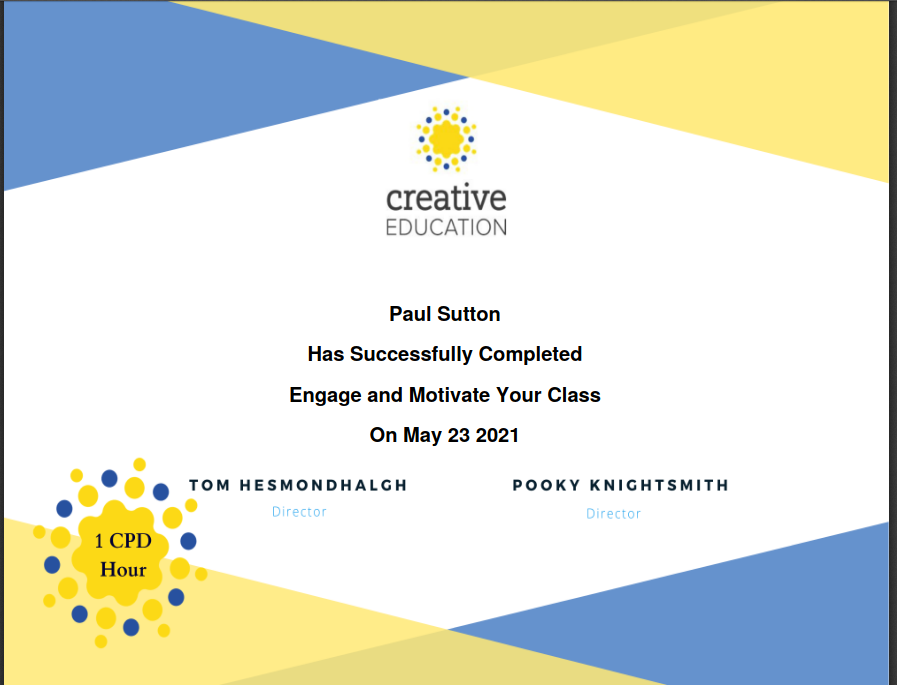
Creative Education : How to Engage & motivate your class 23/5/2021

Just completed another excellent short course with Creative Education. Got a few ideas from this to take in to Coder Dojos or Code Clubs at least. Should also be very useful in classrooms when working with small groups.

Course presented by Austen Hardwick.

Some good vocabulary for my CV too.

This course is based upon 4 ‘P’ principles which enable children (and teachers) to find fulfilment in their working day. Born out of personal experience, it builds a framework for classroom learning in which children and teachers are able to explore their potential in a mutually supportive and positive environment. Developed within primary schools (although with the potential for secondary application), these principles can change the atmosphere of learning for everyone. 

Motivate Class

REFERENCES

TAGS

#CreativeEducation,#Support,#Children,#Help,#Motivate,#Class

Moon Hack 2021

Code Club Australia is ready to welcome you to Moonhack 2021! [1] This global event will be running 24–30 May with the theme 'planet-saving solutions'.

I have put information below and included DIRECT links to the information as the e-mail bulletin seems to contain tracking links, which are suspicious but also I don't consent to.

Where : Global Online When : 24–30 May

MORE INFO

REFERENCES

  1. Moonhack 2021

Freenode IRC exodus

Recent events, relating to the ownership of Freenode IRC network, has resulted in a mass exodus, to a new network, LiberaChat. [1]

REFERENCES AND BACKGROUND INFORMATION

1 LiberaChat

TAGS

#IRC,#Chat,#Exodus,#LiberaChat,#Freenode

Creative Commons Licence
This work is licensed under a Creative Commons Attribution-ShareAlike 4.0 International License

Informational Interviews

So I recently attended the Scismic webinar on Informational Interviews. This follows on from the 'A summary of you' webinar from 7th May.

The webinar included an explanation on what an informational interview is, the purpose. preparation and how to go about setting on up. The difference between this and a formal interview process and the fact these interviews are about finding out about roles and not about asking for a job.

Some excellent tips were on the sort of questions to ask, the type of questions can be put in to four categories.

A really good webinar. I am adapting my notes as I am not looking at working in Biotech, nevertheless the idea of the informational interview could be really useful going forward.

If you are looking for a job in Biotech I would recommend reaching out to Erin at Scismic and seeing how they can help.

REFERENCES

1 Scismic

TAGS

#Jobs,#Interview,#Information,#Networking,#Applications, #Scismic,#Webinar,#BioTechnology,

Creative Commons Licence
This work is licensed under a Creative Commons Attribution-ShareAlike 4.0 International License

CoderDojo Training

As we come out of lock down in the United Kingdom, thoughts are turning to the restart of events. This includes Code Club. We are thinking it may be better to restart this as a CoderDojo as that allows more flexibility and creativity in activities and for attendees to focus on their own projects and self directed learning.

I have therefore, undertaken the training linked to running a CoderDojo.

Ethos Mentoring Safeguarding

Update: FutureLearn course completed.

Update : 17/5/2021 I am also undertaking the FutureLearn course on starting a CoderDojo.

REFERENCES

TAGS

#CoderDojo,#Training,#Safeguarding,#Ethos,#Mentoring,#Clubs,#Tech,#Children,#YoungPeople

Creative Commons Licence
This work is licensed under a Creative Commons Attribution-ShareAlike 4.0 International License