Sprig

A blog musing about methods that could create an optimistic future

It is no secret that white reflects heat, and that is true for your roof as well. In fact, many hot climates around the world have been utilizing this knowledge for centuries.

“The darker the surface, the more the heating. Fresh asphalt reflects only 4 percent of sunlight compared to as much as 25 percent for natural grassland and up to 90 percent for a white surface such as fresh snow.” Yale

Other places have also started catching on. For example, even in 2012 in the USA, volunteers started painting tar roofs white in New York. 1 However, this is not something trending everywhere. Some places are accustomed to dark colored roofs, so even in hot climates, they are slow to change.

This change will of course be easier in places where flat roofs are more common and ready to paint, but slanted roofs have options too. For example, metal roofing is more environmentally friendly2 than shingles, is more durable, and can last longer. What is more, the reflective properties of the metal can also help cool your homes.3

#GreenLiving #BetterBuilds #Construction #homes #houses

SprigLogo

Seeds As Intellectual Property

Seeds might seem like a non-controversial subject, but it can get very tricky. Let's say you breed some oat varieties together to create a plant that is resistant to a type of blight. Well, now you can claim the plant as your intellectual property, and thus make it illegal for farmers to save the seeds from the crops they grow. If the farmers want to protect their crops from blight, they'll have to buy your seeds every single year. 1 2

As this continues, companies try to increase the production of the crops (for example, bigger than ever strawberries), sometimes at the cost of breeding out nutritional properties  and varieties that might have resistance to other risks (for example, a plant having higher resistance to droughts).

There are some efforts to fight this, however. For example, there is the Open Source Seed Initiative and Open Source Seeds which both aim to protect and increase options for seeds that are public domain.

Seed Bombs

Masanobu Fukuoka (1913 – 2008) was a promoter of no-till and natural farming from Japan, and was well known for his work on fighting desertification. 

He was a microbiologist and agricultural scientist specializing in plant pathology, and his personal research and writings earned him awards as he traveled the world teaching(including meeting with the United Nations).

Seedball is a mixture of clay and various seeds, that allows the seeds to stay protected inside the ball until it rains, and the conditions become favourable for sprouting.

One aspect he was most known for was his use of seed balls, which was an ancient technique he re-discovered and popularized. The idea is that the seeds are protected, but will become exposed when it rains. As the clay breaks apart, the seeds that are meant to grow will grow.

In 1973, those seed bombs started being used by Liz Christy for guerrilla gardening, and has been used for that since.

DIY Seed Bombs:

  1. Gather a variety of seeds, and mix them together
  2. Knead the clay, adding small amounts of water. Kneed well to avoid cracks.
  3. Mix seeds into a small amount of clay so that the seeds are not exposed and roll into a round shape.
  4. Throw the seed balls where you want them to grow.

#farming #gardening #permaculture #rewilding

SprigLogo

Grey water is waste water from your house that is not from your toilet, and is instead from things like your shower, sink, and dishwasher. Instead of letting the water go down the drain, some people are reusing their grey water to both save water and (for those with water-bills) save money.

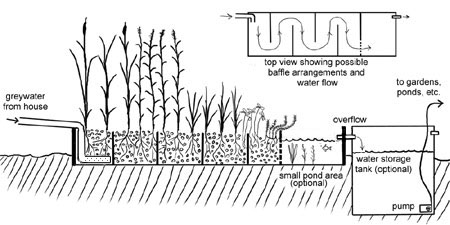
How it typically works is that the grey water is piped into a series of natural filters, so that the result is surprisingly clean water without the use of chemicals. That water (while not drinkable) can be used to water plants.

Do note that to use this system, you must use bio-degradable detergents, soaps, and so on. Non-biodegradable products may be too harsh for your system to break down and could harm plants and wildlife.


Garden System:

Water is piped out into a filtration system series. Here is a common setup:

Course Medium:

Something to catch foods and other solids. Examples: – A container of mulch or coconut fibre with worms. The worm castings (waste) can be removed for the garden. – A container of sand.

Grease Trap:

The oil and geese will raise to the surface of the water as it settles, so that it can be removed from the water. – 📺 How to make the easiest home-made grease trap by Off Gridding on a Shoestring – 📺 How a Grease Trap Works by Southwaste Disposal LLC

Mock Wetlands:

wetland plants grown in a gravol rock medium (such as volcanic rock). The plants and microorganisms will help break down food particles and minor pollutants into harmless elements. Some wetland plants are even known to remove heavy metals. – 📺 How to Recycle Waste Water Using Plants by Andrew Millison

Holding tank.

A tank to hold the now filtered water.

Suggested Videos: – 📺 Simple Permaculture-Based Grey-Water Treatment System

Greywater | Source: Lawrence Fields.


Toilet System:

Some companies (such as Aqualoop are selling systems that clean your water in a reservoir within your house, so that the grey water can be used within toilets. There is little point to use potable (drinkable) water within your toilet, so these systems can save money and water.

#water #garden #farming #greywater

SprigLogo