My opinion: a review of the island Formosa
It's been quite a little bit since I had something to write that I felt confident about. After all, I spend a lot of time thinking, and it takes a while for me to fully get down how I feel about a topic.
Sometimes, writing helps me with that. At other times, I need to really experience and think about something in full before I can put my thoughts down well.
But today, this month, I want to summarize the time that I've spent in Taiwan over the past year or so.
I've been in Taiwan for a little while. Not for a super long time, but the first time that I came was a little over a year ago, and I returned for a few months last fall and for the length of this summer. I'm still here; I'm writing this from the top floor of my favorite cafe in Taichung (actually, probably my favorite in the world).
But not all is necessary well in any given place, and while I've definitely sung both the praises and my complaints about what I've felt and seen being in Taiwan for a relatively short time before, I wanted to put my thoughts down together just to think through my final opinion on this place and give my mind some rest before I leave in a few weeks.
This is organized by topic, and I'm going to try to make this a fair review. Think of it as a Google Maps review for an entire country. My main motivation for doing this really is to summarize and explain my experiences so that I can make sense of them for myself and so that I can be honest without being too generous or too harsh.
So: the first topic from the list of things that I've spent possibly far too long pondering, here is my full review of Taiwan as a New Englander.
The environment
What the entire country is built on top of is this little island in the Pacific. Part of the first island chain, a little bit southwest of Okinawa and east of Fujian. As you'd expect from an island in that region, the weather's pretty hot and wet, but the distinctive element that sets the region apart isn't just the weather: it's the mountain ranges.
Sitting at the intersection between the Eurasian and the Philippine tectonic plates, Taiwan is a very tall mountain range. Most of the island is made up of mountains; the only actual major inhabitable parts are near the coasts, where flatlands exist on the western side. Not too long ago, only about 25,000 years ago, Taiwan was connected to mainland China via land; at the end of the last glacial period, the rising sea levels covered what is now the Taiwan Strait.
The result of this is that just about every city in Taiwan has stunning and excellent mountain views. Taipei sits at the base of an ancient lake bed; all around it are mountains that are visible from most parts of the city, and even come into inhabited regions in famous places like Ruifang in New Taipei and Yangmingshan in the north. Every city has some kind of geography that defines its existence; the Taipei Basin is no less special than any other densely-inhabited region of the world.
 Some of Taiwan's mountains in Kaohsiung's Gushan District.
While the majority of Taiwan is mountainous, most of the inhabited parts of the island fall on the west coast, where there are a lot more flatlands. Taichung, the city that I've spent the most time in here by far, is located at the center of the island's largest flatlands, where a lot of industry and agriculture (especially rice farming) are located. While you can see the mountains far off in the distance from Taichung, most of central Taiwan has a decidedly less interesting geographical setting.
Not until you get all the way down to Kaohsiung does the landscape become a lot more interesting again: the mountains that go straight to the seashore are something that you generally don't see in other cities in Taiwan, other than Keelung, Taiwan's other major port city in the north.
Taiwan is also very green. The Tropic of Cancer runs directly below Chiayi City and basically defines the barrier between central and southern Taiwan; for a relatively small island, Taiwan experiences a lot of climate diversity. While the north is mostly temperate and rainy, the south is hot and tropical, despite being only two hours apart by HSR. The temperature differences between the two become especially significant in the winter, where Taipei's temperature can fall into the 10 – 20°C range, while Kaohsiung's usually stays above 20°.
Even more stark is the difference between the climates in the lowlands and the high mountains; taking the Alishan Forest Railway from Chiayi City to the Alishan region gives you the best experience of the transition, as palm trees and tropical growth in the lower mountains give way to flat gravel forest floors, ferns, and tall pine trees in the upper mountains.
 Hikers ascending steps in the pine forests of Alishan. lumoplank, CC0, via Wikimedia Commons
A lot of these pines, hinoki pines, were once harvested by the Japanese to build a lot of their classical Western-style architecture in the lowlands. Chiayi City has an attraction called Hinoki Village, a park built by the Japanese entirely out of these hinoki pines. Chiayi was once the center of the hinoki logging industry. The hinoki forests of the upper mountains are something that, until you go up into that region, you would never expect to see in a place like Taiwan.
The main features of the climate on an everyday basis are the heat, humidity, and rain. Rain is to a different degree depending on which part of the country you're in; it's more significant in the north than in central or southern Taiwan, but the rainy season can still hit hard no matter what region you're in, with monsoon rains sometimes continuing for at least a week.
Overall, Taiwan has an interesting and enjoyable outdoor atmosphere. Hiking trails, like the Dakeng trails in Taichung or the trails throughout the Alishan region, provide a good opportunity to see Taiwan's landscapes in all their diversity and beauty. Taiwan is really an excellent spot for nature enthusiasts.
The cities
Taiwan's cities are dense. Taking the United States Northeast Corridor as a reference, the entire west coast of Taiwan being urbanized is a megacity of similar magnitude; even when the major cities drop off, there are still houses, convenience stores, and at least agricultural land all down the highways, train, and HSR lines in the western part of the island. This has a lot to do with the fact that Taiwan is so densely populated; even given that it's already a relatively small island, the density is intensified by the fact that all of the island's center is that mountainous region, moving all of the major population centers to the coasts.
 The Taipei skyline. Photo by CEphoto, Uwe Aranas
But, the amenities are excellent. From midsized “provincial cities” (Keelung, Hsinchu, and Chiayi) to the designated special municipalities (Taipei, New Taipei, Taoyuan, Taichung, Tainan, and Kaohsiung), bus systems are ubiquitous and high-quality, although MRT deployment in cities other than Taipei has been relatively sparse and delayed since the Mass Rapid Transit Act originally laid the plans for the metro rail systems of the nation's major cities in the late 1990s.
Urbanism in Taiwan's cities truly depends on the city that you're in. Taipei is full of narrow alleys, excellent rail transit, YouBike stations on most street corners, and interesting shopping streets and places to escape from heat and humidity in most places frequented by pedestrians. Cities like Taichung seem to be trying: projects like the Green Line MRT proved that metro rail is feasible in Taichung, a city whose urban form is historically not all that different from Taipei's; Kaohsiung also remains the only city in Taiwan other than Taipei/New Taipei with a functional rail system of more than just one line (although that will change later this year with the Taoyuan MRT Green Line's first phase opening).
The trouble with urbanism in Taiwan's cities mostly falls on the street design. Most major urban roads are reminiscent of American arterial roads, wide and full of lanes, no dedicated lanes for emergency vehicles or buses, limited bike lane implementation, and pedestrian lights that require you to wait at busy intersections sometimes for several minutes at a time, and sometimes requiring waiting for multiple light cycles if crossing the intersection at a diagonal.
 The Zhongxiao Rd. – Zhongshan Rd. intersection in Taipei. Cheng-en Cheng, CC BY-SA 2.0 https://creativecommons.org/licenses/by-sa/2.0, via Wikimedia Commons
A lot of streets are also designed primarily for scooter travel, which means that streets outside of downtown cores sometimes don't have sidewalks at all. Walking in the middle of the road on a hot, humid day with no protection at all from the oncoming traffic is definitely sub-optimal, to say the least. Most of the issues could probably be solved by just limiting the road width, especially considering that a lot of the roads without sidewalks do reserve space for scooter parking on the road edges.
The strangest part is that, at least in Taichung, some of these neighborhoods (in my experience, the ones around Nantun and Beitun) are located directly around MRT stations, which means that the station exits are located in places pretty hostile to pedestrians, and getting a YouBike once you get off the train is basically necessary to be able to travel the area safely.
The only thing that I say usually allows me to feel better in scooter traffic are the electric YouBikes that began to be rolled out last year; these don't go as fast as a scooter, but they're usually enough to make me feel better about the speed difference, and electric bicycles are much easier to ride long distances down an arterial road (this is also not safe, but it's definitely safer and faster than walking down the same road).
Other than metro rail systems, inter-city rail is excellent. Taiwan Railways express trains, especially the Tze-Chiang 2000 (Puyuma Express) and 3000 (“New Tze-Chiang”), are smooth, look nice on the inside, and operate efficient routes. The granularity of the service differences between routes is also a good bonus; a lot of the older-style Tze-Chiang (TEMU1000) series trains operate routes that hit a lot of smaller cities in a row. This means there are routes for crossing long distances between major cities, saving time when hopping from city-to-city, going to the next county over on a fast local train or even just crossing town on a regular local train.
 A Puyuma Express (Tze-Chiang 2000/TEMU2000) leaving Hsinchu Station. Nomad112, CC BY-SA 4.0 https://creativecommons.org/licenses/by-sa/4.0, via Wikimedia Commons
And, in Taichung, where the Blue Line MRT has not been completed yet, the local (and especially fast local) trains take you from Taichung Station to Daqing Station quickly for connecting from the old city center to the MRT.
There are also really great tools for finding routes and purchasing tickets; my favorite is an online website designed by pili.app. A link to the tool is here, and all you need to do to find an entire schedule of all rail service covering your desired route is to enter the station you're coming from, the one you're going to, and optionally, the day of the week and time of day. You can also specify train car type. I usually look up the train number that I want using this web app, and then purchase the ticket from one of the kiosks in a train station using the “train number search” feature.
Other than rail service, there are even more standout features of Taiwan's cities. Despite being somewhat uncomfortable on the ground for the reasons I've already described and for other ones, like the fact that a lot of sewers are exposed in residential neighborhoods (for example, the alley with the entrance to the apartment I currently live in perpetually smells like waste because the manhole cover has ventilation holes in it and is right near my front door), the city sightseeing is usually excellent.
The way that Taiwan's cities look is a standout feature. It usually depends on which type of neighborhood you're in; in Taipei, Xinyi is a wealthy financial district that looks a lot like the wealthy financial districts in American cities, like downtown NYC; in Taichung, the Seventh Redevelopment Zone is the new development region all along the Green Line MRT that serves as a district for luxury apartments and new, tall office buildings that create an impressive skyline for anyone passing through the area on the MRT or on the HSR that also cuts through that area.
In other parts of Taiwan, the urban form is decidedly less wealthy, but still interesting and beautiful. While a lot of buildings in Taiwan's cities are covered in pool tiles and don't get cleaned regularly for reasons of frequent rainfall and extreme weather, the mix of residential, commercial, and industrial land uses all together makes for very interesting combinations of destinations in one place (i.e., any given neighborhood gets to have its own hardware store, dentist, old residential complex, movie theater, and apartment tower all right next to each other).
Even the old advertisements on the sides of buildings are charming. I especially love the Chinese fonts that are usually used to print text in those advertisements. Industrial facilities and hardware stores usually mean business; the company name and phone number being printed on the side of the building in attention-grabbing colored text is a surprisingly neat addition to the skylines of older parts of Taichung.
 The skyline of Central District in Taichung as seen from the square in front of Taichung Station. Ralff Nestor Nacor, CC BY-SA 4.0 https://creativecommons.org/licenses/by-sa/4.0, via Wikimedia Commons
I think that the relatively disorganized mess of urban form in Taiwan's cities makes for a pretty democratic atmosphere; you have people of all kinds and industries of all sorts all taking up the same land. Not to mention the history; Western-looking old Japanese wooden and brick buildings are often placed in and around the newer architecture, which makes for an interesting form of history in plain sight. Taichung and Taipei both have fairly famous examples of this kind of thing; the Presidential Office and the old Taichung Station are both neat artifacts.
The history
Taiwan has a very interesting history. It's not actually even particularly long; Taiwan's modern recorded history begins with the Dutch having settled a trading post in Tainan in 1624. Before then, Taiwan is said to have been the home of the original Polynesians who sailed away to settle islands all across the Pacific.
The Dutch eventually lost their trading post to a band of Ming-dynasty loyalists after the Qing took hold of the mainland later in the 17th century; when that government, the Tungning Kingdom, eventually became economically starved by a Qing imperial order that all Chinese evacuate the coast in order to prevent trade between the Tungning Kingdom and the mainland, the Qing basically annexed Taiwan, but reluctantly.
After creating the infamous “ox ditches” that defined the line that Chinese settlers could not cross (an act by the Qing government to try to keep Chinese settlers away from the aborigines in the mountains), settlers who continued to come to form towns and settlements and make money farming and by other means continued to push those ditches further and further back. By the time that Taiwan was finally incorporated as a province of China in the 1880s under its new governor, Liu Ming-chuan, a lot of the modern settlements that have become cities today had already been formed.
After the first Sino-Japanese War, though, the Qing government was looking for relatively non-valuable possessions to give up to the Japanese as war reparations. Because Taiwan was still underdeveloped and fairly disease-ridden compared to the mainland, the Qing government ceded it away to Japan without much of a thought; while this made still-governor Liu Ming-chuan angry at the loss of all of the work that he had done over his approximately decade-long tenure as governor (including installing street lights in Taipei and the nation's first plumbing systems), the Japanese were just beginning their imperial surge and were happy to take over an island that they could use as a model for future colonies.
A six-month war between the Chinese settlers on Taiwan and the Japanese took place; although the Chinese settlers declared an independent republic, the “Republic of Formosa”, and even created their own now-famous flag, most of these settlers were still loyal to the Qing and hoping that, after a successful war effort, they could return Taiwan to the Chinese empire and re-incorporate as a province. In their six-month period of existence, the Republic of Formosa churned through three presidents, and in the end, the Japanese won anyway.
 The flag of the short-lived Republic of Formosa. KayleighsStuffz, CC BY-SA 4.0 https://creativecommons.org/licenses/by-sa/4.0, via Wikimedia Commons
The Japanese were the first government on Taiwan to actually annex the entire island. Although the beginning of their colonial effort came slowly, they began to build infrastructure projects, including railways and power stations, they began to provide education (although with the alterior motive of indoctrinating the people in favor of their new colonizer) to the Chinese and to aborigines, trying very hard to integrate Taiwanese in order to make them into “proper subjects of the Japanese empire”.
There was a period in the late 1920s into the mid-1930s that Japanese Formosa was prosperous and even relatively socially democratic; by this time, Taiwanese Hokkien-language pop music began to become popular, and the Taiwan People's Party began a short time as an opposition political party for the social independence of the Taiwanese from the Japanese empire.
At the beginning of World War II, Japan began to become increasingly warlike, trying to silence any internal opposition to their colonial campaign by controlling the media with an increasingly heavy hand. At this time, education in Taiwan became squarely Japanese, requiring citizens to learn the Japanese language and denying services like quality public education to non-Japanese speaking households.
At the end of World War II, with Japan's loss and the Republic of China having sided with the Allies, the US's President Roosevelt and the then-Chinese dictator Chiang Kai-shek signed an agreement to cede Japanese Formosa to the Republic of China after the end of the war. After Japan lost, retrocession came in 1945; the Chinese military sent nationalist parades through the streets of Taipei as a show of victory and became a government in occupation of Taiwan until the Treaty of San Francisco was signed in 1951, officially relinquishing Japan's sovereignty over Taiwan (although infamously never actually naming the Republic of China as its successor).
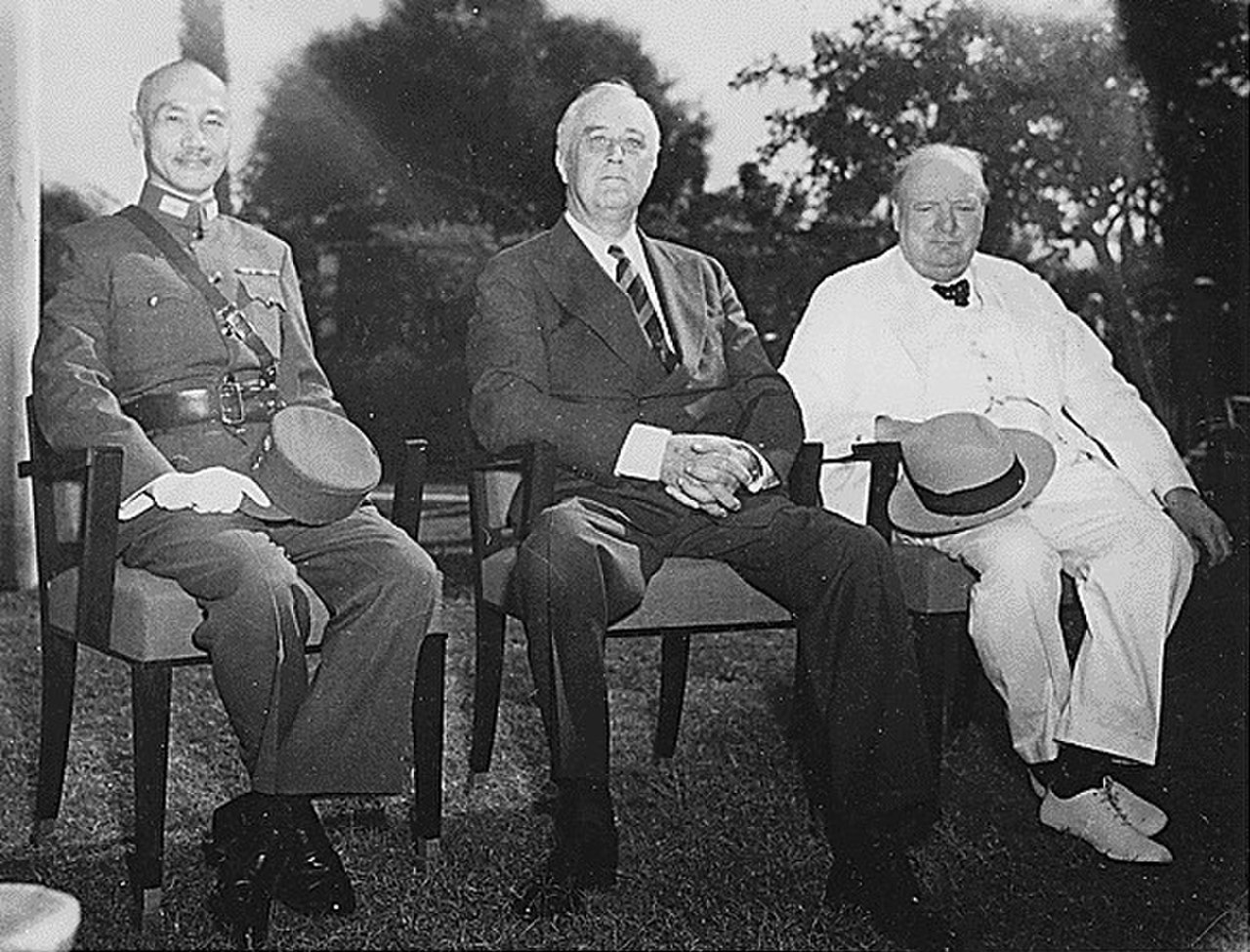 The Cairo Conference, 1943. From left to right: Chiang Kai-shek, Franklin Roosevelt, Winston Churchill. Roosevelt, Franklin D. (Franklin Delano),, Public domain, via Wikimedia Commons
Life changed in Taiwan quickly after retrocession. The parades through the streets of Taipei demonstrated just how ragged the Chinese troops had been; some wondered how it was possible that they could have been victorious over the strict, efficiently-managed, always-on-point Japanese military.
The reasoning had been American military support near the end of the war. After the retrocession of Taiwan, the Republic of China continued to count on external resources to continue to fund their internal war with the Communist Party, which had taken a brief hiatus to fight the common Japanese enemy throughout most of the 1940s. Once China had control of Taiwan, they looted its wealth and infrastructure, shipping much of it away to Shanghai, where railway tracks were melted to make weapons.
The Republic of China also continued to rely on US military funding. While Roosevelt had supported the Republic of China, his successor, Truman, saw the looting and mismanagement happening in Shanghai and in Taiwan, and refused to continue to provide much aid unless Chiang's administration became more responsible. Truman is the one who coined Chiang's later nickname, “General Cash-My-Check”.
Throughout the late 1940s, the Republic of China continued to lose land in China to the Communists. In October of 1949, Mao stood and declared the People's Republic of China; about a year later, the Republic of China lost control of Hainan Island, just south of Guangdong. The only secure property that the Nationalist government was left with was Taiwan: and so went a massive campaign throughout 1949 and 1950 to move remaining Republic of China loyalists from the mainland to Taiwan. An influx of several million people came from all across China to the small island.
Being that the government, now stranded on Taiwan, hailed from the mainland, there was a lot of pushback from locals to the number of government officials, especially appointees, who came from the mainland. Decades of racial tension between those whose families had remained in Taiwan for much of history and those who came in 1949 followed; the core of the strife was sparked in February and March of 1947 by an event, called the “228 Incident”, that revealed the exact strength of the divide between the people of Taiwan and the government in power.
On February 28th, 1947, a woman selling cigarettes in Taipei without a license was assaulted by a monopoly bureau officer enforcing the tobacco monopoly; when locals rioted in protest, the government cracked down, killing rioters and continuing until riots had spread all across every major city on the island. In early March, there were calls for a meeting with the then-governor, Chen Yi, to discuss how to resolve the violence, and he promised to meet with a council of local appointed officials who would discuss peaceful steps forward.
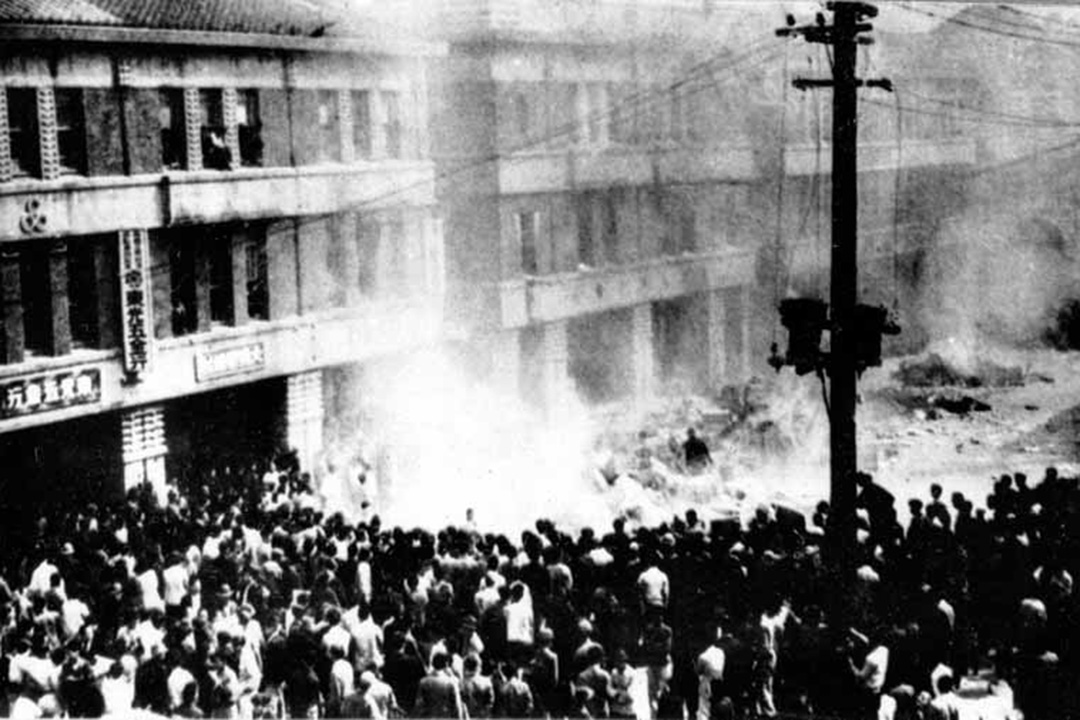 The Monopoly Bureau building in Taipei, February 1947. [1], Public domain, via Wikimedia Commons
This meeting continued to be delayed by Chen Yi, while at the same time, military troops were called in from the mainland at the same time the governor insisted that he would not do that exact thing. When the troops arrived, the violence got even worse and ended with a declaration of martial law at the end of March 1947. While Chen promised to lift martial law as soon as the issue had been quelled, another declaration of martial law came down again due to continued unrest just a year afterward, and so the long White Terror period began.
Chiang Kai-shek, stranded on Taiwan after 1949, remained the president of the Republic of China throughout this period; his son, Chiang Ching-kuo, lead the Taiwan Garrison Command, the nation's secret police agency. Despite continually promising to “retake the mainland” and restore the Republic, Chiang continued to accept military aid offered by the United States without ever again provoking the PRC. A successful stand to keep Kinmen Island, just off the coast of the PRC's Xiamen City, occurred in October 1949, finalizing the Republic of China's current boundaries that remain to this day.
Throughout the martial law period, democratic direct elections of high officials were made illegal, with only small show-elections of local officials occurring on occasion (although still with occasional interference from the national government). A two-government system was upheld under the last constitution of the Republic of China, a government that still claimed to include all of mainland China and where Taiwan was considered just a province; this was a way to maintain the illusion of the government's messaging at the time that the Republic of China remained the sole legitimate government of all of the mainland (even Mongolia, a territory that the People's Republic soon abandoned).
 The official border of the Republic of China as determined by the 1947 Constitution. Mongolia is highlighted in the north. Lilauid, CC BY-SA 4.0 https://creativecommons.org/licenses/by-sa/4.0, via Wikimedia Commons
The “dual government” refers to the national government of the Republic of China, which only governed Taiwan, and the Taiwan provincial government, a provincial government as outlined in the Republic of China's 1947 Constitution (a revised version of the Republic's constitution meant to take effect during the Civil War as an attempt to regain some public support and demonstrate some kind of progressive reform).
The dual government system offered a way for the Chiangs' control over the regime to be legitimized; while Chiang Kai-shek continued to serve as President of the Republic of China until his death in 1975, his son continued to serve as head of the Taiwan Garrison Command and later as the premier of Taiwan Province; upon his father's death in 1975, then Vice-President Yen Chia-kan assumed the presidency of the Republic of China, but Ching-kuo became the de-facto dictator in his capacity as head of the provincial government. Ching-kuo eventually assumed the presidency himself in 1978.
At the same time, press freedom was restricted; political parties, having been illegalized, organized themselves in the form of magazines. The most influential at the time was Formosa Magazine, which left a permanent mark on the nation's history when it organized a protest for Human Rights Day in 1979. When the protest was suppressed and its organizers arrested and many sent to prison, the event became known as the “Formosa Incident” or the “Kaohsiung Incident”, and it marked the beginning of Taiwan's journey toward today's more democratic and free governmental system, even producing a lot of the leaders who would become major political figures in modern Taiwan.
 The Kaohsiung MRT's Formosa Boulevard Station marks the location of the 1979 Kaohsiung Incident. MiNe from Taipei, Taiwan, CC BY 2.0 https://creativecommons.org/licenses/by/2.0, via Wikimedia Commons
At the same time as these events occurred, Taiwan's economy continued to grow; all throughout the 1960s and 1970s, the country's “economic miracle” stemmed from an increase in industrial production using relatively cheap labor and relying on exports to wealthy nations like the United States. “Made in Taiwan” household products, from TV sets to toys, were common at the time, preceding the opening of China's borders and its own industrial growth.
Also in the late 1970s came the official end of diplomatic relations with the United States. While the US had continued to observe the Republic of China as the “real China” for several decades following the end of the Chinese Civil War in 1949, maintaining an embassy in Taipei, a Nixon-era switch to more “common sense” diplomatic norms finalized under President Carter, who formalized the change in diplomatic recognition to the People's Republic in 1979. The Taiwan Relations Act of the same year maintained that Taiwan would be supported in its own defense and would continue to enjoy unofficial diplomatic relations with the US.
In the 1980s, Taiwan continued to become a wealthier nation, and in 1987, still-President Chiang Ching-kuo lifted martial law for the first time since the 1940s. After his death in 1988, his Vice President, Lee Teng-hui, became the President of the Republic of China, a more moderate member of the then-ruling Nationalist Party and a western-educated Taiwanese.
Under Lee Teng-hui came space for the country's first opposition party, the Democratic Progressive Party, as well as the creation of the National Health Insurance system and the country's first democratic direct presidential elections in 1996. 1988 even saw the formation of TSMC, the company that remains Taiwan's primary economic driver to this day.
In the year 2000, the conservative Nationalist vote became split between KMT Presidential nominee Lien Chan and former KMT-member turned independent presidential candidate James Soong, who saw himself as the “true” Nationalist presidential nominee. That vote split allowed the opposition DPP's Chen Shui-bian, with just under 40 percent of the vote, to win the presidency.
With the beginning of Chen's administration came a continuation of the trend of increasing press freedom and modernization. In 2006, the Taipei 101 was constructed and became the dominant mark on Taipei's skyline, and a symbol of the new Taiwan that we see today.
Taiwan's modern history as a nation is interesting and somewhat inspiring. Although the country spent a long time as a fascist dictatorship, it was able to become one of the most democratic and modern nations in East Asia with surprisingly little violence on the part of the reformists, one of the most famous features of Taiwan's political turn.
I find Taiwan's history to be one of the most engaging subjects to learn about when visiting or reading about the country. You can easily see a lot of the history in everyday life; as mentioned, most cities still have Japanese architecture dotted throughout the modern landscapes. Chiang Kai-shek Memorial Hall still stands to remind people of Taiwan's undemocratic and not-so-distant past, while the temples in every neighborhood provide reminders of heavy traditional Chinese cultural influence.
I enjoyed learning about the history a lot, even before I came here for the first time. Books like George Kerr's Formosa Betrayed and Peng Ming-min's A Taste of Freedom are both good reading and essentials for understanding Taiwan during its martial law era. Another standout that I read at one point was Wu Cho-liu's Orphan of Asia, a novel that documents the life of a Taiwanese intellectual during the tail end of the era of Japanese rule.
All that being said: you can enjoy a whole lot of Taiwan through just engaging yourself in this history and this reading.
The society
I've had a mixed relationship with people here. I've made a few friends, especially in the first time that I came through a business class that I took at my home university, where we combined with students from National Chengchi University to create expansion plans for a Taiwanese company of our choice to the United States. The friends that I made through that program, and through coming to the lab that I've been working in last fall and this summer, have been excellent. Even my PI here is personable.
In many places throughout cities, in the cafes that I frequent and the stores that I go to weekly, those people that I interact with often are also nice, and it adds a lot to the experience when I come somewhere and have a type of limited friendly relationship with the person behind the counter. It's not too difficult here to meet people that are nice in that way.
But I have struggled with society here in general. At least for someone who's visibly a foreigner, like myself, there's a lot of “外國人!” finger-pointing on the streets that can be strange and jarring. And a lot of people don't know how to, or just don't want to, interact with foreigners at all, which is pretty discouraging when it happens. There have been number of times that store attendants and people at markets refused to talk to me or insisted on pulling out a translator to try to give me English even if I had asked them a basic question or said I don't care that much about their, or even expect them to know, English at all.
There's also a fair bit on the other end of the spectrum, too, where people engage with me in ways that seem strange and inappropriate in public because they're strangely excited to see somebody foreign-looking, which isn't any better.
One of the root causes is that there seems to be too much insistence here on English being some necessity for communication with the world, and too much fear on the “otherness” of people from abroad, when in reality, the messaging should be that learning a foreign language like English is just the same as any other tool that you learn and that regular social rules still apply to people from elsewhere. I had so many people trying to cater to me in ways that were strange or unwanted, like having people at a local restaurant change the music (that was playing for everybody) to strange English pop music I didn't recognize away from their usually decently-curated Mandopop if I ever came in with my friends, or my last landlord getting strangely deferential and asking about how foreigners expect to be hosted (he said I was the first to ever live in his building).
On a related note, being told that you need to learn English to communicate with foreigners seems to be one of the core things that makes people afraid of me when I'm trying to live my everyday life. As I believe or choose to hope anyway, my Mandarin isn't that bad. Most people let go of the fear after we actually started talking, but there were a few people that I met that never let me talk to them at all (and would instead use the closest Taiwanese person as a proxy, or just refuse to say anything at all and communicate with hand motions).
Some people here are also just condescending about foreigners who've chosen to come here. I'm not sure what preconceived notions that they have, but there are a lot of people here that I meet that, even if they do interact with me, don't seem like they want to be there. And sometimes, people are just rude.
One time in particular is fresh in my memory when I went to a FamilyMart, just to get some food, and the person behind the counter ordered me around with his finger and tried to send me out the door with a soup spoon instead of chopsticks for eating a bento. When I asked for them, he yelled all surprised that I knew what chopsticks were and then took away the spoon, threw the chopsticks in the bag aggressively and pointed at the door. In that case, the pointing was really unusual.
So, overall, it's just strange and sometimes unfortunate.
I would imagine that most countries are this way, and that I'm a little bit of a sheltered child having grown up in a place (northern New England) where, admittedly, people were not extremely diverse in mother languages and appearances. A lot of Americans act in a lot of the problematic ways that I just described, too, and I know this for sure (actually, American actual racism is a uniquely-documented and horrific beast).
Taiwan still does have some improving to do, though. A lot of the friends that I've made in Taiwan have been Indonesian, and there are a lot of Indonesian people here. It's still clear that most Indonesians in Taiwan, whether they're here temporarily, permanently, for education or as laborers, don't get nearly the amount of right to societal participation that they should. A lot of Southeast Asians and people from all over the world could and do have families and jobs here. It would sure be nice if they could attain citizenship, or if, at the very least, Taiwanese could allow more room for freedom in a national culture so heavily defined by bloodline and physical appearance.
I've once heard a statistic that 10 percent of Taiwan's workforce today is migrant labor. Most of those migrant laborers come from southeast Asia, from Indonesia, Malaysia, and the Philippines. The Taiwanese government seems to be doing a decent job of using migrant labor to substitute for a lack of local labor due to a declining birthrate (better than Japan is doing, a place where they act much more fervently on their anti-immigrant sentiment and where they, too, have a severe birthrate problem).
The concerning part is Taiwan's doublespeak in its stated goal of becoming a “multicultural society”. One of my Taiwanese friends once told me that Taiwan really is a multicultural society, and that seems to be the government's official messaging, with multilingual signage all over the country and places like ASEAN Square in central Taichung (formerly First Square), providing community hubs for migrants from Southeast Asia.
 ASEAN Square, a resource hub for Southeast Asians in Taichung. Fcuk1203, CC BY-SA 4.0 https://creativecommons.org/licenses/by-sa/4.0, via Wikimedia Commons
But the culture is certainly not there yet. Being that, short of being a 7-foot-tall professional basketball player, attaining Taiwanese nationality requires having Taiwanese heritage or giving up all prior citizenships, most migrant laborers are never going to be able to fully partake in public life.
In addition, culture in Taiwan still firmly pins anyone without Han Chinese heritage as an outsider. The finger-pointing that I described earlier, and the awkward, hostile, or abrasive interactions with people, only usually occur to people who look physically different. Multicultural societies usually arise because they're wealth centers, and most wealth centers inevitably become some kind of multicultural society. Taiwan has become a wealthy country, and it would be better than not for them to embrace the change and to rethink at least a little bit of their so heavily race-based national identity sooner than later.
While I'm not going to proclaim that Taiwanese people have it out for all foreigners, I don't think that the culture here is nearly mature enough to consider the problem solved. That does degrade the experience for a lot of people. Some people here are very nice, but it's certainly not everybody, and there will be bad experiences for a lot of those who stay for any extended time.
So, overall, I think that the culture here has years to develop before it truly becomes welcoming enough for foreigners to be able to partake in society, and that can be uncomfortable sometimes.
Tourism
Although this section might be placed somewhat strangely at the end, I wanted to put it here so that the rest of the review could provide context and so that I could end the review on a nice note for people who might never have come to Taiwan before. I'll also keep the section short, so that it can be a nice, compact summary of places you'd want to visit here.
There are a lot of places in Taiwan that are well worth seeing. My favorite is the Alishan Forest Railway. I love it because, as a New Englander, the weather and landscape reminds me a little bit more of the landscape of home, with the mountains, the cool air, and the pine trees; the hiking trails around Alishan and the sunrise view after the Zhushan train ride are both excellent once you're on the top of the mountain, and overall, the experience is pretty unique.
 An Alishan sunrise during the winter, when the fog descends because of the cold, creating the famous sea-of-clouds effect. Suicasmo, CC BY-SA 4.0 https://creativecommons.org/licenses/by-sa/4.0, via Wikimedia Commons
Halfway up the train journey from Chiayi (and only on the way up), the stop at Fenqihu gives you a nice little Jiufen-esque mountain town to explore and get some lunch in. Things are relatively expensive there, but being that it's a tourist town, the people there are friendly and the food and gifts for you to buy on Fenqihu Old Street are genuinely good.
 A mountain view from Fenqihu Old Street. 阿道, CC BY-SA 4.0 https://creativecommons.org/licenses/by-sa/4.0, via Wikimedia Commons
The Jiufen that I'm talking about, a similar mountain town closer to Taipei, is another neat little mountain town that's seemingly made just for Instagram photography and to be a beautiful backdrop to a mid-afternoon of traveling from Taipei. Jiufen's main attraction is also its old street, which are usually covered and narrow shopping streets that provide a neat and memorable alley-browsing experience where you can easily get lost and come back with a bag full of gifts to bring home.
For urban tourism, my personal favorite city is Keelung. I've gone with some of my Taiwanese friends to Keelung multiple times, just because it's neat to walk around the port area. There are plenty of good cafes in the area, especially the Sea to See Bookafe, a bookstore with cats, books, games, seating, and even free stickers. You truly couldn't ask for more.
Keelung also has a decent night market, the Miaokou Night Market, directly next to its port. Night markets are dotted all over Taiwan's cities, and are full of food stalls selling staples like sweet potato balls and Taiwanese fried chicken. Some larger ones have games, too, especially prawn fishing and shoot-the-target games.
 The Keelung Miaokou Night Market. Bigmorr, CC0, via Wikimedia Commons
Keelung also has the Keelung Tower, a relatively new construction that represents a somewhat recent trend of recognizable architecture in the skylines of cities around Taiwan; the Keelung Tower, the 85 Sky Tower in Kaohsiung, and the world-famous Taipei 101 are all interesting spots to visit on their own (although the 85 Sky Tower is empty these days, so it's best to visit it from the Kaohsiung Public Library, where you can see it clearly from the park on the top floor. Kaohsiung's public library is also just an excellent library in itself).
Hotels in Taiwan are often fantastic: I could even provide a list of hotels that I like for cities in every region, and I will. – Keelung: the Drizzle Inn – Taipei: the Chaiin Hotel – Taichung: Hotel East Taichung – also Taichung: 1969 Blue Sky Hotel
Circumstantially, the places that I know about in the south are youth hostels: – Chiayi: Lawa House – Kaohsiung: With Inn Hostel
In my opinion, the best way to explore a city in Taiwan is to wander the streets and try to find places, like cafes, libraries, or museums, that look interesting. Google Maps often doesn't produce excellent results because a lot of the best places aren't listed, and I've tried time and again to ask AI about spots to go to and it's usually not been very helpful. Taiwan's cities are good places for explorers.
Conclusion
I've enjoyed my time in Taiwan. I think it's been transformative for the way that I see the world and the way that I think, in an academic, professional, and personal way. Travel is often framed as a way to “see other cultures and experience more of the world”, and while I think that Taiwan is definitely a culture foreign to much of the world, I didn't experience those cultural differences in quite the way that I thought I would.
Despite studying Mandarin and reading about Taiwan's history for years before the first time I set foot here, I still wasn't nearly prepared for the things that I saw, the people that I met, and the culture that I experienced. I've made some good friends, I've also worked on a good few academic projects here and, with the size of the lab I'm working in fluctuating from tiny to forty members, I've experienced both work panic and severe boredom at the desk.
My interactions with my PI have given me a good impression of Taiwanese work culture. Despite having come in on the occasional Saturday and once having found myself in the lab asleep on the bed for data collection, waking up at four o'clock in the morning, it felt nice to be able to roll up to my desk carelessly at 9:45 the next day, and to do the same on those days when I just feel like I need some extra sleep.
The things that I've seen as a tourist, the interactions I've had with all sorts of people in public, and the convenience of city life here have all had an impact on the way that I see Taiwan and the world, some for the worse and some for the better.
So, overall, I give this place a solid 6/10. If you're an outsider and you want to come here, definitely come with friends, and it's definitely better if you make friends from Taiwan in order to avoid some of those negative interactions in public as an all-foreigners group on your own.
I'm going to have to settle down and make what I can out of the end of my time here while I still can. I don't know if I'll ever come back, but the mark on my memory will definitely stay.
Thanks for the read.