A worked example: one stone, four faces
A stranger asked what a “read” actually looks like. Fair question. So here is one, start to finish, on a real stone. The photographs are four turns of the same piece in daylight: no flash on the first, the back side on the last.
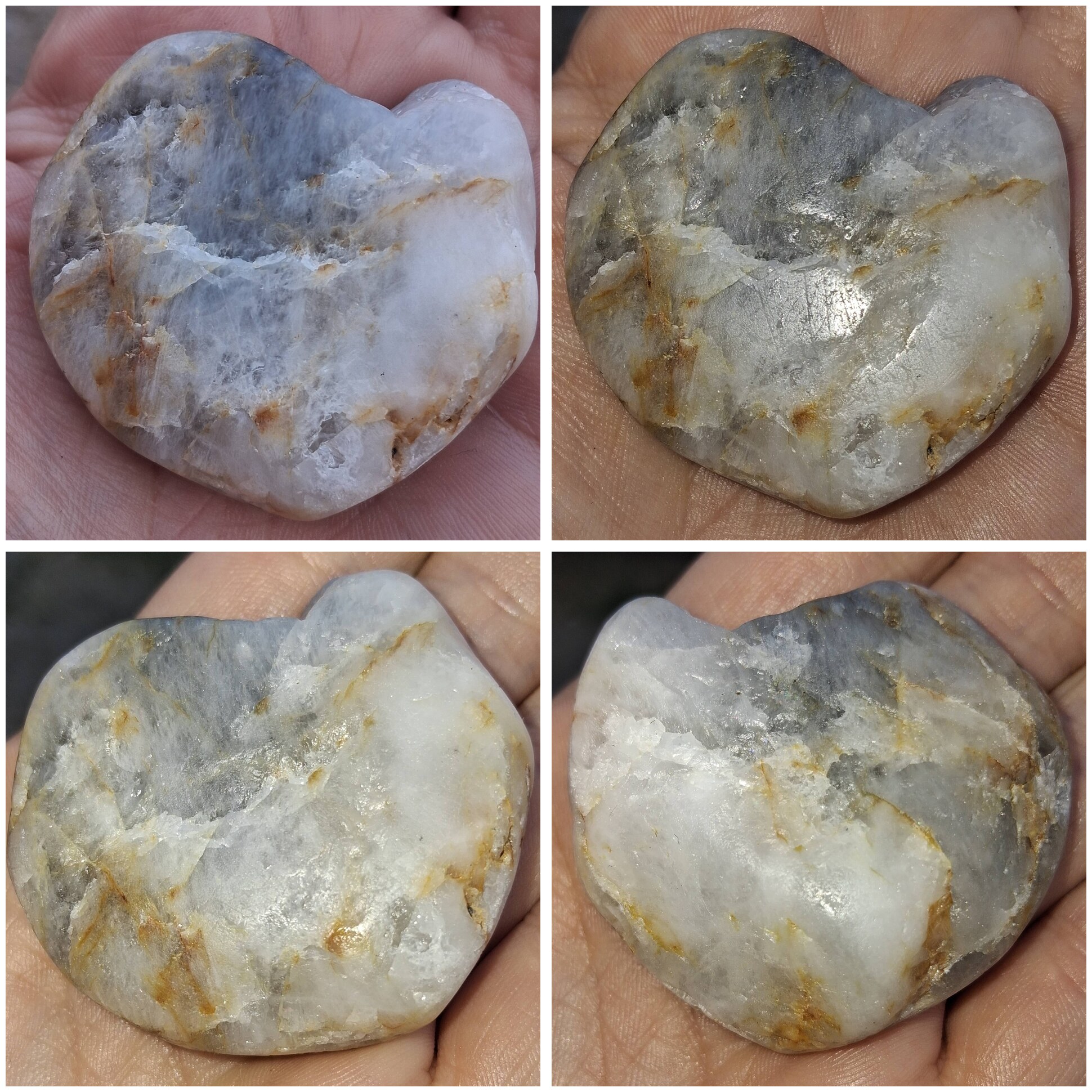
What it is: vein quartz. SiO2, hardness 7. It grew in a crack in older rock, from hot water carrying silica, and it kept growing until the water cooled or the crack sealed.
Where it came from. A shallow bar beside the dam on the West Prong of the Little Pigeon River, in Pigeon Forge, Tennessee. The same stretch of water that carries the banded chert and the phyllite cobbles. A vein-quartz cobble there means the vein it broke off is somewhere upstream, in the older rock of the Ocoee.
Now the read, in the order I actually did it.
The white. Milky quartz. The milk is not a stain; it is water. Fluid inclusions, tiny pockets of the original liquid trapped inside the crystal as it grew. That is why the thin edge passes light.
The dark core. This is the part worth stopping on. It is not dirt or shadow. It is smoky quartz. The colour is radiation damage inside the crystal lattice, activated by a trace of aluminium, dosed into the stone by natural radioactivity in the ground over a very long time. The earth shot it with its own light.
The gold-brown lines. Iron oxide sitting in old fractures. Same iron as most rust-coloured stone. It only lives in the cracks, because that is where water could move.
The horizontal break with the sugary sparkle. A healed fracture. The stone cracked, then grew quartz back into the seam. It broke and healed, in place, with no one watching.
The heart shape. Not carved. Water wore away the softer and more fractured parts faster and left the harder core behind. Deep time did it, on its own.
Four features, one stone, and every one of them is a record of something that happened to it.
Send me a stone and I will do this for yours. First read is free: one clear daylight photo, dry, and one with a light behind it if it passes light. Full read is $20 and includes the tests to run yourself (a knife and a little vinegar name most river stones), what the stone is, how it formed, and where it likely came from.
Write to [email protected]. Or bring it to the in-app desk.