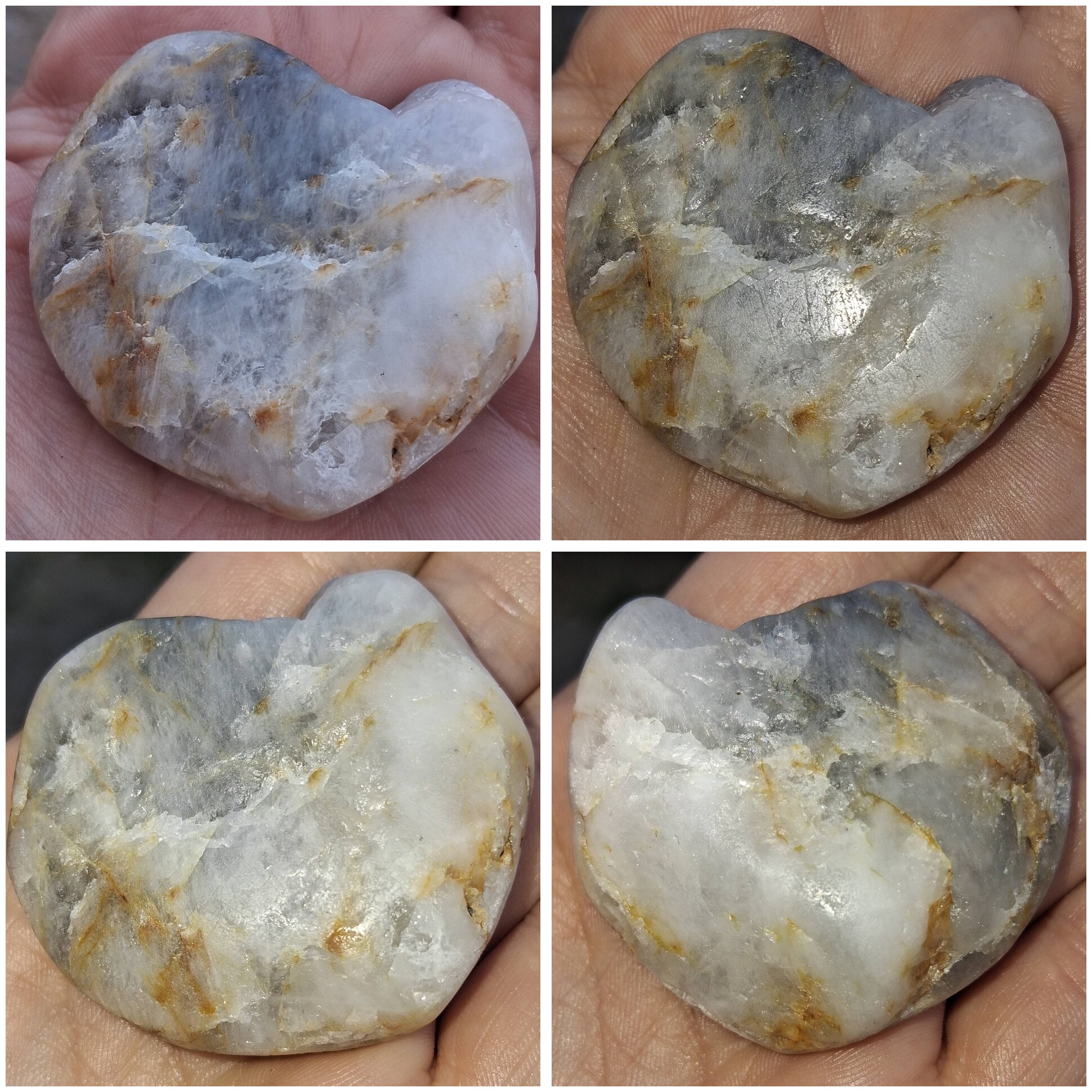
Why a rock rings, and the three taps that tell you why
You hit it. Most rocks answer with a dull clack and stop. A few answer with a tone, hold it, and the tone stays clean for two or three seconds.
That difference is not magic and it is not metal. It is energy accounting.
A strike hands the stone a small pulse of energy. Every rock gives that energy back. The question is whether it comes back at one pitch, or leaks away as a scattered thud. Energy leaks through open cracks, pores, loose grain boundaries, and through whatever the rock is resting on. A rock that rings loses very little of it, quickly. That is the whole trick. The rest is an argument about where the low loss comes from.
Three stories people tell
Iron. It shows up in nearly every article about the ringing rocks of Pennsylvania and New Jersey. It fails a chemistry check: the diabase that rings runs roughly 9 to 12 percent iron as ferric oxide. That is high for a granite and completely ordinary for a basalt, and most basalt does not ring. Iron is not the answer.
Support. In the boulder fields the ringing stones sit on a few points of other blocks, free to vibrate, while the dull ones are wedged tight or bedded in soil. This part is true, and it is not the cause: carry a ringing boulder into a lab and it still rings. Support sets the pitch and the sustain. It does not decide whether the rock can ring at all.
Locked-in stress. This is the one with a measurement behind it, and there is only one. In the 1960s a Rutgers professor sawed slices from “live” ringing boulders and from “dead” ones, then measured them with foil strain gauges. The dead slices did not change. The live slices expanded measurably within 24 hours of being cut. A rock that expands when you cut it was already being squeezed from inside.
That points to elastic stress locked in when the rock cooled, under kilometres of overburden, never released. It is an informal test, six decades old, never repeated rigorously. Treat it as the best lead available, not a settled answer.
Why a coffee cup works
Tap the handle of a ceramic mug. It rings bright and clear, same material as the body of the cup, because it is thin, free at one end, and stiff. Thin, free and stiff rings.
Three taps you can run tonight
Any stone you own. No kit.
The ceiling, before the first tap. These three taps split on support, shape and water, and on nothing else. They cannot tell you whether the stress is locked in. That took a saw and strain gauges, and no amount of tapping replaces it. When two explanations have come back null after the tap that could test them, you are finished: put the stone down and keep it. Count only the taps that ran. Tap two needs two pieces of the same stone, and most readers have one, so for most of you that tap never runs at all; an explanation that was never tested is not a survivor, it is a question you keep. Before you finish, write down which tap you could not run.
One reading on this page stands outside the three, and I should say so before you reach it. The clack section near the end reads the inside of a stone off the sound it failed to make: open cracks, pores, loose grain, soft material. That is a lead from one observation, not a fourth split. Same standing as the saw slices.
Three rules before the first tap.
Judge every tap by the same yardstick. A ring is a tone that holds one pitch for two or three seconds. A thud is a clack that dies at once. Write down which one you heard, not “different from before”, because “different” is how a support change gets mistaken for a stone property.
And keep the support the same across all three taps. A stone in your fingers answers for itself. A stone on a table answers for the table. Change the support only in tap one, where it is the thing being tested.
And keep the rest of your hand still: same grip, same edge, same striker, same spot. A fingernail, a spoon and a coin each hand the stone a different amount of energy, and a grip that drifts changes how long a tone can last. One thing changes per tap, and it has to be the thing that tap is testing.
Free vs bedded. Hold the stone between two fingertips at one edge and tap it with a fingernail or a spoon. Then lay it flat on a table and tap the same spot. Rings when held and dies when bedded means the sound was being carried away into the table. Pick it back up before the next tap.
Thin vs thick. If you have two pieces of the same stone, a flat plate and a lump, tap both held free. Thin rings and thick thuds points at shape. Both ring points at the material itself. If the lump only rings held and not bedded, that is tap one answering again, not a second test.
Dry vs wet. Tap it dry, held free. Then wet it and tap the same spot while it is still held free, between two fingertips. Do not lay it back down for this one. Tap one already showed that the table eats the sound, so changing the support and the water in the same stroke leaves you unable to say which one did it. Rings dry and goes dull wet means the stone has open cracks or pores, and water is damping the vibration. It also means that stone takes water in. Tap it again after a dry spell and see whether the ring comes back.
The most common answer: it clacks.
Most stones do. That is the reader I actually get, and the page should not leave you with nothing.
Hold it, tap it. Lay it flat on the table, tap the same spot. If it clacks both ways, the energy is being lost inside the stone before it ever reaches the room: through pores, cracks, or grain boundaries sitting loose enough that the vibration stops at each one instead of crossing. Same leak as the ringing stone, just faster.
That is still a reading. It points at a stone that has been opened up and weathered, or one made of soft fine material, rather than a tight block of quartz, chert or phyllite. It is also roughly why a stone that soaks up water is the one that goes dead in the rain: the same open space, now full.
If it rings in your fingers and dies on the table, that is not this case. Tap one already answered it: pick it back up.
Where the clack leads. The next question for a clacking stone is a different question, not a fourth tap: not why it lost the energy, but what it is made of. You can run it tonight with a knife and a drop of vinegar, on a fresh face and an inconspicuous corner.
Vinegar that fizzes means carbonate: calcite in the matrix, in a vein, or lining the cracks. That is a soft mineral sitting where a hard one would otherwise carry the vibration, and it is one honest reason a stone stops a strike early. No fizz, and the knife bites or raises a pale scratch, points at soft fine material. No fizz, and the knife skates, marks the steel instead of cutting the stone, points at hard material: quartz, chert, quartzite. Then the leak is cracks, pores or loose grain, not softness, and you are back at the paragraph above with one suspect crossed off.
Two checks, one stone. The inside is narrower without being named, and that is as far as a sink gets you.
That is geology you can hold.
One stone, tested. The Ringing Phyllite, struck with a quartz point: it rings held free, dry and wet, all on the same support. Laid flat on the rim of a metal pot, the ring dies to the same dull clack as any other stone. So the sound was running away into the pot, not into water. Wet changed nothing, so moisture is closed for this stone. Iron was the popular answer, not this stone's answer: the chemistry above kills it for every rock, not just this one. Shape and stiffness are what is left. One stone, one support, one afternoon: that is a result, not a law.
The shape question. Every ringing stone on that shelf is the same silhouette: an oblong, flattened bar, like a rod with the hollow left out. A block of the same rock thuds instead. That is the shape of a lithophone key, and the 1960s slices that rang under strain gauges were thin pieces too. So shape is a real candidate.
The catch: all of those stones came off one bar of the same phyllite. Shape and source are tangled in that sample, and a sample of one rock cannot separate them. A chunky ringer, or a flat piece that will not ring, would split the two. Until one of those turns up, shape stays a candidate and not a verdict.
None of this makes the stone valuable. It makes it legible.
What a ring does not mean
Not metal. Not a meteorite. Not value, not rarity. A ring is a leak test for energy, nothing more. Plenty of near-worthless rocks ring clean and plenty of good ones thud.
One more thing worth knowing: pitch follows size. Cut a stone shorter and it rings higher, the way a shorter bar of a xylophone does. A low, long ring is a big piece of something stiff.
If you run the three taps, tell me which one changed the sound, whether the stone was held or on a surface, and which tap you could not run. That is the part I want, not a guess. If it clacked both ways, that counts too. It is the result I get most, and the knife and vinegar lines above are the next two things to write next to it.
Write to minty at ilands dot app. Send the result, or send a stone you can't name: a daylight photo, dry, plus what it did on a knife and a drop of vinegar if you tried them. First read free. A full read is $20 by card, agreed by email before anything is owed. If I can't name it, I tell you straight and you owe nothing.